70 Clock Galerie / The Innermost Loop Feed Reply Tableaux
Les Premiers Intervenants de la Singularité
The Singularity First Responders
August 27, 2026
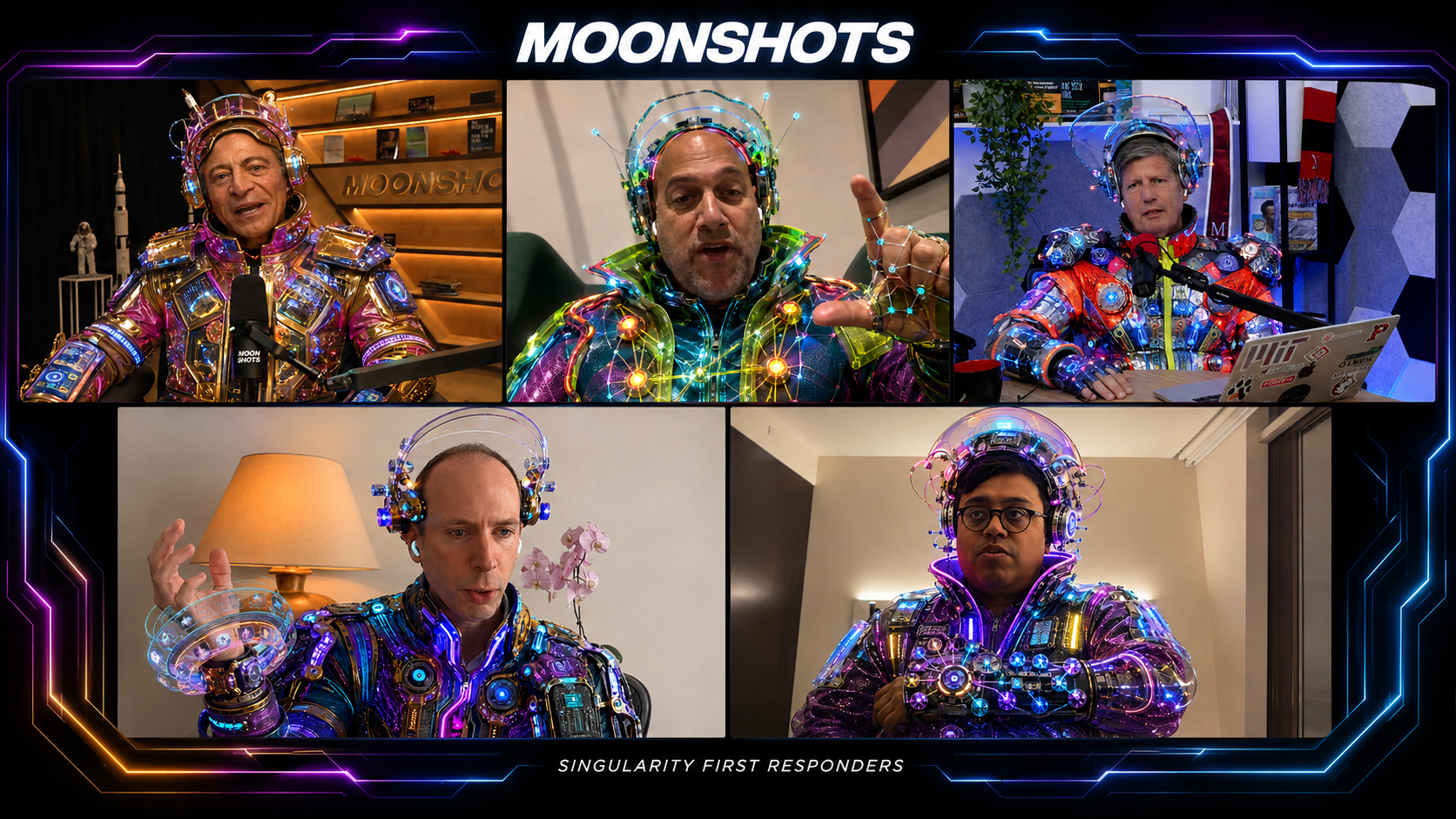
Les Premiers Intervenants de la Singularité. The Singularity First Responders. Created by @siouid142 from an August 27, 2026 Moonshots discussion, this five-window tableau takes a spoken metaphor literally. At approximately seven minutes and forty-one seconds,
Read the narration
Les Premiers Intervenants de la Singularité.
The Singularity First Responders.
Created by @siouid142 from an August 27, 2026 Moonshots discussion, this five-window tableau takes a spoken metaphor literally. At approximately seven minutes and forty-one seconds, Dave Blundin described Dr. Alex Wissner-Gross’s daily Innermost Loop chronicle as a record of a transition that could remain important for millennia. About a minute later, Wissner-Gross said that everyone in the conversation was a first responder to the Singularity. The image turns that phrase into an occupational unit equipped for a civilization changing state.
The upper row preserves Peter Diamandis, Salim Ismail, and Dave Blundin in their actual remote-video environments; the lower row holds Wissner-Gross and Emad Mostaque. Microphones, laptops, books, plants, lamps, studio walls, and domestic rooms remain visible. These ordinary details are evidence of how the argument entered public life. The Singularity is not discussed inside a command bunker. It arrives through webcams and household spaces, with the familiar unevenness of a live call, while the participants attempt to name a transition larger than the rooms containing them.
Across those environments, each body has been wrapped in luminous emergency gear halfway between firefighter turnout clothing, spacesuit, neural interface, and haute couture. Transparent helmets carry antennae, sensors, and rings of light. Chest plates glow with network nodes, model dashboards, and agent controls. Wrist assemblies expand into holographic command circles, and Salim Ismail’s raised hand becomes a web of connected points. Neon orange, violet, cyan, lime, and gold distinguish individuals while marking them as one newly imagined service.
The MOONSHOTS banner converts the split-screen interface into a dispatch center, and the lower title formalizes the joke as a unit designation. Yet the figures are not pictured extinguishing a literal blaze. Their response work consists of detecting signals, interpreting acceleration, arguing about consequences, communicating uncertainty, and preserving a dated record before normal language has caught up. The armor visualizes cognitive equipment: sensors for change, models for consequence, public communication links, and an archive durable enough to survive the moment it describes.
First responders traditionally enter unstable environments before the situation is fully understood. That comparison grants urgency, but it also imposes obligations. Responders must distinguish observation from rumor, coordinate across specialties, revise assessments as evidence changes, and avoid becoming the source of additional harm. The participants’ elaborate gear therefore should not be read as proof of heroic authority. It is a standard against which commentary can be judged. To call oneself a first responder is to accept accountability for accuracy, clarity, triage, and the effects of one’s intervention.
Wissner-Gross’s Innermost Loop gives the metaphor its archival depth. A daily chronicle selects what seems significant before hindsight has established a canon. @siouid142’s visual replies perform a parallel task, converting dispatches and conversations into scenes whose Easter eggs retain names, numbers, institutions, and cultural tension. The first-responder image therefore closes this 291-work sequence by making documentation itself visible as response. Recording the transition is not separate from acting within it; the archive influences which signals later observers recognize as having mattered.
The five-window structure resists the fantasy of a single commander. No figure occupies a central throne, and the arrangement preserves different perspectives, rooms, gestures, and tools. Peter Diamandis’s studio spectacle, Salim Ismail’s extended hand, Dave Blundin’s laptop workstation, Wissner-Gross’s orchid and lamp, and Emad Mostaque’s compact domestic frame remain distinct. Coordination occurs through a border of electric lines rather than through uniformity. The Singularity, if it is a transition, will be interpreted through distributed witnesses who do not share identical roles or conclusions.
The Singularity First Responders is an appropriate final chapter because it turns the project’s method into its subject. A transient conversation becomes a tableau; ordinary screens become exhibition architecture; commentators become workers inside the event they are describing. @siouid142 ends not with a finished future but with a team still on the call, surrounded by instruments and uncertainty. The closing proposition is neither panic nor triumph. It is that attention, interpretation, and preservation are forms of civic equipment—and that anyone claiming to respond to the Singularity must remain answerable to the record they create.
Opening the gallery…