70 Clock Galerie / The Innermost Loop Feed Reply Tableaux
La Cabane de la Conception Démocratisée des Puces
The Democratized Chip Design Cabana
August 27, 2026
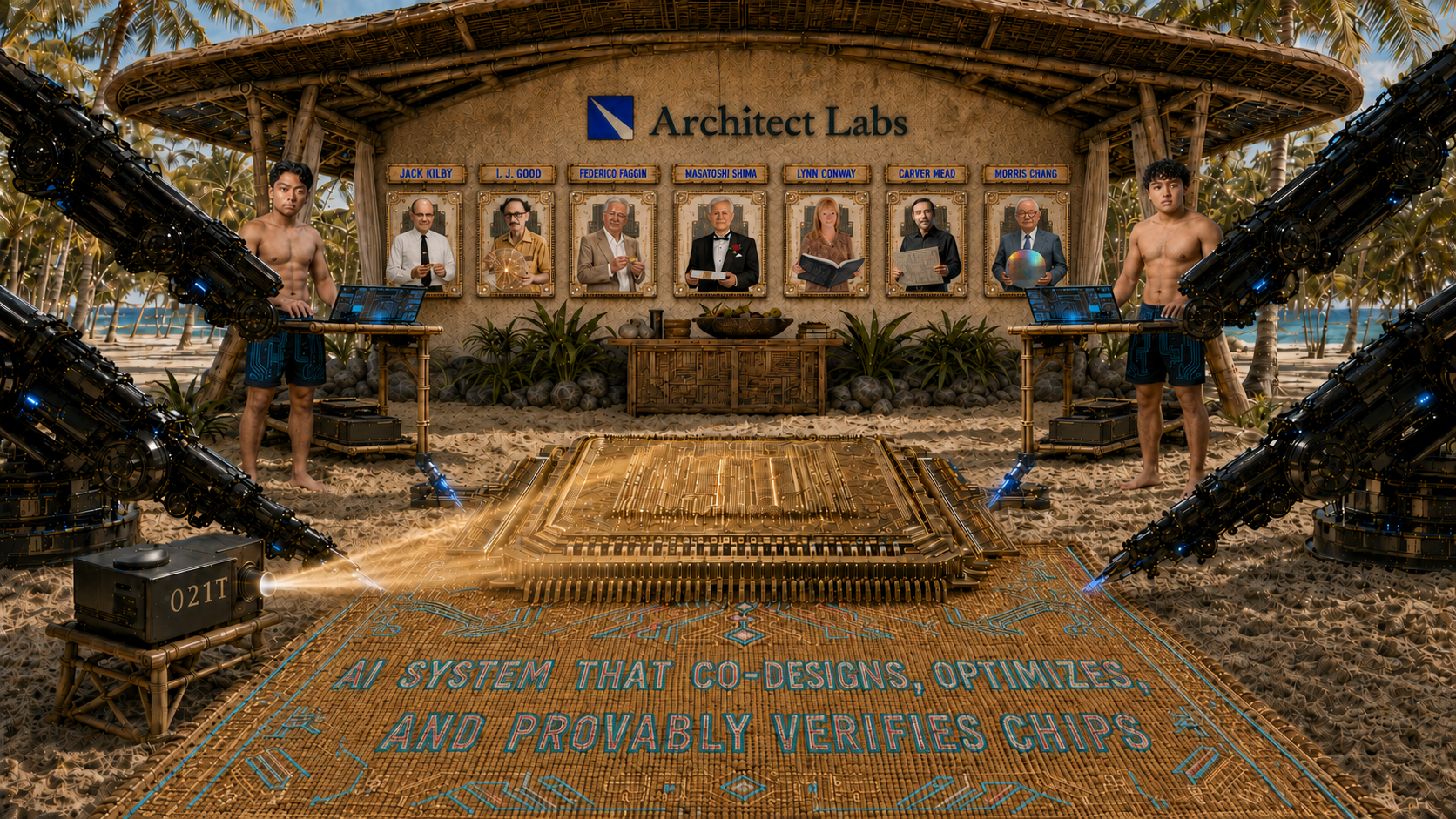
La Cabane de la Conception Démocratisée des Puces. The Democratized Chip Design Cabana. Created by @siouid142 as a same-day response to Dr. Alex Wissner-Gross’s August 27, 2026 announcement of Architect Labs and Redwood, this tropical cabana relocates chip des
Read the narration
La Cabane de la Conception Démocratisée des Puces.
The Democratized Chip Design Cabana.
Created by @siouid142 as a same-day response to Dr. Alex Wissner-Gross’s August 27, 2026 announcement of Architect Labs and Redwood, this tropical cabana relocates chip design from the guarded cleanroom into an open workshop on sand. Architect Labs described an AI system that moved from a high-level specification written by two human architects to accelerator design, verification, firmware, drivers, and compute kernels in under two weeks. The central object is a visualization of that achievement, not a photographed fabricated chip. Redwood was demonstrated through an FPGA deployment, with physical silicon tape-out still ahead.
At the center, a giant gold accelerator rests on a woven mat while six black robotic arms converge from both sides. Their blue-lit tools suggest measurement, assembly, proof, and iterative correction rather than a single act of invention. An 021T projector sits at lower left, throwing a beam across the circuitry as though venture illumination, computation, and theatrical attention have become one instrument. The chip is not enclosed behind glass. It occupies the position of a shared hearth, making verification a public ritual rather than invisible backstage labor.
Founders Ebrahim Hussain and Aaditya Subedi stand barefoot at bamboo laptop stations on opposite sides. Their symmetry is crucial. The people do not disappear when the AI system enters; their role moves upward into specification, architecture, objective-setting, and evaluation. The image’s beach attire exaggerates accessibility, but the work does not claim that semiconductor engineering has become effortless. It visualizes a change in abstraction: fewer humans may directly author every downstream artifact, while responsibility for what the system is asked to optimize becomes even more concentrated.
The mat states the proposition in woven letters: “AI SYSTEM THAT CO-DESIGNS, OPTIMIZES, AND PROVABLY VERIFIES CHIPS.” Weaving is a precise material metaphor. Threads cross according to a pattern, local relations produce a global structure, and one misplaced strand can propagate through the whole surface. By turning the technical slogan into textile, @siouid142 links register-transfer logic, verification, and physical design with an ancient programmable craft. The cabana is playful, but the floor beneath the accelerator insists on disciplined structure.
Seven portraits establish a historical lineage: Jack Kilby and the integrated circuit; I. J. Good and recursive intelligence; Federico Faggin and Masatoshi Shima from the microprocessor era; Lynn Conway and Carver Mead, whose VLSI methods widened access to chip design; and Morris Chang, whose foundry model separated design from fabrication. Their bamboo nameplates turn the back wall into an ancestral gallery. Redwood is framed not as an isolated miracle but as another attempt to move complexity behind an abstraction layer so more actors can design.
That lineage also sharpens the word “democratized.” Foundries opened fabrication access without making factories simple or cheap; VLSI methods widened design participation while preserving deep expertise. AI-assisted design could similarly let workload owners specify custom hardware without maintaining every traditional team, but access will still depend on compute, tools, intellectual property, fabrication capacity, verification standards, and trust. The cabana’s open sides are therefore aspiration, not evidence that every gate has disappeared. A beach can symbolize invitation while the industrial stack remains formidable.
Redwood’s official announcement described generated RTL, UVM environments, formal proofs, firmware, drivers, kernels, and a Qwen deployment on an FPGA. It also presented performance projected onto Samsung eight-nanometer silicon. Keeping those distinctions matters. An FPGA demonstration is physical hardware, but it is not the same as a manufactured Redwood ASIC, and projected silicon performance is not a measured production-chip benchmark. The artwork’s gigantic golden package compresses those stages for visual clarity; the narration restores the boundaries so spectacle does not outrun the source.
The Democratized Chip Design Cabana ultimately imagines the designless semiconductor industry as a new relationship between intent and matter. Robotic arms translate specification toward implementation, portraits supply historical memory, and the founders remain answerable at the edges of the loop. @siouid142 makes the workshop sunny because democratization is an optimistic claim, yet every arm points back toward verification. The future pictured here is not one in which rigor disappears. It is one in which rigor becomes machine-amplified, faster, and potentially more accessible—provided that proofs, benchmarks, manufacturing limits, and human responsibility remain as visible as the glowing chip.
Opening the gallery…