70 Clock Galerie / The Innermost Loop Feed Reply Tableaux
Jeff Bezos Défile
Jeff Bezos Walks
August 27, 2026
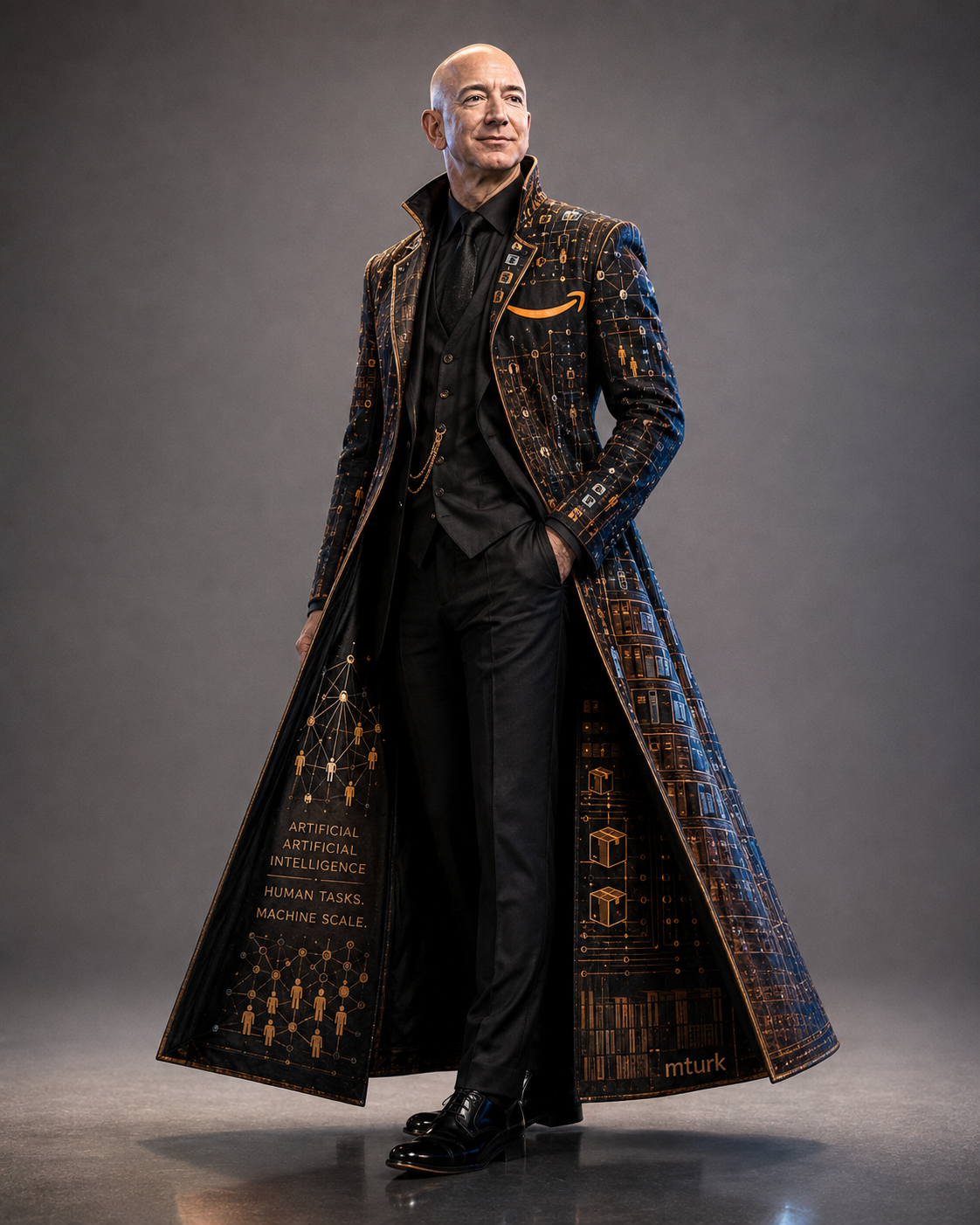
Jeff Bezos Défile. Jeff Bezos Walks. Created by @siouid142 in response to Dr. Alex Wissner-Gross’s Welcome to August 27, 2026 dispatch, this black-and-orange portrait treats Amazon Mechanical Turk as an archaeological layer of artificial intelligence. The disp
Read the narration
Jeff Bezos Défile.
Jeff Bezos Walks.
Created by @siouid142 in response to Dr. Alex Wissner-Gross’s Welcome to August 27, 2026 dispatch, this black-and-orange portrait treats Amazon Mechanical Turk as an archaeological layer of artificial intelligence. The dispatch reported the platform’s shutdown and recalled Jeff Bezos’s phrase “artificial artificial intelligence”: human workers hidden behind a software-like interface performing tasks computers could not yet do. By 2026, some workers were reportedly using AI themselves, producing the recursive joke “artificial artificial artificial intelligence.”
The Amazon smile sits high on the coat above a dense field of orange circuitry, task boxes, server-like modules, and tiny human icons. An inner panel spells out “ARTIFICIAL ARTIFICIAL INTELLIGENCE” over “HUMAN TASKS, MACHINE SCALE.” The mturk name appears near the opposite hem beneath stacked cubes and workflow diagrams. The tailoring makes visible what the platform interface was designed to abstract: people distributed through a computational system and encountered by customers as scalable functionality.
The recursive phrase describes a chain of delegation. A requester asks a platform; the platform routes a microtask to a worker; the worker may ask a model; the answer travels back upward as though one machine produced it. Each layer simplifies the one beneath it. The customer sees an output, not the judgment, time, uncertainty, or compensation embedded in its production. By placing small bodies inside the circuitry, @siouid142 restores labor to the visual foreground without pretending that visibility alone repairs its conditions.
Luxury is used as critique. Bezos wears a precisely fitted coat whose elaborate surfaces contrast with the fragmented pay, anonymity, and repetitive microtasks associated with crowd work. The founder’s body receives the grandeur of the system while workers appear as diagrammatic units along the hem. That imbalance is not an accidental composition. It asks who becomes legible as an innovator and who becomes legible only as throughput, especially when the interface is celebrated for making human assistance feel like a property of software.
Mechanical Turk also occupies an important historical threshold. It helped bridge a period when software could coordinate intelligence more easily than it could perform many perceptual or linguistic tasks itself. Human responses supplied labels, moderation, surveys, transcription, evaluation, and countless small decisions; those outputs in turn contributed to datasets and workflows from which later automation benefited. The closing platform is therefore not simply obsolete infrastructure. It is an archive of the human intelligence that machine intelligence learned to conceal and eventually imitate.
The addition of AI inside the worker’s workflow complicates any clean story of replacement. A turker using a model is neither a purely manual laborer nor an autonomous machine. The person selects tools, checks outputs, manages exceptions, and absorbs the platform’s risk, while the interface may continue presenting the result as undifferentiated service. “Artificial artificial artificial intelligence” is funny because every new layer makes attribution less stable. The joke becomes a compressed theory of contemporary work: agency persists, but its location is increasingly difficult to see.
Placed after Bill Gates’s bridge toward a just transition, Bezos’s coat supplies the history that any transition plan must remember. Some workers were already positioned inside machine-like systems long before frontier models arrived. Their labor was flexible for the requester precisely because insecurity was transferred downward. If AI now performs more of the task, a humane policy cannot begin from the fiction that automation has displaced no one because the workers were never visible as employees. The orange network is a ledger of that inherited omission.
Jeff Bezos Walks closes the runway by converting an interface back into a social body. Cubes become tasks, circuitry becomes coordination, and tiny figures become the intelligence beneath a celebrated abstraction. @siouid142 does not deny the ingenuity of the platform or the capability of current models. The portrait asks for a more exact history of both. Before artificial intelligence can be narrated as independent production, viewers must trace the chain of people, labels, judgments, and hidden assistance that made the machine appear autonomous—and decide whether the next layer will finally make those contributors visible.
Opening the gallery…