70 Clock Galerie / The Innermost Loop Feed Reply Tableaux
Dr Dre Défile
Dr Dre Walks
August 27, 2026
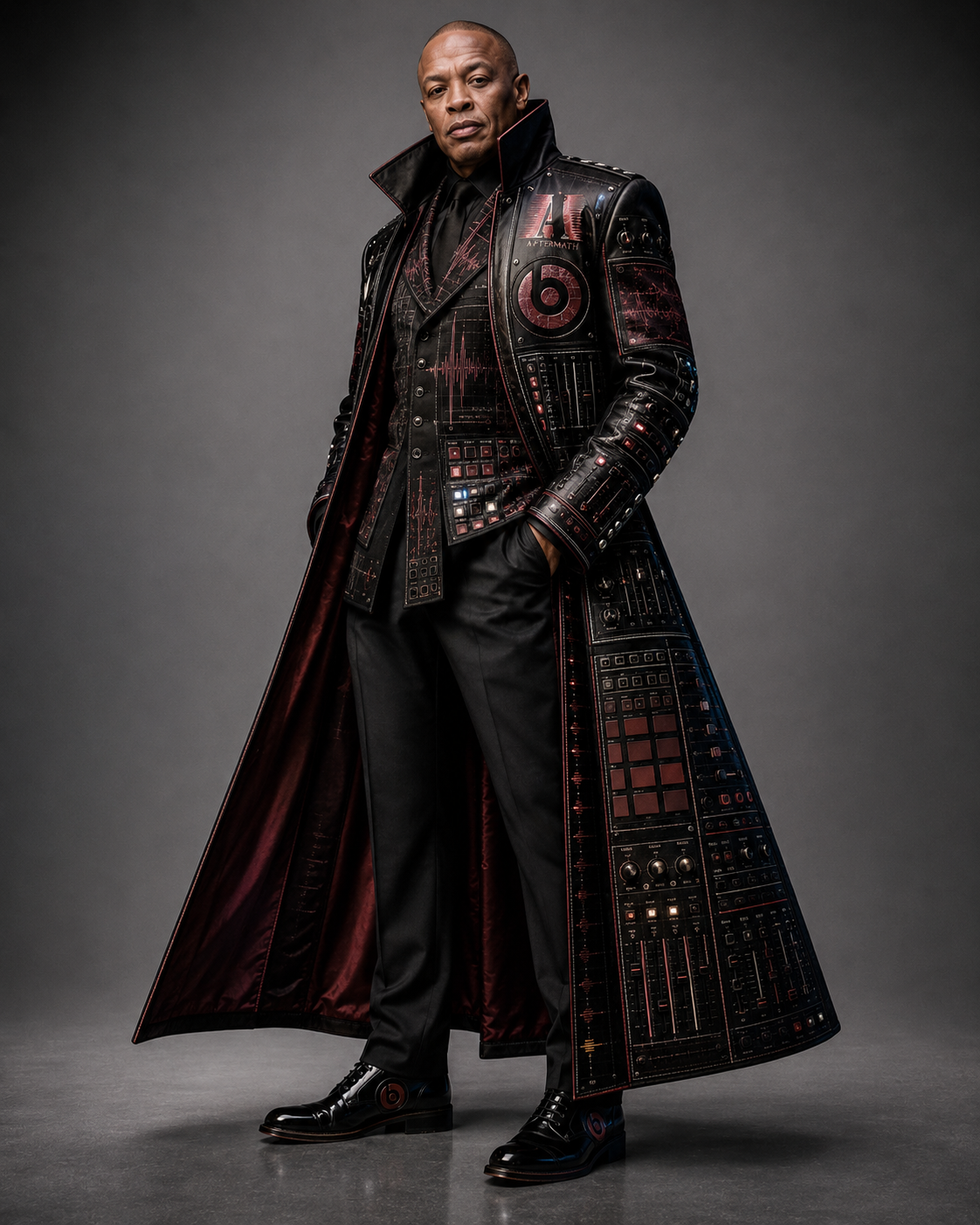
Dr Dre Défile. Dr Dre Walks. Created by @siouid142 from Dr. Alex Wissner-Gross’s Welcome to August 27, 2026 dispatch, this black-and-red portrait begins with a historical analogy attributed to Dr Dre: resistance to artificial intelligence resembles the musicia
Read the narration
Dr Dre Défile.
Dr Dre Walks.
Created by @siouid142 from Dr. Alex Wissner-Gross’s Welcome to August 27, 2026 dispatch, this black-and-red portrait begins with a historical analogy attributed to Dr Dre: resistance to artificial intelligence resembles the musicians who once dismissed drum machines. The artwork does not claim that every use of AI is artistically equivalent or that automation leaves creative labor untouched. It uses the drum machine as a precise precedent—a tool accused of replacing musicians that became an instrument through which new rhythms, workflows, and genres were invented.
The Aftermath insignia and the circular Beats mark occupy the upper coat like the heraldry of a production house. Waveforms, sequencer grids, faders, pads, switches, and equalizer bands cover the lapels, vest, sleeves, and long panels. Red light moves through the black structure like signal through a studio rack. Nothing is disguised as natural fabric. The garment makes technical mediation explicit, turning the producer’s body into an exploded console where every surface waits for selection, timing, modulation, and restraint.
The silhouette gives Dre the presence of both conductor and machine operator. A severe high collar frames the face, while the coat’s vertical controls descend almost to the floor. Even the shoes carry circular audio emblems, making each step part of a beat architecture. Yet the image does not picture him pressing a single automated button. The density of the interface suggests the opposite: more tools create more possible decisions. Automation may remove one manual action while expanding the field in which taste, sequencing, editing, and cultural judgment must operate.
A drum machine is an especially useful object for thinking about AI because it sits between replacement and invention. It can reproduce a pulse without a drummer, but its historical importance lies in sounds and patterns no acoustic kit produced in the same way. Artists learned its constraints, abused its settings, sampled its outputs, and made its mechanical regularity expressive. The coat therefore resists the idea that authenticity resides in the absence of technology. Craft often develops through intimate knowledge of a tool’s timing, errors, affordances, and limits.
The analogy also has boundaries. A generative system can intervene in language, image, voice, composition, and identity at a breadth far beyond a rhythm box. Questions of training data, consent, attribution, labor, and synthetic imitation do not disappear because an earlier technology eventually became accepted. @siouid142 preserves those unresolved stakes by keeping the garment dark, armored, and densely wired. The portrait honors creative adaptation without turning one success story into a universal permission slip for every form of automation.
Within the August 27 runway, Dre stands between John Ternus’s exposed Apple stack and Leopold Aschenbrenner’s financial anatomy. That placement makes culture the conversion layer between hardware and market. Chips and memory become historically consequential when artists, audiences, and institutions discover what to do with them; markets then price the resulting possibility. Dre’s red-black coat interrupts the amber financial atmosphere with the reminder that adoption is not only a technical or capital process. It is a struggle over language, genre, status, and who is recognized as an author.
The studio-console imagery also reverses the common fear that AI will make creative work invisible. Here the mechanisms are enlarged until they become the entire visible costume. Every slider and pad announces mediation. The work suggests that honest technological art should expose its controls, sources, and decisions rather than hide them behind the fantasy of effortless output. Dre’s calm stance intensifies that demand. Mastery appears not as frantic novelty but as the capacity to listen, choose, discard, and place a sound where it changes the whole.
Dr Dre Walks ultimately treats tools as languages whose meanings are made through use. The coat does not promise that artists will automatically remain powerful, nor does it mourn every displaced technique as the death of creativity. @siouid142 gives the historical analogy a body full of controls so viewers can see what the slogan leaves out: instruments reorganize labor, access, authorship, and aesthetics at once. The final question is not whether AI belongs in the studio. It is who learns to play it, whose material it contains, who is heard through it, and what new music becomes possible without erasing the people who made the old one.
Opening the gallery…