70 Clock Galerie / The Innermost Loop Feed Reply Tableaux
John Ternus Défile
John Ternus Walks
August 27, 2026
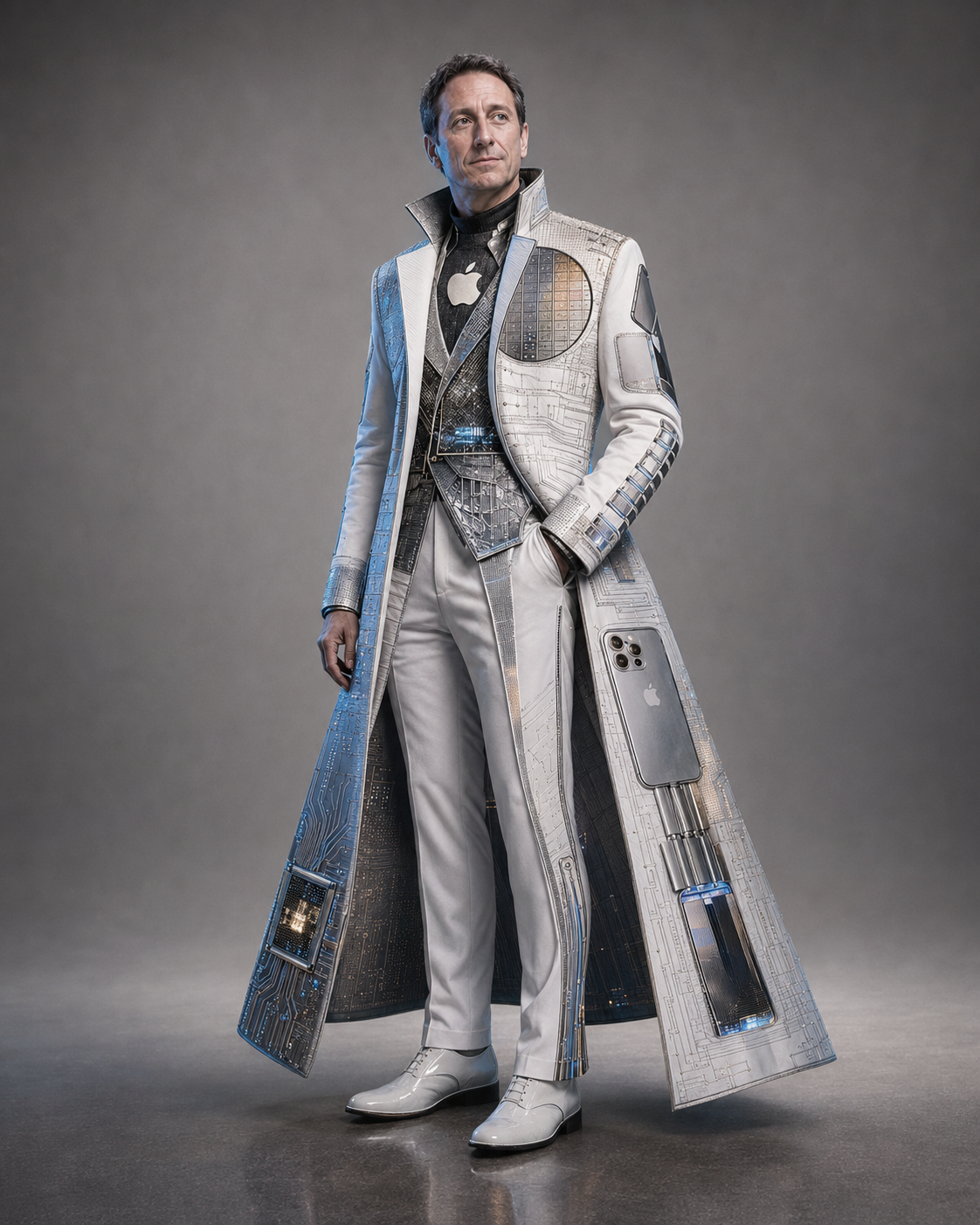
John Ternus Défile. John Ternus Walks. Created by @siouid142 in response to Dr. Alex Wissner-Gross’s Welcome to August 27, 2026 dispatch, this white Apple portrait turns John Ternus into the human interface for a reported next-generation local-compute stack. T
Read the narration
John Ternus Défile.
John Ternus Walks.
Created by @siouid142 in response to Dr. Alex Wissner-Gross’s Welcome to August 27, 2026 dispatch, this white Apple portrait turns John Ternus into the human interface for a reported next-generation local-compute stack. The dispatch placed leadership succession beside an M5 Ultra Mac Studio with 512 gigabytes of memory, a first two-nanometer M6, a September hardware event, and a foldable iPhone priced at 1,999 dollars. These were source claims and expectations, not guarantees supplied by the artwork. The coat asks how executive identity, silicon cadence, and product form become one public narrative.
An Apple mark glows at the center of the black underlayer, surrounded by pale circuit diagrams that spread across lapels, sleeves, trousers, and train. The white exterior preserves the controlled minimalism of an Apple presentation, but the exposed traces reverse the company’s sealed-box aesthetic. Instead of hiding complexity behind an immaculate surface, the garment opens the surface and lets the logic board become ornament. The person who normally represents finished products is made to wear the substrate those products conceal.
A large wafer occupies the upper chest like a ceremonial breastplate. Its grid of dies makes fabrication visible as repetition, yield, and material process rather than abstract “compute.” Lower down, an iPhone stretches into a jointed mechanical limb, half consumer device and half prosthetic architecture. Memory blocks, chip packages, and board traces flow toward the hem. The vertical organization reads as a stack: fabrication near the mind and heart, mobile interface near the hand, and data movement distributed through the body.
The bright garment separates Ternus from the surrounding black coats of safety, finance, labor transition, and platform history, but it does not isolate him from their questions. Local frontier models require memory, power, thermal design, packaging, software, and privacy decisions. A device capable of running increasingly sovereign intelligence is also a governance object. Which processes remain on the device, which leave for a cloud, and who can inspect or repair them become features as consequential as screen, hinge, or camera.
The dispatch’s succession theme makes this more than a hardware portrait. A chief executive inherits a synchronized set of clocks: model cadence, chip cadence, manufacturing capacity, developer expectations, and consumer replacement cycles. The raised collar and long white silhouette evoke a ceremonial transfer of authority, while the fragmented circuitry shows how distributed that authority actually is. Leadership may be personified onstage, but every polished announcement depends on foundries, suppliers, operating systems, industrial designers, and immense chains of technical coordination.
The wafer and elongated phone also set two scales against one another. One is microscopic and repeated; the other intimate and singular, held close to a person’s body. Apple’s cultural power has long come from making the first disappear inside the second. @siouid142 reverses that relation, enlarging the wafer until the viewer must see the industrial architecture behind the personal object. The coat’s elegance is therefore analytic. It shows that “local” intelligence is never purely local; it is condensed global infrastructure carried in a pocket.
Within the House Innermost Loop runway, Ternus stands between arguments about civilizational risk and Dr Dre’s history of creative tools. That placement turns Apple hardware into a threshold between model and practice. The device is where abstract capability meets music, communication, work, memory, and everyday judgment. A foldable phone or large-memory studio computer matters not only as product novelty but as a new site where models can act without constant reliance on remote data centers. The consumer interface becomes part of the frontier.
John Ternus Walks finally presents minimalism after it has been opened for inspection. White tailoring still promises control, coherence, and ease, yet every panel reveals the circuitry and material dependencies required to produce that feeling. @siouid142 does not predict that one executive or device will determine the local-AI era. The portrait makes the responsibility visible: if increasingly powerful intelligence is to inhabit personal hardware, the next Apple leadership must align silicon, software, privacy, repair, and human use without letting the immaculate surface erase the system underneath.
Opening the gallery…