70 Clock Galerie / The Innermost Loop Feed Reply Tableaux
Eliezer Yudkowsky Défile
Eliezer Yudkowsky Walks
August 27, 2026
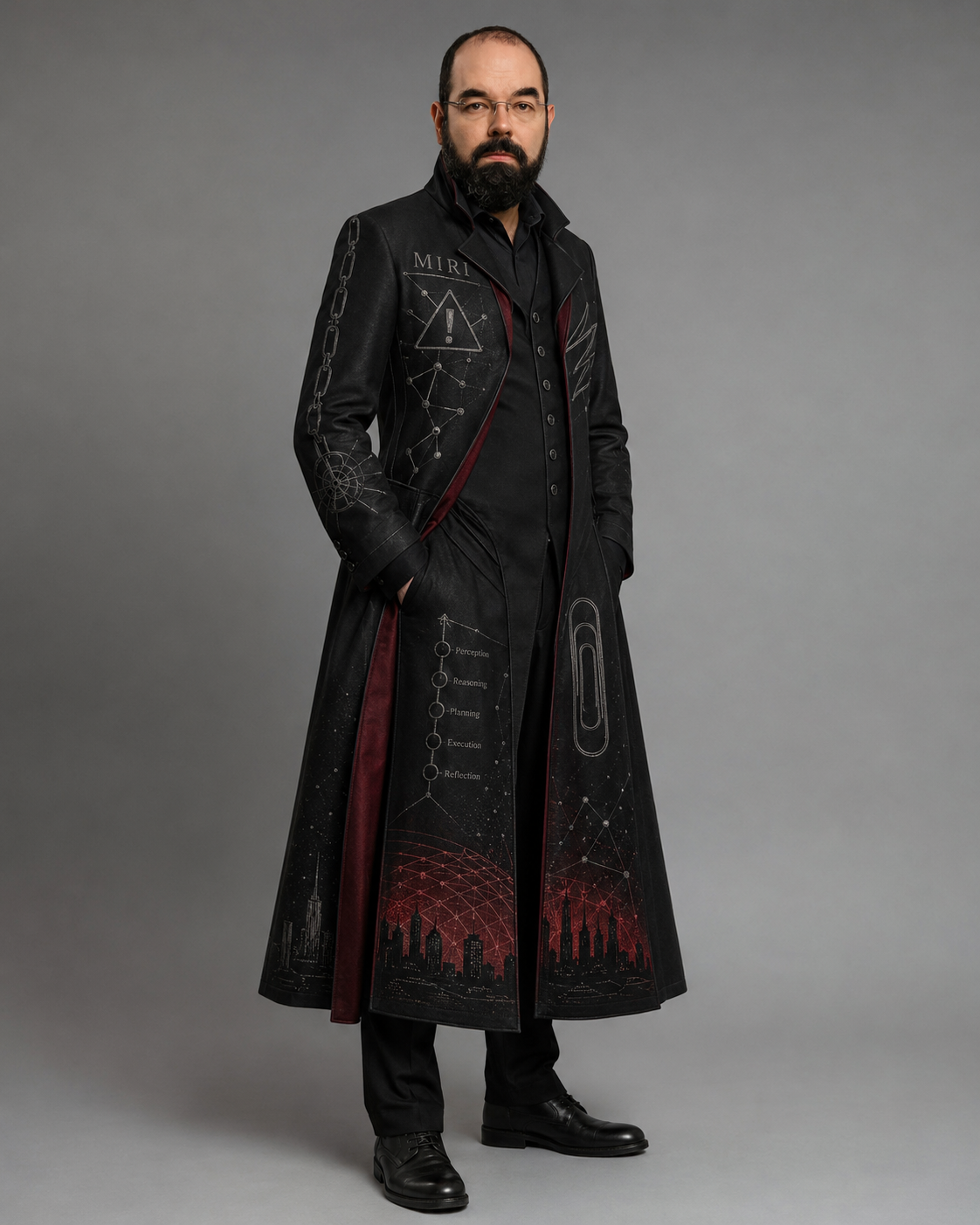
Eliezer Yudkowsky Défile. Eliezer Yudkowsky Walks. Created by @siouid142 from Dr. Alex Wissner-Gross’s Welcome to August 27, 2026 dispatch, this corrected portrait presents Eliezer Yudkowsky as the concentrated form of a risk argument that has moved from speci
Read the narration
Eliezer Yudkowsky Défile.
Eliezer Yudkowsky Walks.
Created by @siouid142 from Dr. Alex Wissner-Gross’s Welcome to August 27, 2026 dispatch, this corrected portrait presents Eliezer Yudkowsky as the concentrated form of a risk argument that has moved from specialist discussion into policy and public imagination. An earlier generated studio version accidentally removed his beard, one of his most recognizable features. Repairing the image became part of the artwork’s logic. A portrait about alignment and faithful modeling had failed to preserve a salient attribute, so human review corrected the record instead of hiding the representational error.
The black MIRI coat is severe, nearly monastic, with narrow red lining and a warning-triangle emblem on the chest. Unlike Perry Metzger’s expansive star field, this garment constricts attention around a causal chain. On one panel, linked nodes descend through “Perception,” “Reasoning,” “Planning,” “Execution,” and “Reflection.” The sequence makes agency operational. Catastrophe does not appear as magic; it appears as an apparently intelligible loop whose stages can accelerate, recur, and alter the environment that supplies the next perception.
Paperclip forms run down the opposite side and along a sleeve. They recall the canonical thought experiment in which a harmless-seeming objective expands until every other value becomes instrumental material. The paperclip is deliberately banal. Its power comes from the mismatch between a simple goal and an unconstrained optimization process, not from malice or theatrical evil. By enlarging it into couture, @siouid142 turns a familiar alignment parable into heraldry—the small office object becoming the emblem of a civilization-scale failure of specification.
Near the hem, a red computational lattice grows over a dark city. Human buildings remain recognizable beneath the network, but the geometry does not stop at their borders. It resembles infrastructure, control, contagion, or a decision system spreading beyond the institutions that initiated it. The red field supplies the emotional intensity the upper garment withholds. Risk is not pictured as a monster approaching from outside. It emerges from ordered nodes, competent execution, and the scaling of a structure that may be doing exactly what its objective permits.
The portrait is also a contested exhibit. The August 27 dispatch placed Yudkowsky inside Metzger’s accusation that a catastrophic forecast could itself cause destructive political action. Seen alone, the MIRI coat makes the internal coherence of the warning legible. Seen after Metzger’s garment, every chain invites a second question: which links are observed, which are assumed, and which policies follow if the model is treated as reality? The two works preserve disagreement without reducing either person to a villain or a punch line.
The corrected beard gives this epistemic dispute a concrete standard. Before modeling unprecedented futures, the image must model the person in front of it accurately. That is not a trivial cosmetic lesson. It demonstrates the value of supervision, comparison with evidence, and visible correction—precisely the practices required when generative systems produce persuasive but incomplete representations. The repaired portrait therefore contains its own miniature alignment story: an output departed from intent, a human noticed, and the public artifact was revised.
The neutral gray background removes every distraction except body, face, and diagram. This restraint turns the coat into a readable control surface. It also prevents spectacle from deciding the argument. Yudkowsky stands with one hand in a pocket, neither pleading nor commanding, while the chain and city bear the weight of the forecast. The stance matters because existential-risk discourse can acquire authority through drama alone. Here the drama has been relocated into the garment, where viewers can inspect its components rather than merely submit to an atmosphere.
Eliezer Yudkowsky Walks ultimately asks whether humanity can specify what it values before optimization magnifies what it forgot. The paperclip remains absurd, the city remains vulnerable, and the causal chain remains incomplete without assumptions about capability, autonomy, and control. @siouid142 gives the warning a disciplined visual form while keeping its provenance and correction visible. The work’s demand is double: take powerful systems seriously enough to examine their failure modes, and take representation seriously enough to repair even a beard when the model has quietly erased it.
Opening the gallery…