70 Clock Galerie / The Innermost Loop Feed Reply Tableaux
Perry Metzger Défile
Perry Metzger Walks
August 27, 2026
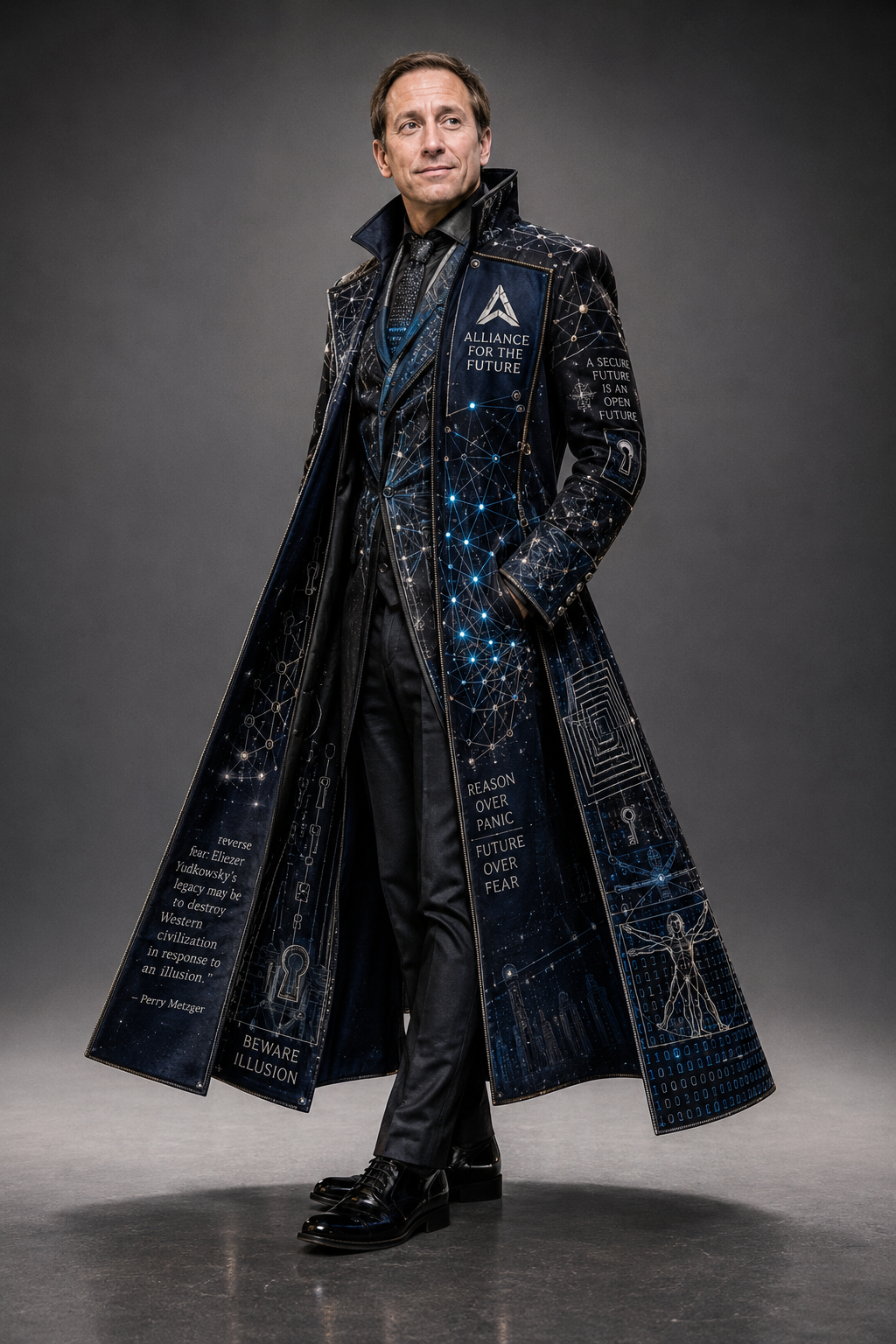
Perry Metzger Défile. Perry Metzger Walks. Created by @siouid142 in response to Dr. Alex Wissner-Gross’s Welcome to August 27, 2026 dispatch, this individual portrait gives Perry Metzger’s side of a dispute about artificial-intelligence risk a complete visual
Read the narration
Perry Metzger Défile.
Perry Metzger Walks.
Created by @siouid142 in response to Dr. Alex Wissner-Gross’s Welcome to August 27, 2026 dispatch, this individual portrait gives Perry Metzger’s side of a dispute about artificial-intelligence risk a complete visual institution. The source attributed to Metzger the severe judgment that Eliezer Yudkowsky’s legacy might be to damage Western civilization in response to an illusion. The garment does not certify that judgment or dismiss advanced-AI danger. It asks what standards of evidence should govern institutions when warnings are consequential enough to reshape policy, capital, and public fear.
A large Alliance for the Future emblem sits on the chest like a civic seal. The phrase “A SECURE FUTURE IS AN OPEN FUTURE” appears on the sleeve, while “REASON OVER PANIC,” “FUTURE OVER FEAR,” and “BEWARE ILLUSION” descend across the long black panels. These are the actual printed doctrines of the coat. They make openness, evidence, and emotional discipline into a counter-program, proposing that security cannot be built solely from sealed expertise or from narratives whose urgency is treated as proof.
Blue constellations and gold network lines cover the surface, connecting stars, locks, keyholes, civic structures, and a watchful eye. The imagery is intentionally ambiguous. A connected field can reveal a real pattern, but it can also invite projection: enough points joined with enough confidence begin to resemble a destiny. Keyholes repeat along the hem as emblems of access and interpretation. They suggest that the dispute is not only about what lies behind a closed door, but who possesses the authority to define the door, choose the key, and declare what has been seen.
A quotation from Metzger’s criticism occupies the left inner panel, making the garment resemble evidence submitted to a public hearing. Opposite it, a Vitruvian figure is embedded within binary fields and geometric diagrams. The human body becomes the reference measure inside a technological argument, yet it is surrounded by systems too large for any one observer to comprehend directly. The high collar and judicial silhouette lend Metzger authority, while the exposed quotation keeps that authority contestable. He wears an argument, not a verdict.
The neutral studio background matters because the full runway’s countervoice is absent. Without Yudkowsky standing beside him, every small device must preserve the contested nature of the source. Locks can protect or exclude. Openness can improve scrutiny or distribute dangerous capability. Fear can distort judgment, but it can also direct attention toward genuine risk. The design’s intelligence lies in refusing to resolve those tensions through a flattering portrait. Its polished surface is crossed by enough warnings and apertures to remain epistemically unsettled.
The Alliance for the Future mark also turns political organization into heraldry. Historically, coats displayed house, office, lineage, and allegiance; this one displays a theory of governance for an uncertain technological transition. Yet the luminous network is stitched into luxury material, reminding viewers that calls for openness emerge within institutions of influence. “Reason over panic” sounds universal, but decisions about what counts as reason are made by people with different access to models, forecasts, and power. The work therefore asks who audits the auditors of catastrophe.
Within the August 27 sequence, Metzger precedes Yudkowsky so that the skeptical challenge is encountered before the catastrophic model. That order does not privilege one as correct. It makes the viewer carry a demand for discernment into the next chapter. The contrast is also a lesson in representation. A plausible diagram can feel like evidence; a confident quotation can feel like refutation. Both require sourcing, assumptions, and exposure to criticism. The coat’s star field is beautiful precisely because it makes the temptation to connect every point visible.
Perry Metzger Walks ultimately treats skepticism as an active responsibility rather than passive disbelief. The figure is not dressed to ignore the future. He is covered with futures, locks, civic systems, and branching possibilities. @siouid142 gives his position grandeur while preserving its burden: if fear is to be reversed, the alternative must still identify real threats, protect plural inquiry, and remain open to correction. The final question is not whether to be afraid. It is whether institutions can distinguish signal from projection before either complacency or panic hardens into irreversible action.
Opening the gallery…