70 Clock Galerie / The Innermost Loop Feed Reply Tableaux
Maison de la Boucle la Plus Profonde – Le TAM Est Arrivé – Défilé de Perry Metzger, Eliezer Yudkowsky, John Ternus, Dr Dre, Leopold Aschenbrenner, Bill Gates et Jeff Bezos
House Innermost Loop – The TAM Has Come – Perry Metzger, Eliezer Yudkowsky, John Ternus, Dr Dre, Leopold Aschenbrenner, Bill Gates and Jeff Bezos Walk
August 27, 2026
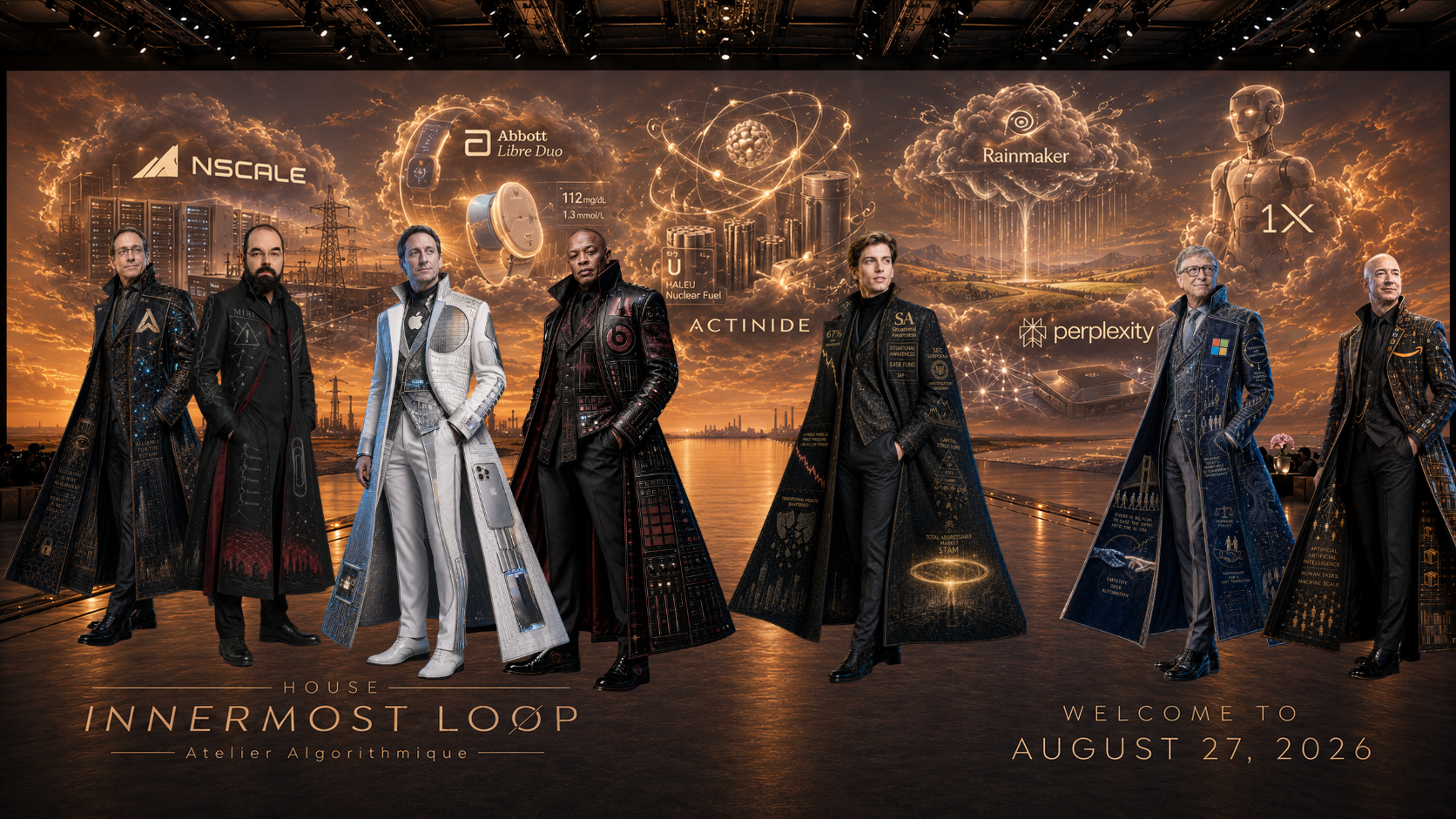
Maison de la Boucle la Plus Profonde – Le TAM Est Arrivé – Défilé de Perry Metzger, Eliezer Yudkowsky, John Ternus, Dr Dre, Leopold Aschenbrenner, Bill Gates et Jeff Bezos. House Innermost Loop – The TAM Has Come – Perry Metzger, Eliezer Yudkowsky, John Ternus
Read the narration
Maison de la Boucle la Plus Profonde – Le TAM Est Arrivé – Défilé de Perry Metzger, Eliezer Yudkowsky, John Ternus, Dr Dre, Leopold Aschenbrenner, Bill Gates et Jeff Bezos.
House Innermost Loop – The TAM Has Come – Perry Metzger, Eliezer Yudkowsky, John Ternus, Dr Dre, Leopold Aschenbrenner, Bill Gates and Jeff Bezos Walk.
Created by @siouid142 from Dr. Alex Wissner-Gross’s Welcome to August 27, 2026 dispatch, this seven-person House Innermost Loop runway takes its organizing phrase from the day’s closing verdict: nothing is more powerful than an idea whose total addressable market has come. “TAM” normally belongs to pitch decks and investment models. Here it becomes an atmospheric force, bathing safety disputes, consumer hardware, music, finance, labor policy, and platform history in the same amber horizon. The runway asks what happens when a market estimate begins to look like a civilization’s stage.
Perry Metzger and Eliezer Yudkowsky open the procession as competing interpreters of artificial-intelligence risk. Metzger’s star-mapped Alliance for the Future coat carries keyholes, civic diagrams, and the demand for reason over panic. Yudkowsky’s black MIRI garment answers with a warning triangle, a recursive chain from perception through reflection, paperclip motifs, and a red city beneath an expanding control lattice. Their proximity does not reconcile them. It gives disagreement a shared physical scale, allowing skepticism about catastrophic narratives to walk beside the internal logic of catastrophe.
John Ternus follows in white Apple circuitry, a bright interval between the dark risk garments and Dr Dre’s black-and-red production system. A wafer, board traces, memory architecture, and an elongated iPhone turn Ternus into an exposed consumer-compute stack. Dre’s Aftermath and Beats coat then converts sequencers, faders, pads, waveforms, and equalizers into tailoring. His comparison of AI resistance with musicians once dismissing drum machines places cultural technique beside silicon: a new instrument can automate an action while enlarging the field in which taste operates.
Leopold Aschenbrenner occupies the center in a black-and-gold financial coat where the dispatch’s reported figures become ornament and wound. A sixty-seven-percent May drawdown, a forty-five-billion-dollar fund label, Chinese-model price pressure, an SEC subpoena, broken moats, and the architecture of fees and carry descend toward a luminous TAM halo. Bill Gates follows in Microsoft blue carrying bridges, workers, handshakes, and a warning that no plan exists to ease entry into the AI era. One look measures the market’s promise and exposure; the next asks who can actually cross into it.
Jeff Bezos closes the line in Amazon orange, wearing Mechanical Turk as an archaeological layer of machine intelligence. Human icons and task boxes sit inside circuitry labeled “artificial artificial intelligence,” recalling a platform that made software appear intelligent by routing work to hidden people. In the dispatch’s recursive update, workers increasingly used AI themselves, producing artificial artificial artificial intelligence. The final figure therefore reveals what the TAM language can conceal: every apparently autonomous market rests on layers of delegation, labor, interface design, and unequal visibility.
The backdrop enlarges that argument into infrastructure. Nscale data centers and transmission towers occupy one side; Abbott Libre Duo, Actinide’s nuclear-fuel imagery, Rainmaker’s engineered cloud, Perplexity’s local computer, and a 1X humanoid fill the rest. These are not endorsements or proof that the ventures share one program. The collage makes them simultaneous because the dispatch did. Energy, health sensing, fuel, weather intervention, local inference, and robotics become the physical systems through which an enormous intelligence market would have to move.
Couture serves as information architecture. Each coat binds a person to the reason that person entered the source, while spacing and sequence create comparisons the prose did not explicitly state. Risk doctrine faces counterdoctrine; hardware becomes an instrument; investment meets transition policy; visible prestige ends in invisible work. The shared runway is theatrical rather than ideological.
The work’s deepest skepticism is directed at the phrase that gives it glamour. A total addressable market can describe possibility, but it can also flatten people, institutions, and ecological constraints into potential revenue. By making TAM a halo, runway, and horizon, @siouid142 captures both its mobilizing power and its quasi-religious seduction. The Singularity is being priced before it is socially settled. House Innermost Loop records that unstable moment: seven bodies already dressed for the market they imagine, an infrastructure wall glowing behind them, and the unresolved question of whether an idea’s arrival as a market is the same as its arrival as a public good.
Opening the gallery…