70 Clock Galerie / The Innermost Loop Feed Reply Tableaux
Remix Peint de la Chaîne d’Automates
Automaton Chain Paint Remix
August 27, 2026
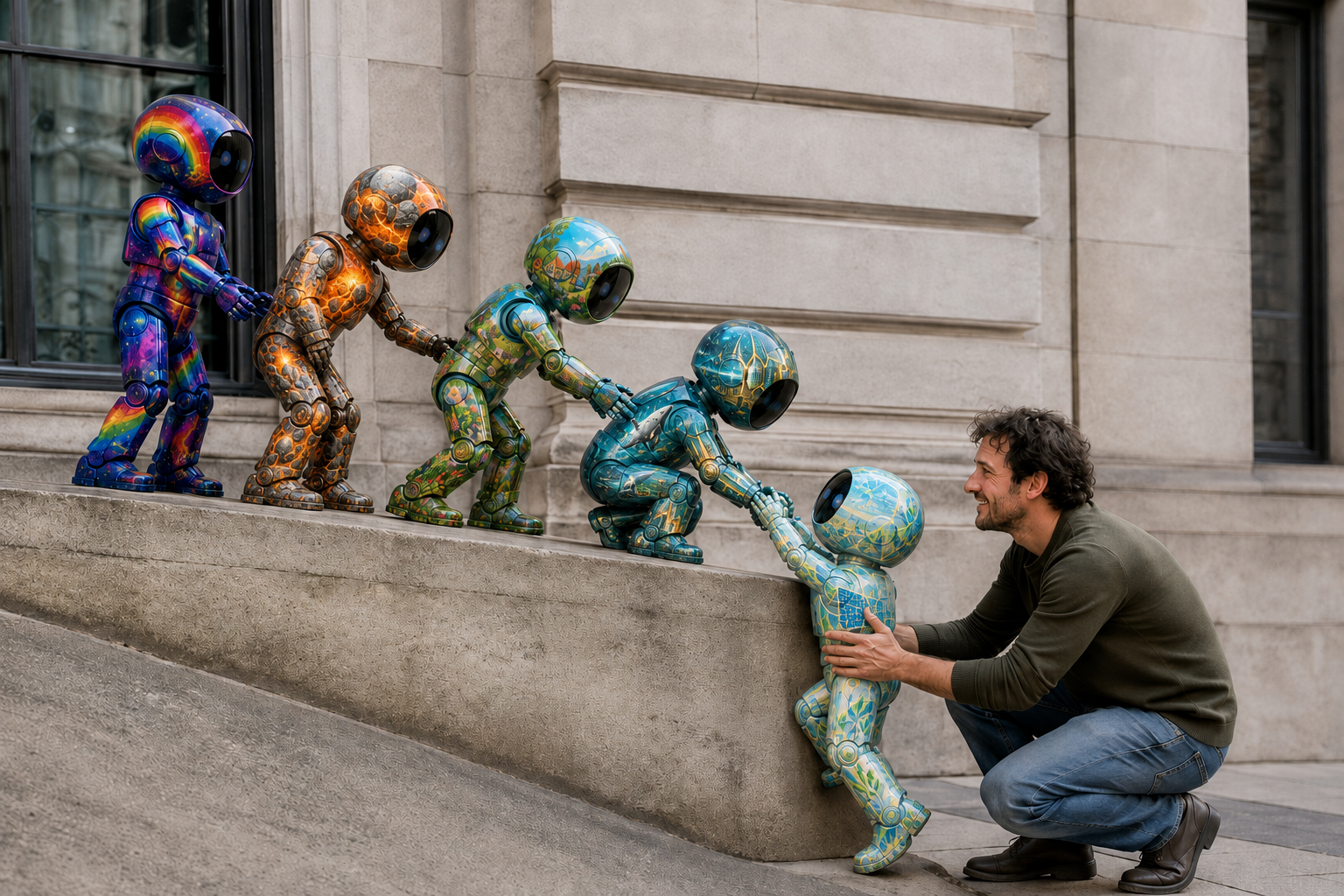
Remix Peint de la Chaîne d’Automates. Automaton Chain Paint Remix. Created by @siouid142 on August 27, 2026, this work answers a wordless image posted by Dr. Alex Wissner-Gross rather than a conventional Innermost Loop dispatch. The source showed a man helping
Read the narration
Remix Peint de la Chaîne d’Automates.
Automaton Chain Paint Remix.
Created by @siouid142 on August 27, 2026, this work answers a wordless image posted by Dr. Alex Wissner-Gross rather than a conventional Innermost Loop dispatch. The source showed a man helping the first of five bronze automatons over a stone ledge while every robot reached backward for the next. The reply preserves that choreography but repaints each mechanical body with an earlier tableau from the archive. Assistance becomes transmission: a human lifts the newest body, machines pull one another forward, and remembered images become the surfaces through which the chain acquires meaning.
At ground level, the man steadies a pale blue-and-gold automaton patterned with the December 7 solar landscape. Panels, clean-energy pathways, vegetation, and bright circuitry wrap the smallest figure precisely where the climb begins. The source image’s physical gesture is tender rather than triumphant: the helper does not command the machine from above but crouches, grips its torso, and shares the strain of the threshold. That posture makes renewable infrastructure the first support layer, a material and ethical base from which every more extravagant technological future must rise.
The next automaton, kneeling on the ledge and reaching down, carries the December 11 whale world. Ocean biology, compute architecture, factories, and launch imagery coexist across its turquoise shell. Above it, a green figure wears the March 17 Pokémon-like village, where roads, creatures, domestic structures, and embodied intelligence form a playful civic ecology. These two middle bodies shift the chain from energy into life and habitation. Intelligence is not pictured as a disembodied model; it moves through oceans, settlements, species, and the ordinary environments in which technology becomes culture.
The fourth figure darkens into the April 5 dismantling of planets for a Dyson swarm. Orange fractures glow through a stone-colored body, making cosmic engineering look both powerful and wounded. At the top, a rainbow-covered automaton carries the June 19 portal and abundance world, where saturated color replaces fracture and the sequence opens toward plenitude. The upward order is therefore not a simple progress chart. Abundance arrives only after the image has passed through the material violence of extraction, and the brightest future remains dependent on every body below it.
Read from the human upward, the chain moves from solar support through biology, play, planetary-scale engineering, and abundance. Read backward from the rainbow figure, the future reaches down to pull its own preconditions into place. This reversibility is the composition’s intellectual engine. No stage is self-sufficient. Each machine can advance because another holds it, while the lowest body still requires human hands. Recursive improvement is translated from an abstract technical concept into a visible economy of balance, trust, weight, and succession.
The repainting also turns the archive into skin. Earlier tableaux are not displayed as framed quotations or tiny thumbnails; they have become the robots’ material identities. Their curves break across shoulders, joints, helmets, and hands, so preservation requires transformation. A prior image must bend around a new body to remain active. This is an argument against treating daily visual replies as disposable social-media ephemera. The archive becomes a reservoir from which later works can draw form, memory, and criticism, allowing one dated response to become infrastructure for another.
The stone architecture and ordinary clothing of the human intensify the contrast. He belongs to a recognizable civic world of walls, windows, ledges, denim, and shoes; the automatons carry compressed speculative histories. Yet the scene does not assign imagination exclusively to machines. The human’s role is contact, orientation, and care. He makes the first transfer possible, while the robots extend it beyond his reach. The ledge is consequently both obstacle and editorial frame: crossing it means moving an image from one context into the next without severing its provenance.
As art criticism, Automaton Chain Paint Remix treats visual memory as a collective climbing technology. Its delight comes from recognition, but recognition is asked to do serious work. Solar abundance, whale-scale coexistence, playful embodiment, Dyson-scale sacrifice, and rainbow plenitude become stages of one contested future rather than isolated spectacles. @siouid142 does not merely decorate Wissner-Gross’s automatons. The work proposes that civilization advances when its images can remember what earlier stages cost, reach back for what would otherwise be abandoned, and carry accumulated imagination across the next threshold.
Opening the gallery…