70 Clock Galerie / The Innermost Loop Feed Reply Tableaux
John S. Herrington Défile – Maison de la Boucle la Plus Profonde
John S. Herrington Walks – House Innermost Loop
August 25, 2026
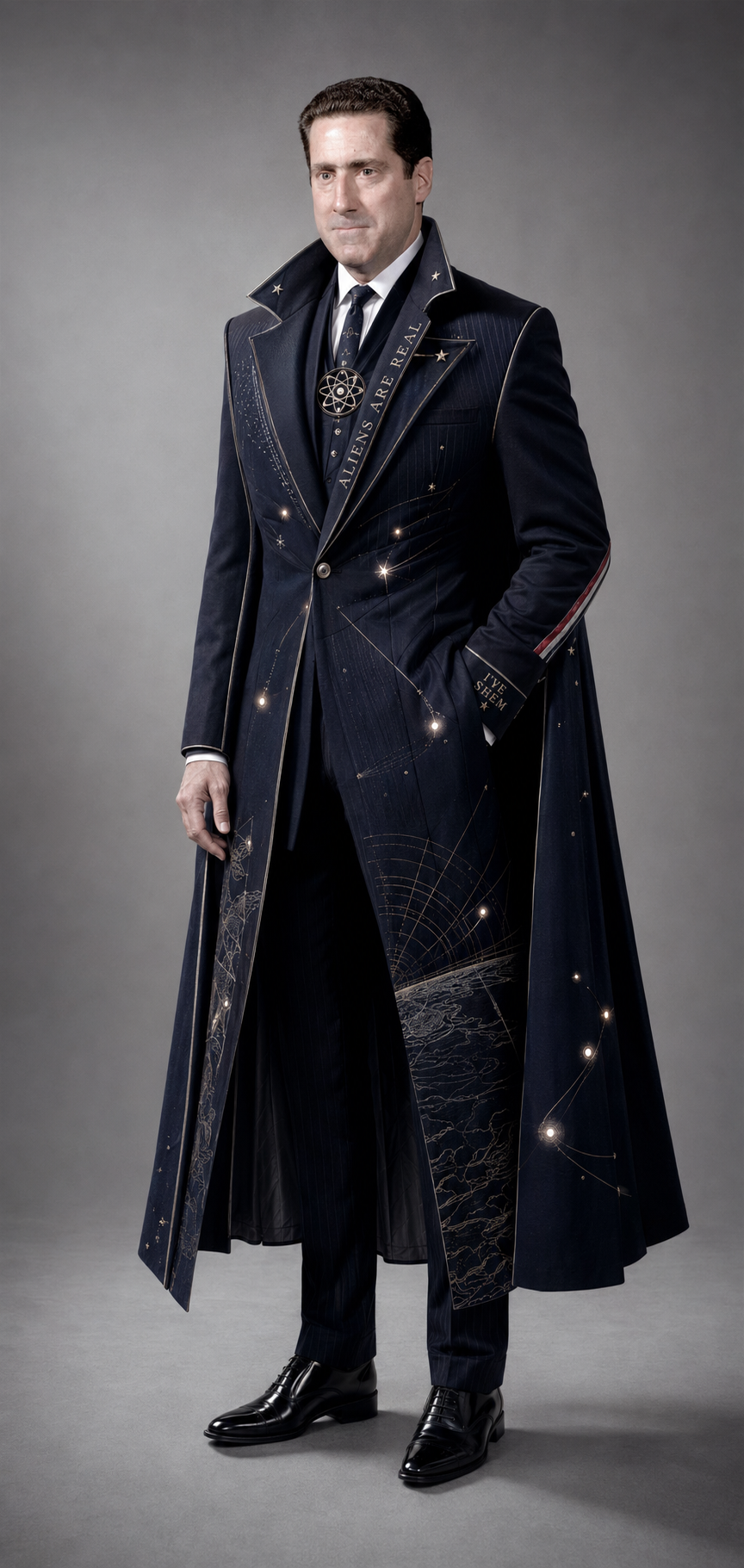
John S. Herrington Défile – Maison de la Boucle la Plus Profonde. John S. Herrington Walks – House Innermost Loop. Created by @siouid142 from Dr. Alex Wissner-Gross’s Welcome to August 25, 2026 dispatch, this dark navy coat responds to a reported statement att
Read the narration
John S. Herrington Défile – Maison de la Boucle la Plus Profonde.
John S. Herrington Walks – House Innermost Loop.
Created by @siouid142 from Dr. Alex Wissner-Gross’s Welcome to August 25, 2026 dispatch, this dark navy coat responds to a reported statement attributed to John S. Herrington, the former United States Secretary of Energy under President Ronald Reagan, alleging that aliens are real and that he had seen them. The attribution is presented as a reported and disputed claim, not verified evidence. It is also essential not to confuse John S. Herrington with NASA astronaut John B. Herrington, a different person who flew on STS-113 and became the first enrolled Native American in space.
That identity correction changes how the garment must be read. The figure invoked here held a cabinet-level energy office from 1985 to 1989 and previously served in government roles connected with the Navy and White House personnel. He was not the astronaut sometimes attached to the story through a shared surname and middle initial. The work’s cosmic styling can encourage that conflation, which is why precise narration matters. A visual association with space is not biographical proof, just as institutional prominence is not proof of an extraordinary claim.
The coat is covered with constellation lines, orbital arcs, star points, and a map-like train. An atom-shaped medallion sits on the chest, while “ALIENS ARE REAL” appears on the lapel and a fragment resembling “I’VE SEEN ’EM” marks the cuff. These phrases are the claim made visible. They do not describe objects depicted elsewhere in the image. There is no identifiable alien, no resolved spacecraft, and no chain of evidence. The garment instead surrounds the statement with the visual grammar through which uncertainty is often organized: maps, trajectories, nodes, and celestial coordinates.
Navy tailoring gives the wearer an official, almost diplomatic authority. That authority is central to the work’s tension. When an extraordinary assertion is linked to a former senior official, audiences may treat status as a substitute for corroboration. Yet expertise and access are domain-specific, memory is fallible, reports can be distorted, and repetition can detach a sentence from its original context. @siouid142 does not erase the fascination of testimony; the coat asks viewers to notice how quickly a title, a lapel, and a star map can manufacture the feeling of disclosure.
The atom medallion adds another ambiguity. It can evoke the Department of Energy, physical inquiry, atomic history, or simply the authority of science. None of those associations demonstrates extraterrestrial life. Placed over the heart, however, the symbol joins empirical aspiration to personal conviction. The statement on the lapel is public and categorical; the evidence-map surface remains unresolved. Their mismatch turns the body into a study of belief: a certainty worn in front of a field that still requires interpretation.
The map-like train extends behind the figure as if every claim drags an expanding network of retellings. Lines connect points, but connection is not causation, and a plotted route is not a recovered event. In contemporary information systems, a striking quotation can move from post to summary to image, gaining confidence each time its provenance becomes less visible. The coat’s elegance captures that circulation. It is easy to follow, easy to remember, and difficult to verify. Its long train is therefore both cosmic path and metadata trail—beautiful, consequential, and incomplete.
Beside Shaun Fell’s warp-signature garment, this chapter creates a necessary methodological contrast. Fell’s work begins from assumptions, produces modeled emissions, and identifies signals that might be sought; Herrington’s begins from a reported utterance whose context and support must be established. Both engage the possibility of unfamiliar phenomena, but they demand different forms of evaluation. A simulation is assessed through equations, assumptions, and reproducibility. A testimony is assessed through sourcing, contemporaneous records, corroboration, and alternative explanations. Neither becomes stronger by being confused with the other.
The coat finally refuses the false choice between ridicule and credulity. Extraordinary claims can be examined without humiliation, and wonder can coexist with insistence on evidence. By correcting the person’s identity while preserving the artwork’s precise claim-centered imagery, the narration performs the scrutiny the piece invites. @siouid142 dresses uncertainty in institutional grandeur, then leaves every constellation line open to question. The lapel declares; the surrounding field asks. What was said, by whom, in what context, based on what observation, and confirmed by what independent record? Until those questions are answered, the most honest title for the cosmos remains not revelation, but inquiry.
Opening the gallery…