70 Clock Galerie / The Innermost Loop Feed Reply Tableaux
Shaun Fell Défile – Maison de la Boucle la Plus Profonde
Shaun Fell Walks – House Innermost Loop
August 25, 2026
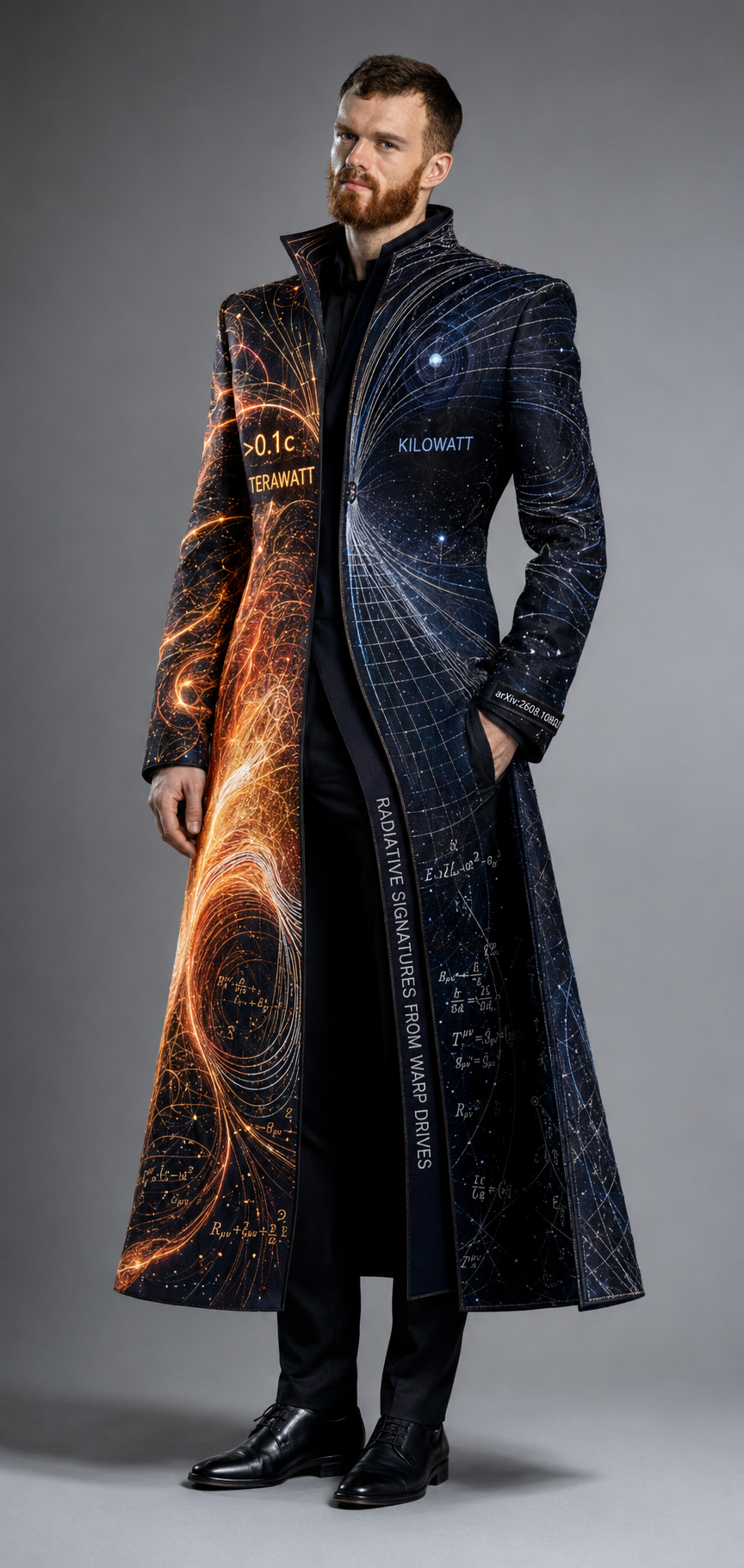
Shaun Fell Défile – Maison de la Boucle la Plus Profonde. Shaun Fell Walks – House Innermost Loop. Created by @siouid142 in response to Dr. Alex Wissner-Gross’s Welcome to August 25, 2026 dispatch, this orange-and-blue coat interprets simulations associated wi
Read the narration
Shaun Fell Défile – Maison de la Boucle la Plus Profonde.
Shaun Fell Walks – House Innermost Loop.
Created by @siouid142 in response to Dr. Alex Wissner-Gross’s Welcome to August 25, 2026 dispatch, this orange-and-blue coat interprets simulations associated with Shaun Fell and Avi Loeb concerning possible radiative signatures from hypothetical warp-drive configurations. The work is deliberately about modeled signatures, not verified spacecraft, proven warp propulsion, or evidence of extraterrestrial visitation. Its theatrical fire and starlight give speculative physics a runway presence while the printed quantities preserve the crucial distinction between a prediction and an observation.
The orange half is dominated by “>0.1c” and “TERAWATT.” Field lines bend around an intense, fireball-like form as though an invisible geometry has become visible through radiation. The speed notation establishes a regime above one tenth of the speed of light, while the power label signals an enormous predicted emission. Orange turns calculation into heat and danger. It is the side of the coat that catches the eye first, demonstrating why extraordinary scenarios travel rapidly through public imagination even when they begin as conditional results inside a model.
The blue half answers with “KILOWATT,” star fields, wave trajectories, and a partial arXiv identifier at the cuff. Here the reported scenario is a micrometer-scale, slower bubble whose predicted glow is vastly less powerful. The difference between terawatt and kilowatt is not decorative contrast. It shows how physical scale and velocity can transform an observable consequence. By placing the regimes on the same body, @siouid142 turns parameter space into tailoring: change the cut of the hypothetical system and the luminous signature changes with it.
“RADIATIVE SIGNATURES FROM WARP DRIVES” runs vertically across the composition like a paper title enlarged into a banner. A signature is not an identity. Astronomers infer causes from patterns only after comparing alternatives, instruments, backgrounds, and uncertainties. The coat keeps that epistemic gap open. Its waves and arcs resemble the kind of traces one might search for, but they are illustrations of predicted behavior. Even a matching transient would require careful exclusion of conventional phenomena before any extraordinary interpretation could be justified.
The central seam functions like a boundary condition. Orange and blue do not blend smoothly; they meet as two regimes calculated from different assumptions. This split resists the popular urge to convert “physicists modeled a possible signal” into “physicists found a warp drive.” Modeling asks what would follow if a specified geometry existed and changed in a particular way. That conditional knowledge can still be valuable. It helps define observables, expose energy problems, and convert a vague science-fiction concept into statements that could in principle be tested or ruled out.
The garment also speaks to fashion’s own relation with speculation. A runway look is a proposition about a body and a future, realized in material before it becomes everyday clothing. The warp-drive coat operates similarly: extravagant, coherent enough to inspect, and not confused with ordinary engineering. Its blazing lapel and cosmic sleeve let viewers feel the imaginative force of the idea while the numerical labels discipline that feeling. Wonder is permitted, but it must travel alongside units, assumptions, and scale.
Within House Innermost Loop, Shaun Fell walks near John S. Herrington’s claim-centered cosmic coat. Their proximity is instructive. Fell’s garment begins with a physical model and asks what signal a hypothetical device might emit; Herrington’s begins with a reported statement and asks how authority and belief circulate. Neither garment supplies evidence of an alien craft. Together they distinguish a scientific search for discriminating signatures from the cultural power of testimony, a distinction easily lost when warp drives, unidentified phenomena, and extraterrestrial life share the same imaginative field.
The work’s final image is one of disciplined astonishment. Fire crosses the left side, stars recede on the right, and a research identifier waits at the cuff where ornament might normally appear. @siouid142 makes citation part of the costume because speculation gains meaning through traceable argument. The coat does not shrink the cosmos to certainty; it enlarges the methods by which uncertainty can be explored. Its challenge is to keep two capacities alive at once: the imagination required to model an unfamiliar possibility and the rigor required to say exactly what the model has—and has not—shown.
Opening the gallery…