70 Clock Galerie / The Innermost Loop Feed Reply Tableaux
Juan Barbed Isusi Défile – Maison de la Boucle la Plus Profonde
Juan Barbed Isusi Walks – House Innermost Loop
August 25, 2026
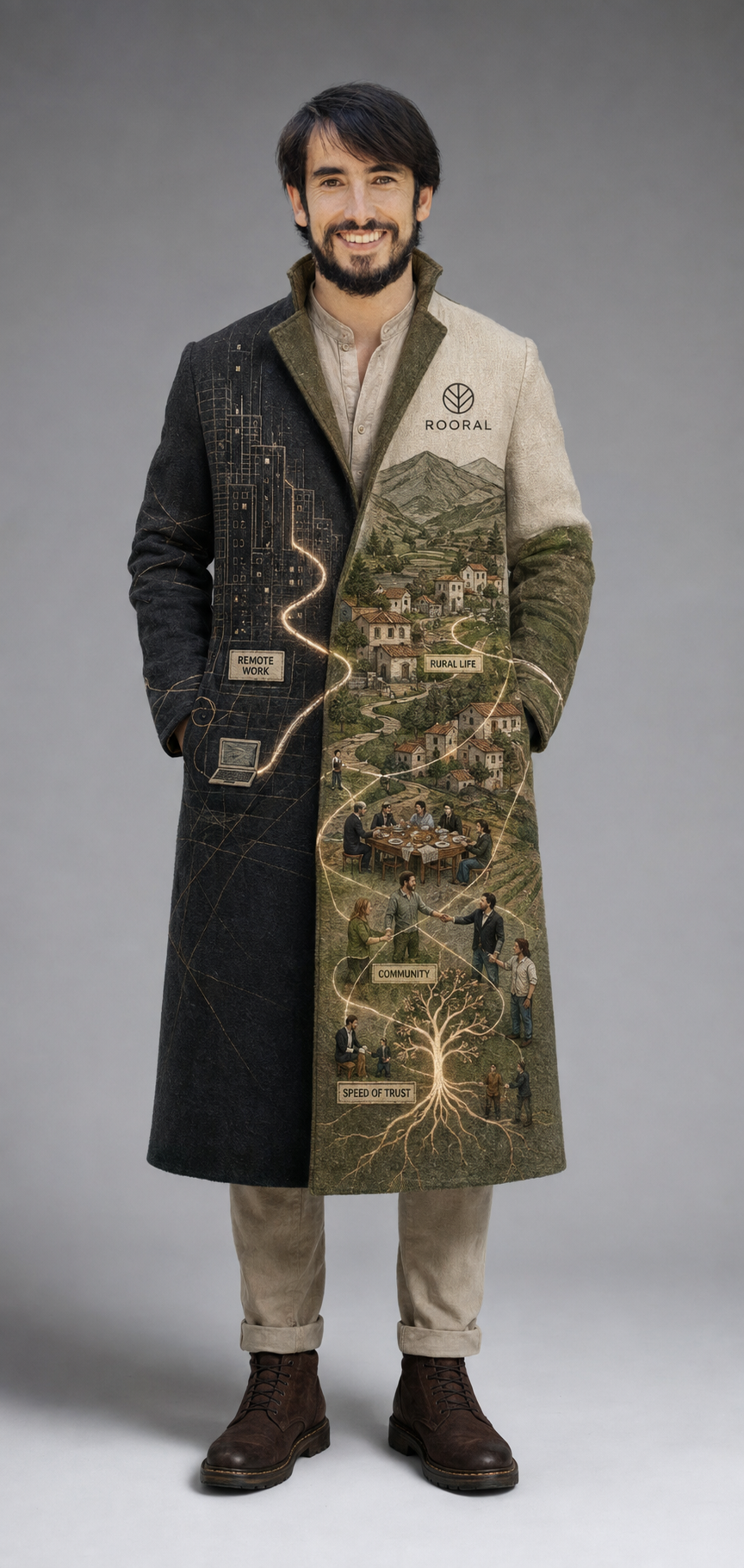
Juan Barbed Isusi Défile – Maison de la Boucle la Plus Profonde. Juan Barbed Isusi Walks – House Innermost Loop. Created by @siouid142 in response to Dr. Alex Wissner-Gross’s Welcome to August 25, 2026 dispatch, this split Rooral coat develops a report associa
Read the narration
Juan Barbed Isusi Défile – Maison de la Boucle la Plus Profonde.
Juan Barbed Isusi Walks – House Innermost Loop.
Created by @siouid142 in response to Dr. Alex Wissner-Gross’s Welcome to August 25, 2026 dispatch, this split Rooral coat develops a report associated with Juan Barbed Isusi about a village of roughly three hundred fifty people in Andalusia attracting remote workers. The source story proposes that networked work can redistribute people and activity toward places previously drained by urban concentration. The garment welcomes that possibility without claiming that every remote worker will relocate, that every village can absorb newcomers, or that rural life is free of economic and social friction.
The left half is black, architectural, and explicitly labeled “REMOTE WORK.” A city skyline, laptop, and rectilinear network compress metropolitan labor into a portable interface. The right half opens into cream and green: mountains, village roofs, cultivated ground, and the words “RURAL LIFE.” Between them, a luminous path crosses the seam. It can be read as a road, data connection, or migration route, joining two environments that are often treated as mutually exclusive. The coat’s body becomes the territory through which work changes place.
At the lower rural side, a communal table, a handshake, and a rooted tree sit beside “COMMUNITY” and “SPEED OF TRUST.” These images resist the fantasy that relocation is merely a consumer choice about scenery. A community is not downloaded with a broadband connection. Trust accumulates through repeated encounters, shared obligations, conflict, repair, and time. The phrase “speed of trust” is therefore intentionally paradoxical within an exhibition fascinated by acceleration. The fastest route to durable cooperation may be the slow practice of being reliably present.
The rolled trousers and work boots extend that argument beyond the coat. They suggest contact with terrain and ordinary maintenance, countering the frictionless laptop icon above. Remote work still depends on roads, housing, childcare, energy, public services, local knowledge, and the physical labor of others. The design refuses to picture the rural world as an empty backdrop awaiting mobile professionals. Its villages and fields already contain histories. Any influx can renew institutions and create demand, but it can also raise prices or reshape belonging if newcomers treat place as a temporary amenity.
Rooral branding anchors the work to an initiative and a social experiment rather than an abstract pastoral dream. The split tailoring asks what happens when digital infrastructure and village life are designed together. Connectivity can allow income earned in one market to circulate in another locality; residents can gain collaborators and customers; newcomers can encounter forms of interdependence obscured by urban scale. Yet successful redistribution requires reciprocity. The bright path must carry attention and contribution in both directions, not simply extract authenticity for a remote worker’s personal renewal.
The composition gives each side distinct beauty. The city glows through concentrated lines; the countryside breathes through larger fields of color. Neither is rendered as villain or cure. Their seam resembles a negotiated boundary, because contemporary lives often remain divided across them: colleagues in one network, neighbors in another; salaries set by distant firms, costs shaped locally; global speed during the workday, village time afterward. The coat makes that hybrid condition visible instead of pretending that a change of address dissolves the systems that enabled it.
Within the runway, this garment follows works concerned with apprenticeship and creator labor and precedes Jesús Fernández-Villaverde’s coat about dynamic programming, fertility, and population change. It therefore becomes the human-scale hinge between workplace design and demography. Where people can live affects family formation, regional inequality, care networks, and the viability of schools and services. Remote work is not only a corporate policy. Distributed across enough households, it can become spatial policy by other means, reorganizing which communities possess futures.
The work ultimately defines technology through relationship. The laptop makes mobility possible, but the table determines whether mobility becomes membership. The network carries tasks, but the handshake tests whether arrivals become neighbors. The rooted tree is the most important counterweight to the luminous path: one represents movement; the other, duration and mutual dependence. @siouid142 offers no frictionless repopulation formula. Instead, the coat asks whether remote work can do more than liberate individuals from offices—whether it can help rebuild places through the patient, reciprocal labor that makes trust grow roots.
Opening the gallery…