70 Clock Galerie / The Innermost Loop Feed Reply Tableaux
Erik Brynjolfsson Défile – Maison de la Boucle la Plus Profonde
Erik Brynjolfsson Walks – House Innermost Loop
August 25, 2026
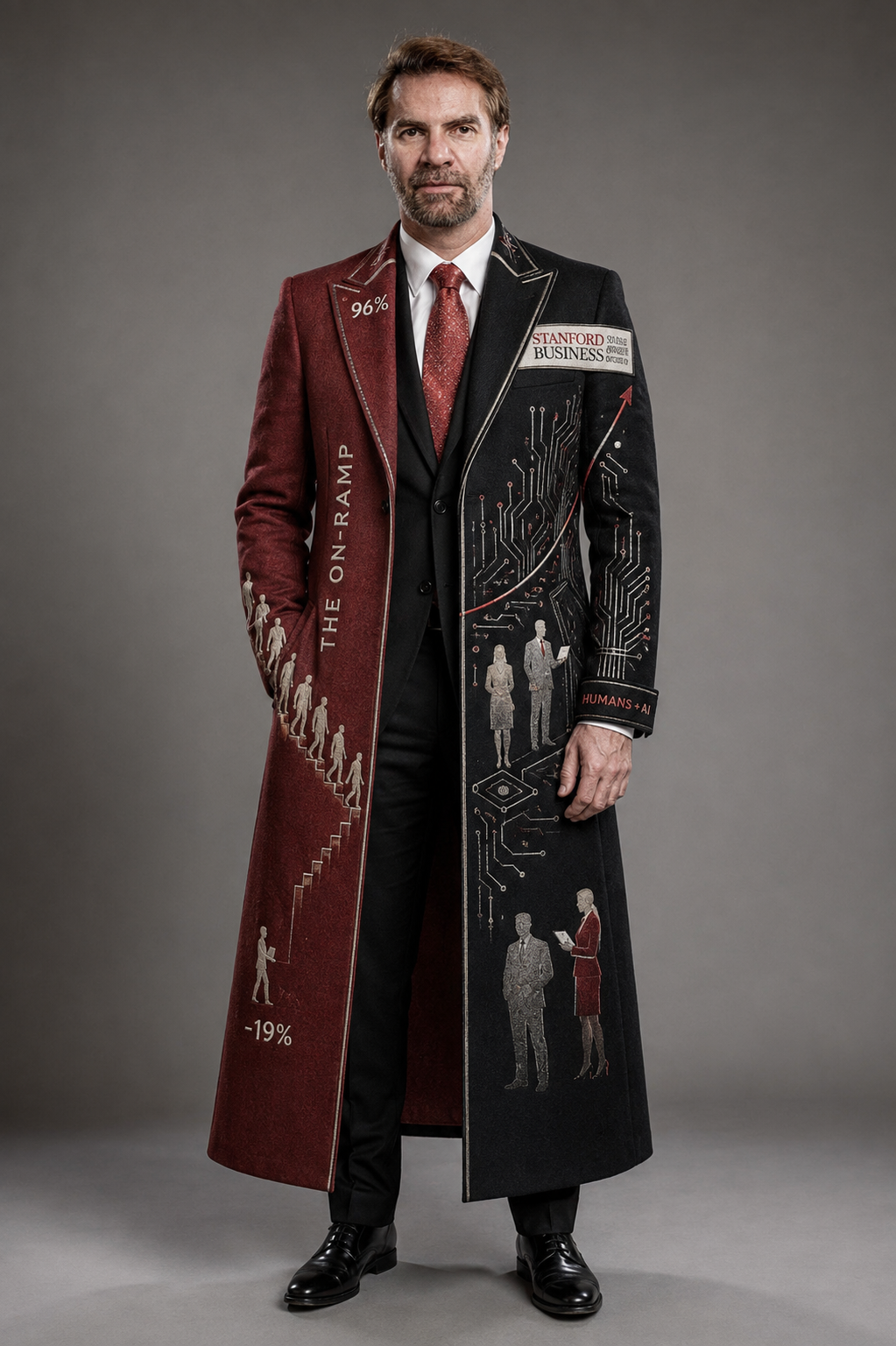
Erik Brynjolfsson Défile – Maison de la Boucle la Plus Profonde. Erik Brynjolfsson Walks – House Innermost Loop. Created by @siouid142 from Dr. Alex Wissner-Gross’s Welcome to August 25, 2026 dispatch, this Stanford Business coat responds to Erik Brynjolfsson’
Read the narration
Erik Brynjolfsson Défile – Maison de la Boucle la Plus Profonde.
Erik Brynjolfsson Walks – House Innermost Loop.
Created by @siouid142 from Dr. Alex Wissner-Gross’s Welcome to August 25, 2026 dispatch, this Stanford Business coat responds to Erik Brynjolfsson’s analysis of artificial intelligence and employment. The source discussion reported no economy-wide destruction of jobs and continuing demand for senior talent, while emphasizing an uneven on-ramp for people entering AI-exposed work. The garment keeps that distinction visible. It is not a universal labor forecast; it is a diagram of how adoption, experience, training, and opportunity can diverge even when aggregate employment appears resilient.
The left lapel is a deep Stanford crimson field carrying the label “96%.” Below it, “THE ON-RAMP” runs beside a staircase of small human figures, and “−19%” appears near the hem. The percentages remain printed evidence within the artwork, not free-floating laws whose denominators can be invented after the fact. Formally, their separation matters more than a false precision would. A very large figure commands the chest while a negative figure waits below, turning the body into a vertical argument about broad participation and localized loss.
A staircase is an exact metaphor for labor-market entry because it combines movement with structure. People do not simply possess or lack AI skill; they encounter sequences of access, practice, feedback, responsibility, and promotion. A missing first step can matter more than an open door at the top. The small figures look like workers ascending, but the rise is neither automatic nor evenly spaced. “The on-ramp” names the institutional design problem: how newcomers obtain the tasks and supervision through which they can become the senior talent employers still seek.
On the right, the Stanford Business patch, circuit patterns, a rising red arrow, workplace figures, and the phrase “HUMANS + AI” present a more optimistic system. Crucially, the plus sign does not erase hierarchy. Humans and AI can complement one another only through choices about task division, accountability, training, and who captures the gains. The arrow can signify productivity or demand, yet it also resembles a path cutting across the garment. The future of work is not delivered by the technology alone; it is tailored through organizations.
The contrast with Chris Churchman’s nearby first-principles coat is productive. Churchman warns that automating early reasoning tasks can weaken apprenticeship. Brynjolfsson’s garment shows the labor-market result of that same design error: firms may continue recruiting proven experts while reducing the junior work that once produced them. A company can look efficient in the present and still damage its future talent pipeline. The two works therefore make education, supervision, and task allocation part of technological infrastructure, not charitable additions to an otherwise complete system.
The dark fabric gives the circuitry a disciplined, almost corporate elegance. This is not the spectacular hardware abundance of Gavin Baker’s chip-covered coat; it is computation entering routines, offices, and career ladders. Crimson accents make the institution unmistakable, while the figures prevent the analysis from dissolving into abstract productivity. Every labor statistic contains people whose biographies unfold across time. A nineteen-percent decline in one observed segment and stable totals elsewhere can coexist, and the garment asks viewers to hold both scales at once.
“Humans + AI” is most persuasive when read as a demand for complementarity rather than a guaranteed outcome. Tools can expand a worker’s reach, but complementary work must be created, taught, and rewarded. If the model performs the tasks through which beginners once demonstrated competence, employers need new ways to evaluate potential and provide safe practice. If productivity rises, institutions must decide whether the benefit becomes shorter hours, higher wages, broader access, concentrated profit, or simply a faster treadmill. The plus sign is thus a governance problem disguised as arithmetic.
By turning an employment argument into a walking coat, @siouid142 restores motion to statistics. The wearer advances, but only because a runway has been built beneath him. That hidden support is the work’s deepest subject: schools, mentors, firms, and policies that make an on-ramp real. The garment rejects both mass-unemployment melodrama and effortless-complementarity reassurance. Its final image is conditional hope. People can rise with powerful tools, but only if society preserves the first step, values the teachers on the stairs, and measures success by who is able to continue climbing.
Opening the gallery…