70 Clock Galerie / The Innermost Loop Feed Reply Tableaux
Chris Churchman Défile – Maison de la Boucle la Plus Profonde
Chris Churchman Walks – House Innermost Loop
August 25, 2026
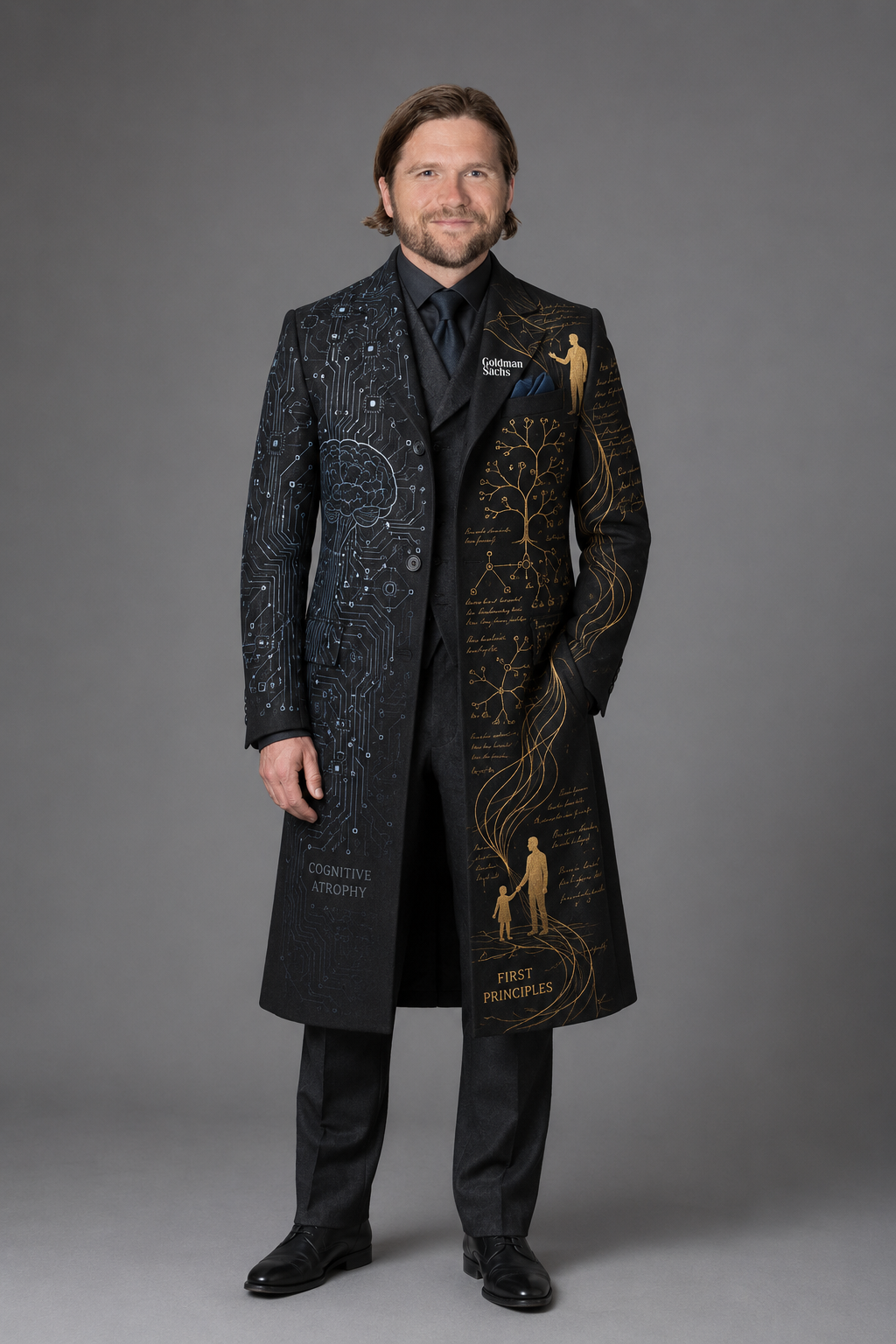
Chris Churchman Défile – Maison de la Boucle la Plus Profonde. Chris Churchman Walks – House Innermost Loop. Created by @siouid142 in response to Dr. Alex Wissner-Gross’s Welcome to August 25, 2026 dispatch, this black Goldman Sachs coat develops a warning ass
Read the narration
Chris Churchman Défile – Maison de la Boucle la Plus Profonde.
Chris Churchman Walks – House Innermost Loop.
Created by @siouid142 in response to Dr. Alex Wissner-Gross’s Welcome to August 25, 2026 dispatch, this black Goldman Sachs coat develops a warning associated with Chris Churchman: if people outsource too much reasoning to artificial intelligence, they may weaken the apprenticeship through which tacit judgment is formed. “COGNITIVE ATROPHY” is printed on the blue-black half, while “FIRST PRINCIPLES” appears on the gold half. The garment does not diagnose a medical condition or reject AI tools. It stages a contest between delegated answers and cultivated understanding.
The left side is dense with electric-blue circuitry and a brain-like network. Information seems to arrive everywhere at once, crossing lapel, sleeve, and torso with frictionless authority. Its visual pleasure captures why cognitive outsourcing is attractive. A responsive system can summarize, propose, calculate, and draft before a novice knows how to begin. Yet the network has no visible origin in lived practice; it appears complete. “Cognitive atrophy” names the risk that this completeness becomes a substitute for building the internal structures needed to recognize when a fluent answer is wrong.
The right side grows differently. Gold lines branch like roots, decision trees, and hand-drawn causal diagrams. Equations and notes remain visible as working marks rather than disappearing behind a polished interface. Near the lower portion, an adult and child evoke apprenticeship: knowledge transferred through observation, correction, repetition, and the gradual acquisition of standards that experts often cannot fully state. This half honors reasoning as a practice. First principles are not slogans carved beneath certainty; they are the starting assumptions one learns to expose, test, and rebuild.
The seam between the two halves runs through the wearer’s body, making the choice deliberately unstable. No person works entirely on one side. A practitioner may use an AI system to search possibilities, then rely on accumulated judgment to evaluate them; a student may learn through explanation, then test that explanation against reality. The danger begins when assistance removes the productive difficulty that forms skill. By keeping both visual systems on one coat, the artwork argues for integration governed by pedagogy, not a nostalgic return to work without tools.
Goldman Sachs branding locates the problem inside institutions where decisions carry consequences and expertise is reproduced through hierarchical work. Apprenticeship is often inefficient in the short term: senior people review drafts, explain errors, and allow juniors to attempt tasks that a machine or experienced professional could finish faster. But those repetitions create future judgment. If every early task is automated because it looks routine, the organization may preserve immediate output while quietly eroding the path by which its next generation becomes capable of handling the nonroutine.
The tree imagery sharpens that temporal argument. Roots are hidden investment; branches are visible performance. A system that harvests only finished answers is like a culture admiring a canopy while cutting away the soil that sustains it. The child-and-adult pairing also prevents “human reasoning” from becoming an abstract heroic faculty. Thought develops socially. It depends on examples, disagreement, explanation, and permission to fail under supervision. The coat suggests that the future of work will be judged not only by productivity, but by whether its tools preserve those developmental relationships.
Within the full runway, Churchman’s figure had been visible before receiving this individual title, so this chapter also corrects the exhibition’s inventory by bringing a previously peripheral garment into full view. That movement from background to foreground echoes its theme. Apprenticeship is easy to overlook because the formative work happens beneath headline outcomes. The garment asks the viewer to notice the invisible educational layer behind expert performance, just as the chapter asks the catalog to account for a figure who was already present but not yet individually named.
The strongest reading is therefore neither fear nor obedience. The blue network offers reach; the gold branches offer grounding. Used well, artificial intelligence could expose learners to more examples, provide rapid feedback, and free mentors for deeper instruction. Used carelessly, it could produce polished artifacts without durable comprehension. @siouid142 makes that institutional choice wearable. The coat’s two halves are equally elaborate, because capability and cultivation both deserve investment. Its final question is practical: after the answer arrives, can the person wearing it reconstruct why it is true, recognize when it fails, and teach the reasoning onward?
Opening the gallery…