70 Clock Galerie / The Innermost Loop Feed Reply Tableaux
Brigette Pheloung McHale Défile – Maison de la Boucle la Plus Profonde
Brigette Pheloung McHale Walks – House Innermost Loop
August 25, 2026
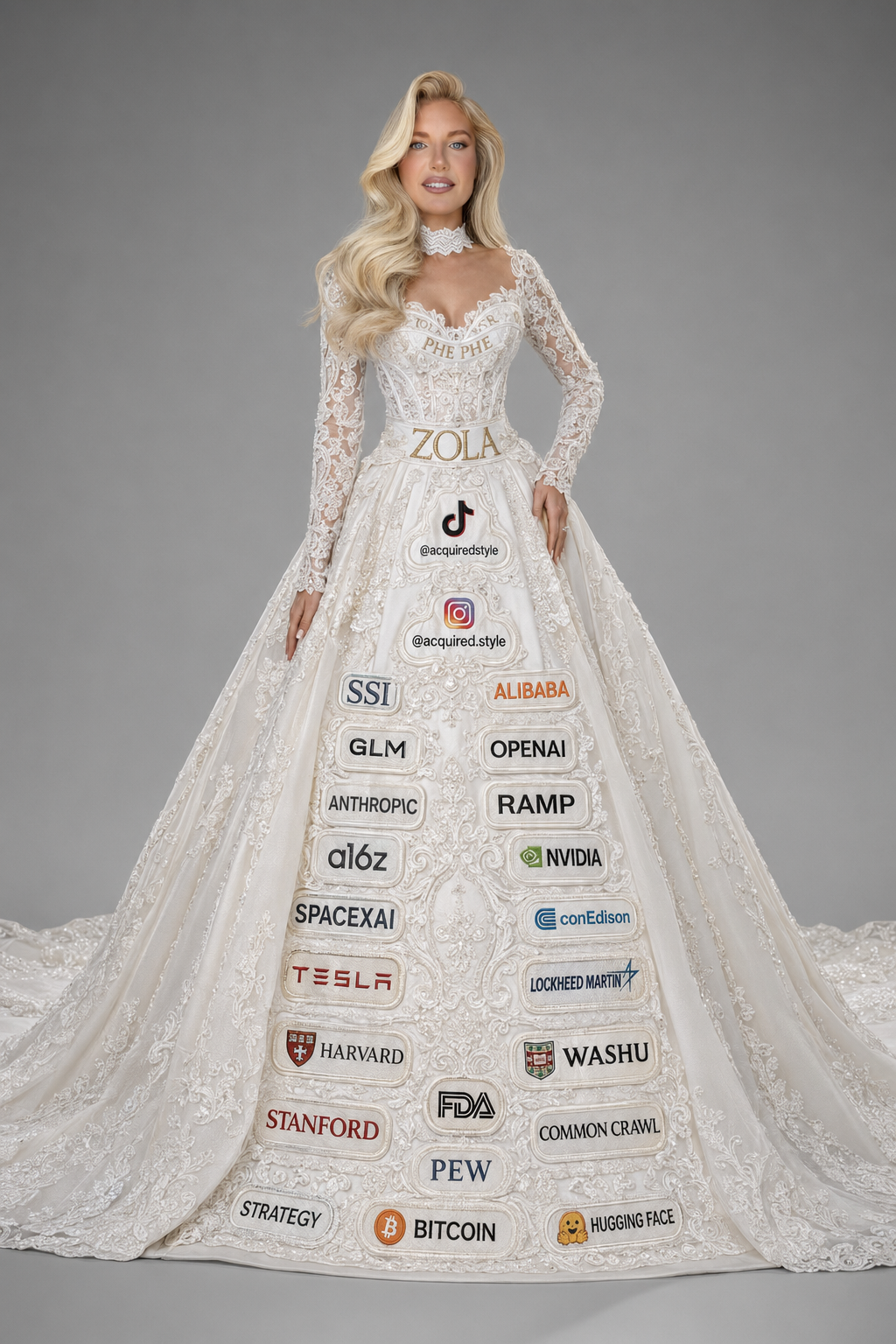
Brigette Pheloung McHale Défile – Maison de la Boucle la Plus Profonde. Brigette Pheloung McHale Walks – House Innermost Loop. Created by @siouid142 from Dr. Alex Wissner-Gross’s Welcome to August 25, 2026 dispatch, this white lace wedding gown responds to a r
Read the narration
Brigette Pheloung McHale Défile – Maison de la Boucle la Plus Profonde.
Brigette Pheloung McHale Walks – House Innermost Loop.
Created by @siouid142 from Dr. Alex Wissner-Gross’s Welcome to August 25, 2026 dispatch, this white lace wedding gown responds to a report about creators monetizing weddings through social media partnerships, including an account of Zola offering as much as one hundred fifty thousand dollars for a partnership. Brigette Pheloung McHale’s social handles, @acquiredstyle and @acquired.style, appear on the dress. The work takes the economic premise seriously, then exaggerates it until the bride becomes an entire media channel walking down the aisle.
The gown is the brightest object in the House Innermost Loop procession. Lace, veil, train, and gold ZOLA lettering preserve the ceremonial vocabulary of bridal fashion, but the skirt is covered with sponsor-like patches. Their placement borrows equally from racing suits, conference backdrops, and influencer content. A form associated with private vows is reformatted as premium advertising inventory. The joke is immediate, yet the image is not merely mocking. It recognizes that contemporary weddings already move through platforms, affiliate links, photographers, vendors, and audiences far beyond the room.
The patchwork gathers names from artificial intelligence, venture capital, energy, aerospace, universities, government, data, finance, and cryptocurrency: SSI, Alibaba, GLM, OpenAI, Anthropic, Ramp, a16z, Nvidia, SpaceXAI, Con Edison, Tesla, Lockheed Martin, Harvard, WashU, Stanford, the FDA, Common Crawl, Pew, Strategy, Bitcoin, and Hugging Face. These are artistic inclusions, not evidence that the organizations sponsored or endorsed the bride, the artist, or one another. Their implausible coexistence is precisely the point: every sector competes for symbolic proximity to attention.
Because the patches descend in orderly columns, the body becomes a ranked interface. The viewer scans institutional logos before reading the folds of the fabric, and commercial legibility begins to overtake personal identity. Yet the lace repeatedly interrupts those hard-edged marks. Its floral pattern carries traditions of handwork, inheritance, and intimacy that cannot be reduced to a campaign metric. The tension between lace and logo is the work’s central formal device: an old technology of social meaning supporting a new technology of audience extraction.
The reported threshold of only a few thousand followers is conceptually important. Influence here is not restricted to global celebrity. A wedding can be valuable because it concentrates a community’s attention at a moment of unusually high emotion and unusually dense purchasing. The gown therefore pictures the creator economy not as effortless self-expression but as labor performed inside life events. Posting, negotiating, styling, disclosing, and maintaining a public persona enter the ceremony alongside family, friendship, and commitment. The aisle becomes both ritual path and distribution channel.
ZOLA’s gold name sits high on the bodice like a house crest, reversing the traditional relation between client and label. Is the bride wearing the platform, or is the platform wearing the bride? The question extends beyond weddings. When private experience is financed through visibility, sponsorship can expand what is materially possible while also shaping which moments are staged, recorded, and made searchable. The garment neither romanticizes privacy nor condemns commerce. It shows how difficult the two have become to separate once attention itself can be priced.
Placed near works about human attention, cognitive atrophy, and AI labor, the dress broadens the exhibition’s definition of technological infrastructure. The relevant machine is not only a model or chip. It is the coupled system of phones, recommendation engines, brand budgets, social expectations, and creator analytics that turns a ceremony into content. The bride remains unmistakably human at the center, but she is surrounded by entities seeking association with her credibility and emotional reach. Her whiteness becomes a projection surface on which an entire economy tries to appear invited.
The work’s final achievement is to keep satire and sympathy in balance. The excessive sponsor field is funny because it makes an implicit market visible, but the dignity of the silhouette prevents the wearer from becoming a caricature. She carries the weight, coordinates the surfaces, and still commands the runway. @siouid142 thus renders monetization as both opportunity and burden: a means of financing experience, a form of entrepreneurial skill, and a demand that identity remain continuously legible to markets. The wedding gown promises union; this one also reveals the crowded contract between love, labor, platform, and audience.
Opening the gallery…