70 Clock Galerie / The Innermost Loop Feed Reply Tableaux
Paola Arlotta Défile – Maison de la Boucle la Plus Profonde
Paola Arlotta Walks – House Innermost Loop
August 25, 2026
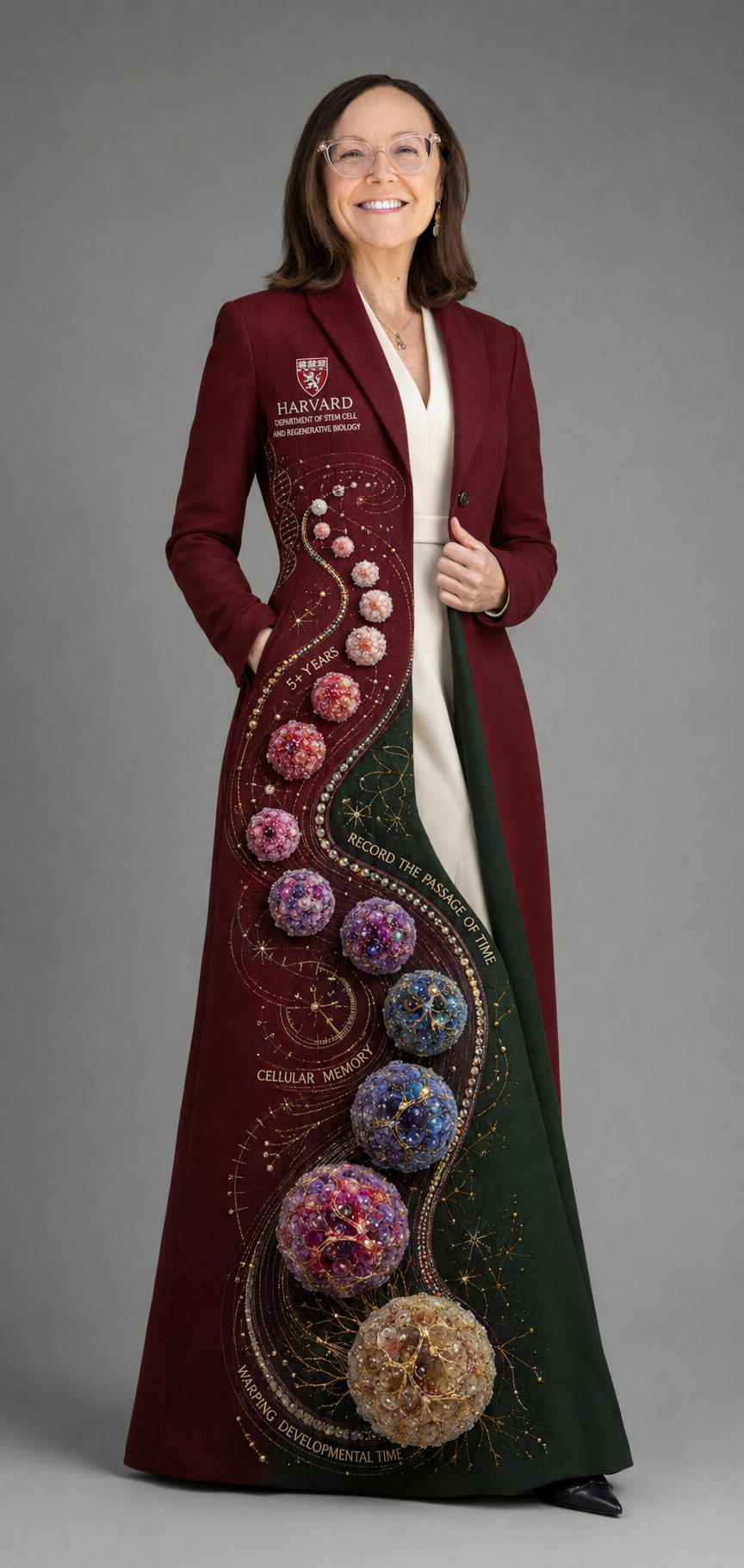
Paola Arlotta Défile – Maison de la Boucle la Plus Profonde. Paola Arlotta Walks – House Innermost Loop. Created by @siouid142 in response to Dr. Alex Wissner-Gross’s Welcome to August 25, 2026 dispatch, this Harvard-crimson, ivory, and deep-green garment draw
Read the narration
Paola Arlotta Défile – Maison de la Boucle la Plus Profonde.
Paola Arlotta Walks – House Innermost Loop.
Created by @siouid142 in response to Dr. Alex Wissner-Gross’s Welcome to August 25, 2026 dispatch, this Harvard-crimson, ivory, and deep-green garment draws on work associated with Paola Arlotta and the Department of Stem Cell and Regenerative Biology. The dispatch described human brain organoids maintained for roughly five years and research indicating that they record the passage of time. The artwork translates that unsettling temporal achievement into couture without pretending that its luminous spheres are microscopy or that laboratory aging is the same as a complete human life.
A long procession of organoid-like forms arcs down the body. Some are compact and pearly; others appear furrowed, branching, or internally illuminated. Read from top to bottom, they resemble specimens placed along a developmental sequence, but they also look like beads on a ceremonial chain. The curve prevents time from becoming a straight ruler. Growth folds, recurs, and changes texture. Each sphere is visibly related to the others yet irreducible to them, giving biological duration a material rhythm rather than presenting aging as a single number.
The inscriptions “5+ YEARS,” “RECORD THE PASSAGE OF TIME,” “CELLULAR MEMORY,” and “WARPING DEVELOPMENTAL TIME” turn the gown into an annotated experiment. Clocks, orbital paths, and branching lines surround those phrases, combining several visual languages for sequence. A clock divides duration into equal units; an orbit returns; a branch creates irreversible divergence. Their coexistence matters. Living systems are timed, cyclic, and path-dependent at once. What a cell becomes is shaped not only by its present environment but by the history carried through its developmental trajectory.
The Harvard shield and departmental identity stabilize the scientific source, while the extravagant silhouette refuses the neutrality often claimed by diagrams. The garment makes research appear as a social spectacle: institutions confer authority, long experiments require resources, and scientific images circulate through public imagination. Crimson evokes academic robes as much as laboratory labeling. Ivory panels give the glowing forms space to register, while green suggests cultivation. The body wearing the work becomes both archive and greenhouse, carrying a sequence that is alive but carefully constructed.
“Warping developmental time” is the most provocative phrase, and the design handles it as a question rather than a promise. To alter the pace or conditions of development in a model is not to discover a clinical route to rejuvenation, immortality, or the reversal of a person’s age. The artwork keeps the claim at the level of experimental time: how tissue models mature, retain temporal information, and reveal processes inaccessible to brief observation. Its clocks are therefore epistemic instruments. They show that some knowledge appears only when researchers wait long enough.
This emphasis on waiting quietly challenges the acceleration elsewhere on the runway. Nearby works describe monthly doubling in AI spending, rapid labor transitions, and technologies measured through increasing speed. Arlotta’s garment proposes another frontier: an experiment whose power lies in sustained maintenance. Five years is visually compressed into one outfit, yet the bead-like milestones insist on accumulated care. The most advanced act may not be faster computation but preserving a delicate system across thousands of ordinary days so that its internal clock can become legible.
The organoid sequence also complicates the familiar metaphor of memory as stored data. “Cellular memory” is not rendered as a chip or filing cabinet. It appears as changes in form, density, and relation—as history embodied in material. That difference matters in an exhibition preoccupied with artificial intelligence. Digital systems often invite fantasies of clean copying and reset, while development leaves traces that cannot be detached from the process that produced them. The gown’s elegance comes from those traces; its surface is beautiful because it has become an archive of transformation.
Ultimately, the work makes time the invisible tailor. The garment seems sewn from crimson cloth, green velvet, luminous tissue, and institutional notation, but its deepest seam is duration itself. The spheres descend like a family lineage, a series of worlds, or thoughts forming before language. By placing them on a walking body, @siouid142 returns the laboratory model to the scale of public attention while preserving uncertainty. The result does not declare that development has been mastered. It celebrates the more exact achievement of making a hidden biological clock observable—and asks what responsibilities begin once we can read it.
Opening the gallery…