70 Clock Galerie / The Innermost Loop Feed Reply Tableaux
Gavin Baker Défile – Maison de la Boucle la Plus Profonde
Gavin Baker Walks – House Innermost Loop
August 25, 2026
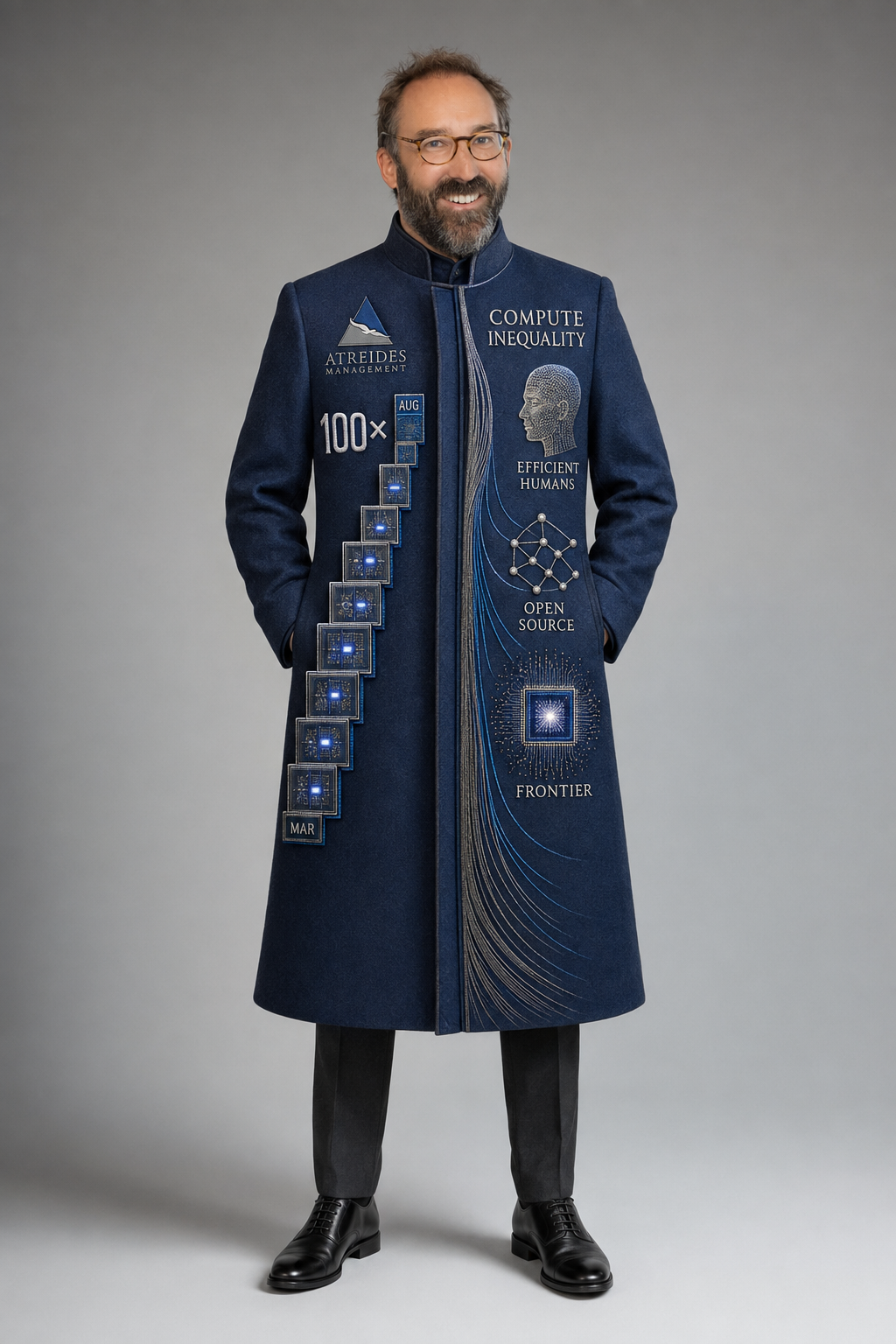
Gavin Baker Défile – Maison de la Boucle la Plus Profonde. Gavin Baker Walks – House Innermost Loop. Created by @siouid142 from Dr. Alex Wissner-Gross’s Welcome to August 25, 2026 dispatch, this dark blue Atreides Management coat visualizes a startling report
Read the narration
Gavin Baker Défile – Maison de la Boucle la Plus Profonde.
Gavin Baker Walks – House Innermost Loop.
Created by @siouid142 from Dr. Alex Wissner-Gross’s Welcome to August 25, 2026 dispatch, this dark blue Atreides Management coat visualizes a startling report attributed to Gavin Baker: one fund was spending one hundred times more on artificial intelligence than it had in March and was still doubling that expenditure each month. The garment treats that reported trajectory neither as a promise nor as investment advice. It uses the scale of the claim to ask how access to frontier computation can become a new form of inequality before its social consequences are fully understood.
The left side announces “100×” above a staircase of glowing chips labeled from March through August. Rather than plotting a calm line, the chips rise like architectural steps that the wearer must climb. The months make acceleration visible as sequence: each apparent plateau becomes the base of another expansion. Yet a staircase also implies exclusion. Some actors are already ascending through capital, hardware contracts, and privileged infrastructure, while others encounter the first step as a wall. The number is therefore both a measure of expenditure and a diagram of distance.
On the right, “COMPUTE INEQUALITY” appears beside a mesh-like human head, the phrase “EFFICIENT HUMANS,” an open network, and the opposing labels “OPEN SOURCE” and “FRONTIER.” These terms do not collapse into a single forecast. Open systems can distribute capabilities, while frontier systems may remain concentrated behind capital, chips, energy, and institutional access. The head is rendered as a network rather than a portrait, suggesting that even the allegedly efficient human is being reformatted by the resource regime surrounding the model.
Blue and gold filaments run across the coat like fiber-optic cables, electrical traces, and capital flows. Their beauty makes concentration seductive. Computation arrives as light, speed, and polished surface, but the same lines also resemble a circuit whose routing has already been decided. Atreides branding gives the work a finance-world specificity while quietly invoking the science-fiction problem of a valuable resource controlled through powerful houses. Here, the scarce substance is not spice but the coordinated stack of chips, energy, data, engineers, and money required to operate at scale.
The garment’s symmetrical authority is deceptive. The left half counts multiplication; the right half asks what that multiplication does to people. “Efficient Humans” may sound complimentary, but beside a gridded head it becomes uneasy. Are people becoming more capable through tools, or are they being evaluated as throughput within a computational system? The coat never resolves the ambiguity. Instead, its tailored form places a human body inside the ledger, reminding us that productivity statistics conceal differences in autonomy, training, bargaining power, and the freedom to refuse an imposed pace.
The open-source emblem provides a necessary countercurrent without becoming a magical solution. Software can be shared while compute remains expensive; model weights can circulate while electricity, memory, and high-end accelerators remain geographically and financially concentrated. Conversely, centralized frontier research can sometimes produce tools later distributed widely. By placing “OPEN SOURCE” near “FRONTIER,” @siouid142 stages a moving boundary rather than a moral binary. The relevant question is who can cross that boundary, under what terms, and with which dependencies attached.
In the full House Innermost Loop procession, this coat stands beside Dan McAteer’s meditation on abundant machine intelligence and scarce human attention. The pairing is exact. Baker’s garment shows that machine intelligence may feel abundant to the institutions able to buy extraordinary quantities of it, while McAteer’s shows that more output does not create more attention. Together they expose two bottlenecks operating at different levels: unequal access to the engines of generation and universally limited capacity to interpret what those engines produce.
The coat finally reads as a balance sheet turned into heraldry. Chips become medals, months become steps, and networks become ornamental veins. Its splendor acknowledges the real excitement of expanding capability, yet the phrase “COMPUTE INEQUALITY” prevents admiration from becoming surrender. A hundredfold increase can signify ambition, panic, conviction, or competitive escalation; the image does not pretend to know which. It asks viewers to look beyond the magnitude and examine the architecture beneath it: who owns the staircase, who supplies its power, who is invited to climb, and who is rendered efficient for someone else.
Opening the gallery…