70 Clock Galerie / The Innermost Loop Feed Reply Tableaux
Dan McAteer Défile – Maison de la Boucle la Plus Profonde
Dan McAteer Walks – House Innermost Loop
August 25, 2026
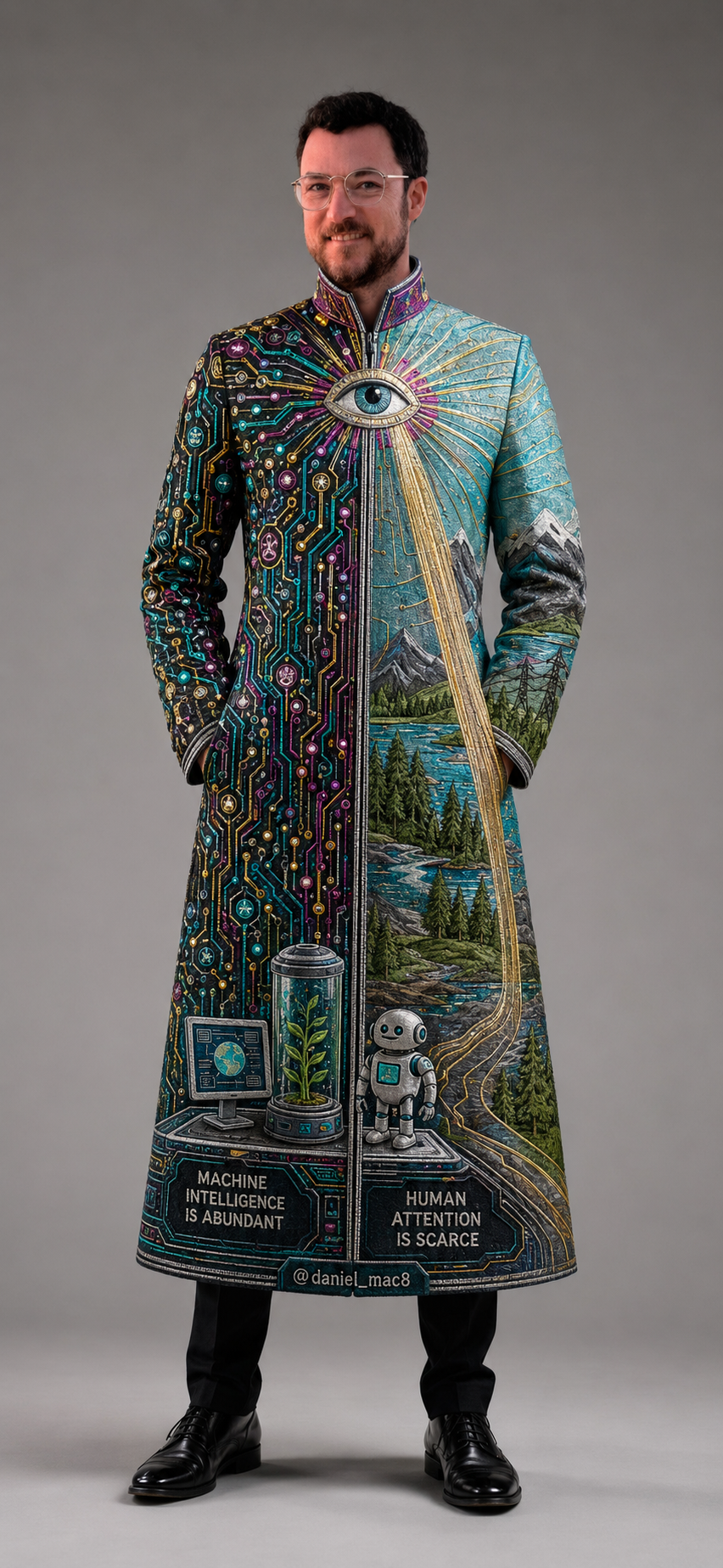
Dan McAteer Défile – Maison de la Boucle la Plus Profonde. Dan McAteer Walks – House Innermost Loop. Created by @siouid142 in response to Dr. Alex Wissner-Gross’s Welcome to August 25, 2026 dispatch, this coat turns Dan McAteer’s proposition into a garment-sca
Read the narration
Dan McAteer Défile – Maison de la Boucle la Plus Profonde.
Dan McAteer Walks – House Innermost Loop.
Created by @siouid142 in response to Dr. Alex Wissner-Gross’s Welcome to August 25, 2026 dispatch, this coat turns Dan McAteer’s proposition into a garment-scale argument: machine intelligence is abundant, while human attention is scarce. Those two sentences are printed near the hem, but the design refuses to leave them as a slogan. It asks what abundance looks like, what scarcity feels like, and why the bottleneck between computation and consequence may no longer be the production of answers, but the human capacity to notice, judge, and care about the right ones.
The coat is divided along a charged seam. One side is black and diagrammatic, threaded with blue circuitry, grids, and data-like pathways. The other opens into a turquoise landscape of mountains, forest, river, roadway, power lines, and sky. This is not a simple machine-versus-nature opposition. Roads and transmission lines extend the logic of the circuit into the landscape, while the circuitry acquires the branching rhythm of rivers and roots. Infrastructure passes through both halves, showing intelligence as an environment rather than a device that can be isolated on a table.
Across the chest, an enormous eye interrupts the split. Its iris sits where the technological and terrestrial fields meet, and colored rays spread outward like an optical spectrum, a warning beam, or the fan of possibilities opened by attention. The eye is not merely a symbol of seeing. It represents selection. A system may generate innumerable patterns, but attention determines which pattern becomes foreground, which signal becomes meaningful, and which future receives action. Placed at the body’s center, the eye makes attention feel embodied, finite, and ethically loaded.
At the hem, a miniature world display, a transparent plant chamber, and a small robot provide three different models of observation. The globe compresses a planet into information; the chamber subjects life to measurement and care; the robot automates sensing and response. Yet none of them resolves the question printed below. Automation can extend perception, but it cannot eliminate the need to choose what deserves protection, which metric matters, or when efficient intervention becomes inattentive control. The tiny plant is therefore not decoration. It is a test of whether intelligence can remain answerable to living time.
The tailoring gives the argument social form. This is a runway coat, a public surface worn before other people, so attention is both the work’s subject and its material. The dark half competes through density; the bright half through color and depth; the eye captures the gaze before the viewer can read the text. The design performs the very economy it analyzes. It must win a few seconds of human focus from an image-saturated world and then use those seconds to complicate the seduction of apparently limitless machine output.
McAteer’s handle appears within the composition, anchoring the proposition to a specific voice rather than presenting it as timeless doctrine. Around that attribution, @siouid142 builds a visual ecology of compute, energy, transport, biology, and perception. The result suggests that abundance at one layer can intensify scarcity at another. More models, agents, and recommendations may create more demands on judgment. Faster inference may produce a slower human task: deciding what to trust, what to ignore, and what should never be optimized merely because it can be measured.
Within the House Innermost Loop runway, this work forms a conceptual bridge between the nearby garments about compute inequality and human-plus-AI labor. Gavin Baker’s coat asks who can command enormous computational resources; Erik Brynjolfsson’s asks how people enter and advance within an AI-shaped workplace. Dan McAteer’s coat identifies the medium passing between those questions. Compute does not become an outcome by itself. It must cross attention, institutional priorities, and human interpretation, all of which remain unevenly distributed even when machine intelligence appears plentiful.
The final tension is not scarcity against abundance, but responsibility inside abundance. The luminous landscape is beautiful, yet it is crossed by the systems that make it legible and usable. The circuitry is powerful, yet it depends on a gaze capable of turning away from spectacle and toward consequence. By joining an eye, a robot, a plant, and a wired planet on one moving body, the work proposes attention as the last intimate infrastructure: exhaustible, contested, and impossible to outsource completely. The coat does not ask whether machines can think. It asks what humans will still decide to see.
Opening the gallery…