70 Clock Galerie / The Innermost Loop Feed Reply Tableaux
Winston Churchill Défile – Maison de la Boucle la Plus Profonde
Winston Churchill Walks – House Innermost Loop
August 25, 2026
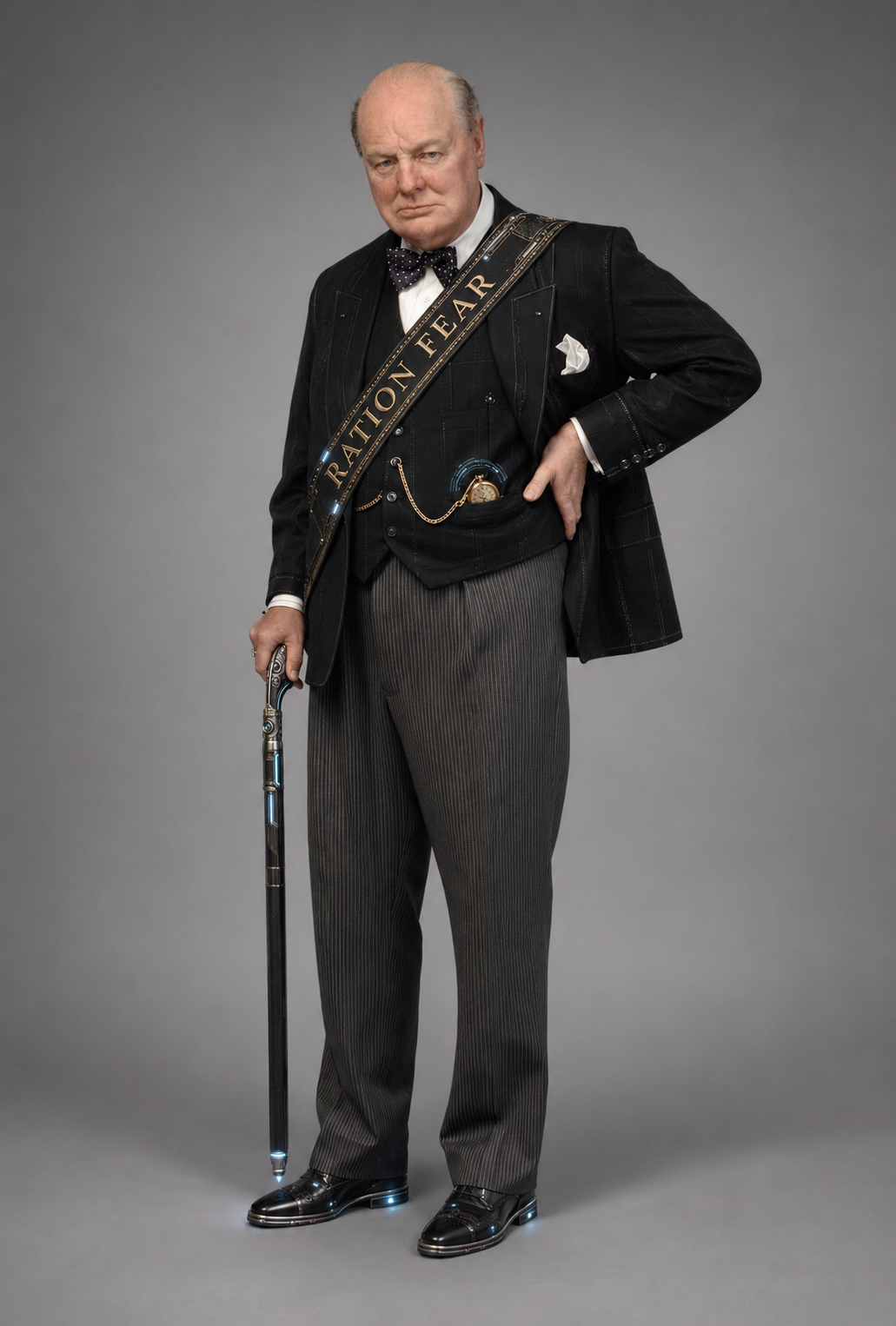
Winston Churchill Défile – Maison de la Boucle la Plus Profonde. Winston Churchill Walks – House Innermost Loop. Created by @siouid142 from Dr. Alex Wissner-Gross’s Welcome to August 25, 2026 dispatch, this individual portrait isolates the central historical a
Read the narration
Winston Churchill Défile – Maison de la Boucle la Plus Profonde.
Winston Churchill Walks – House Innermost Loop.
Created by @siouid142 from Dr. Alex Wissner-Gross’s Welcome to August 25, 2026 dispatch, this individual portrait isolates the central historical archetype from the Ration Fear runway. The newsletter closed with the line “The only thing we have to ration is fear itself,” a deliberate rewriting of Franklin Roosevelt’s famous language about fear. The artwork answers with Winston Churchill, joining two memories of wartime leadership without attributing the new sentence to the historical figure shown.
Churchill stands full length against a neutral gray studio field in a black three-piece suit, dotted bow tie and pinstriped trousers. The recognizable silhouette is formal but not nostalgic. Fine geometric lines run across the jacket like a quiet technical grid, placing a body associated with radio, parliament and wartime resolve inside the visual system of House Innermost Loop. History is not recreated; it is recruited as an instrument for interpreting a new scarcity debate.
A diagonal sash reading “Ration Fear” crosses the torso in gold letters. Sashes usually announce office, honor or allegiance. Here it delivers an instruction. Fear is treated as a limited input to public judgment rather than an atmosphere permitted to saturate every decision. The phrase does not deny danger. It distinguishes the work of measuring risk from the political temptation to make anxiety the default operating system.
The pocket watch at Churchill’s waist provides the portrait’s second governing metaphor. Rationing always occurs over time: supplies must last, queues must be managed and present sacrifice is justified by an anticipated future. A blue digital halo surrounds the old watch, connecting mechanical duration to contemporary monitoring. The object asks whether policy is responding to immediate headlines, long infrastructure cycles or historical stakes that unfold beyond an election.
In his other hand, Churchill holds a black cane fitted with small blue lights. Matching nodes appear on the shoes, lapels, sash and watch. The cane traditionally signals age, authority and physical support; the illuminated version becomes a sensor or control staff. It suggests that inherited institutions can be augmented without being discarded. Yet it also makes leadership measurable, as though judgment itself must now pass through telemetry.
The restrained palette separates this portrait from the dense August 25 runway. There are no evidence-wall logos, no other walkers and no loaves of bread at his feet. Small design decisions therefore carry the entire argument. Black cloth evokes austerity, gold lettering gives fear the dignity of a public command, and blue nodes introduce the cold precision of technical systems. The body stands between emergency rhetoric and quantified governance.
In the larger runway, literal loaves lie across the reflective floor. They connect bread lines to the dispatch’s idea of “thread lines,” queues for scarce GPU computation created when data-center construction is blocked. The portrait removes the bread but retains the sash, allowing scarcity to move from food to intelligence and then to emotion. Calories, compute and fear are not equivalent resources; the artwork’s power comes from testing what changes when the language of rationing migrates among them.
The dispatch provided concrete reasons for anxiety: public opposition to data centers, transformer shortages, lethal autonomous weapons, disrupted apprenticeship and uncertainty about concentrated model control. It also provided reasons not to collapse into panic: medical diagnostics, rescue systems, continued demand for human expertise, rural renewal and scientific inquiry. Churchill’s severe pose holds those competing signals without resolving them into optimism or doom.
Using Churchill carries risk because iconic leaders can turn analysis into borrowed grandeur. The work addresses that danger by making the construction obvious. This is a synthetic likeness wearing invented couture in response to a sentence written in 2026. He did not attend the runway, endorse the newsletter or speak the words on the sash. The portrait uses cultural memory as material while retaining a visible boundary between history and allegory.
As art criticism, Winston Churchill Walks treats governance as the allocation of attention under pressure. The cane, watch and sash form a compact system of support, duration and command. Fear may be necessary information, but it cannot be allowed infinite budget. The portrait’s final challenge is disciplined rather than heroic: preserve enough concern to recognize real danger, enough time to examine evidence and enough agency to keep the future from being designed by panic alone.
Opening the gallery…