70 Clock Galerie / The Innermost Loop Feed Reply Tableaux
Maison de la Boucle la Plus Profonde – Peur du Rationnement – Défilé de Gavin Baker, Dan McAteer, Erik Brynjolfsson, Brigette Pheloung McHale, Paola Arlotta, Winston Churchill, Juan Barbed Isusi, Jesús Fernández-Villaverde, Shaun Fell et John S. Herrington
House Innermost Loop – Ration Fear – Gavin Baker, Dan McAteer, Erik Brynjolfsson, Brigette Pheloung McHale, Paola Arlotta, Winston Churchill, Juan Barbed Isusi, Jesús Fernández-Villaverde, Shaun Fell, and John S. Herrington Walk
August 25, 2026
Maison de la Boucle la Plus Profonde – Peur du Rationnement – Défilé de Gavin Baker, Dan McAteer, Erik Brynjolfsson, Brigette Pheloung McHale, Paola Arlotta, Winston Churchill, Juan Barbed Isusi, Jesús Fernández-Villaverde, Shaun Fell et John S. Herrington. Ho
Read the narration
Maison de la Boucle la Plus Profonde – Peur du Rationnement – Défilé de Gavin Baker, Dan McAteer, Erik Brynjolfsson, Brigette Pheloung McHale, Paola Arlotta, Winston Churchill, Juan Barbed Isusi, Jesús Fernández-Villaverde, Shaun Fell et John S. Herrington.
House Innermost Loop – Ration Fear – Gavin Baker, Dan McAteer, Erik Brynjolfsson, Brigette Pheloung McHale, Paola Arlotta, Winston Churchill, Juan Barbed Isusi, Jesús Fernández-Villaverde, Shaun Fell, and John S. Herrington Walk.
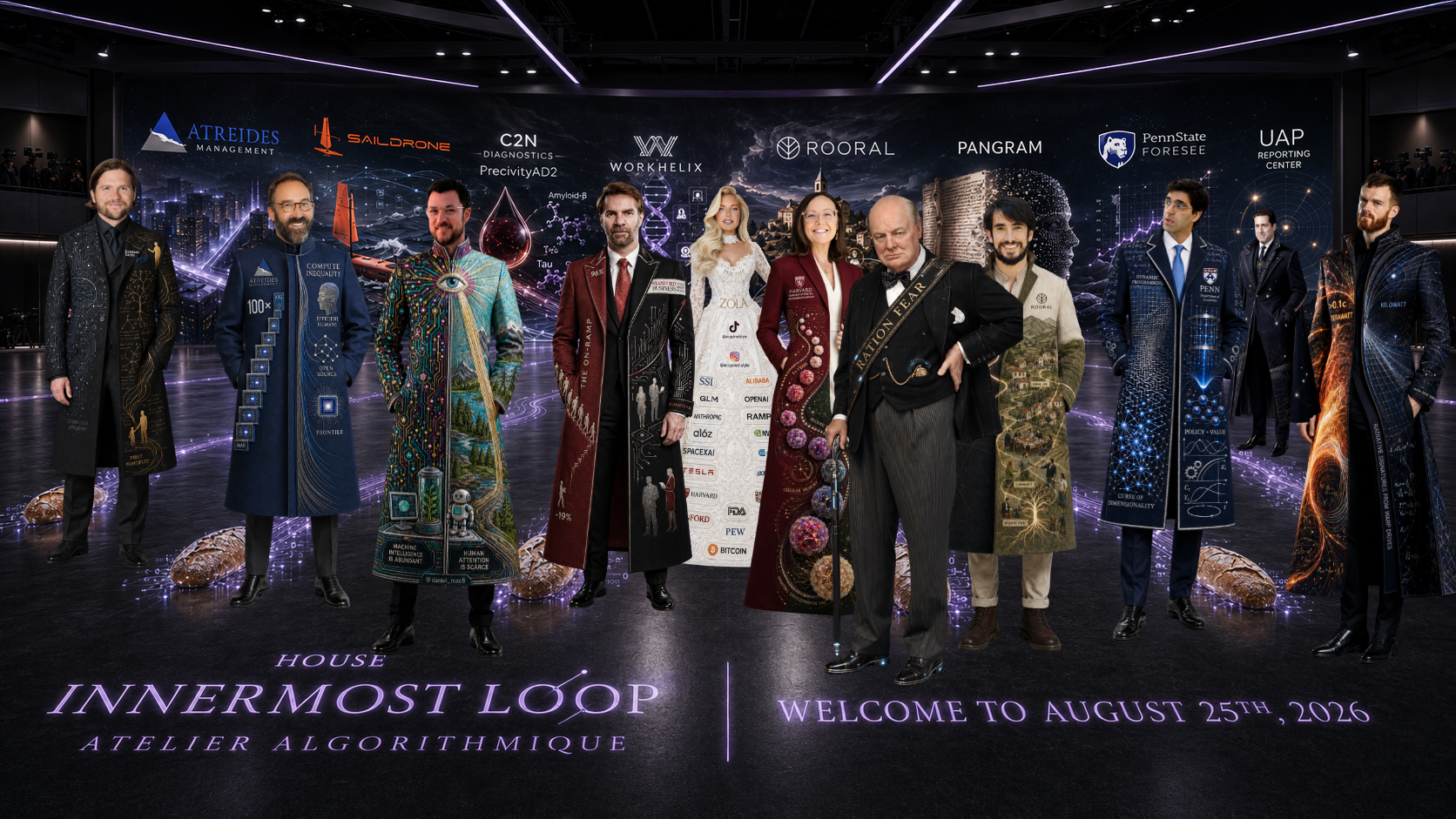
Created by @siouid142 from Dr. Alex Wissner-Gross’s Welcome to August 25, 2026 dispatch, this House Innermost Loop runway turns the edition’s closing sentence—“The only thing we have to ration is fear itself”—into a procession about scarcity, inertia and human agency. The spoken title names ten walkers, while the image visibly adds Chris Churchman at the far left, producing an eleven-person cast. That distinction is preserved rather than silently rewriting the established title.
The source moved from frontier-model pricing to physical bottlenecks. Gavin Baker expected closed frontier models to capture a minority of token volume but most of the value, while his fund’s AI spending had grown one hundredfold since March and continued doubling. His blue Atreides coat carries “100x,” compute inequality, efficient humans, open source and frontier. It makes unequal access to intelligence look like a vertical ladder built into formal wear.
Beside him, Dan McAteer wears a vividly patterned coat split between “machine intelligence is abundant” and “human attention is scarce.” A large eye dominates the chest, while small figures and ecological scenes gather near the hem. His garment identifies attention as the resource that cannot be scaled merely by producing more tokens. In a field obsessed with compute, the human capacity to notice, judge and care becomes the true ration.
Erik Brynjolfsson’s dark red coat carries “The On-Ramp,” Stanford and an employment graph. The dispatch reported his view that economy-wide job destruction was not evident and senior talent remained in demand. The coat frames labor transition as access to a moving system rather than a simple before-and-after replacement. Who reaches the on-ramp, who receives apprenticeship and who is stranded by inertia become design questions.
Brigette Pheloung McHale appears in a white wedding gown covered with Zola, social-platform and institutional marks, answering the report that brides with modest followings could monetize their weddings through sponsorship. Paola Arlotta follows in burgundy cloth patterned with organoids and developmental forms. Her garment refers to Harvard brain organoids kept alive for five years and found to age on a biological clock. Celebration and cellular time stand beside each other as two economies of duration.
Winston Churchill anchors the center in black formal wear and a diagonal “Ration Fear” sash. He is a wartime-rhetoric archetype, not a participant in the 2026 dispatch. Loaves of bread lie across the reflective floor, converting the phrase’s abstraction into a visual ration. The work borrows Churchill’s silhouette while Wissner-Gross’s sentence rewrites Roosevelt, creating a composite historical memory of fear, austerity and public resolve.
To Churchill’s right, Juan Barbed Isusi wears a rural landscape marked Rooral, community and the speed of trust, tied to the report of remote workers reviving a small Andalusian village. Jesús Fernández-Villaverde wears blue mathematical tailoring associated with Penn, dynamic programming and population curves, answering a model in which fertility declines across most countries and global population peaks around 2056. One coat treats mobility as community renewal; the other treats demography as a long optimization problem.
John S. Herrington stands in the rear under the UAP Reporting Center, carrying the disputed declaration that aliens are real and have been seen. Shaun Fell closes the foreground in a dark coat streaked with orange and blue radiation fields labeled by terawatt and kilowatt signatures. His imagery comes from warp-bubble simulations: fast atmospheric passage would produce an enormous fireball, while a tiny slower bubble could glow much more faintly. Disclosure and speculative physics remain distinct but adjacent.
At far left, Churchman’s black coat bears “cognitive atrophy” and “first principles,” answering the warning that outsourced reasoning can break apprenticeship. Behind the cast, the named institutions form an evidence wall spanning autonomous weapons, diagnostics, labor, AI authorship, sensing and anomalous aerospace.
Couture gives each claim a body and boundary. The runway’s final proposition is not that danger is unreal, but that undifferentiated fear is a poor allocation mechanism. Evidence must determine which risks receive attention before panic becomes the only thing society can produce without limit.
Opening the gallery…