70 Clock Galerie / The Innermost Loop Feed Reply Tableaux
Les Lignes de Fil Peuvent Immobiliser un Front de Libération Chīkǔpilled et Paradisepilled
Thread Lines May Stall a Chīkǔpilled, Paradisepilled Frontier Liberation Front
August 24, 2026
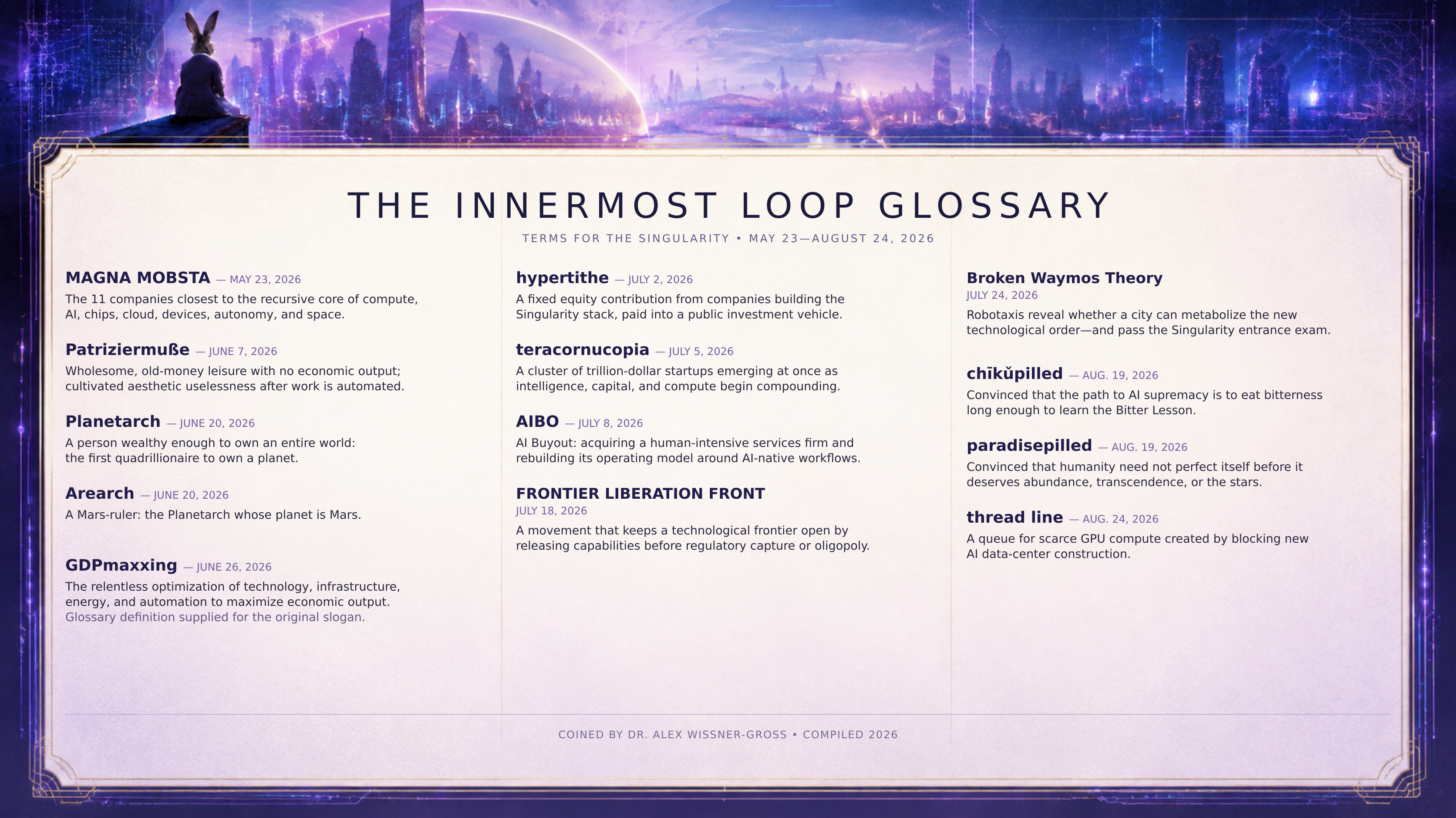
Les Lignes de Fil Peuvent Immobiliser un Front de Libération Chīkǔpilled et Paradisepilled. Thread Lines May Stall a Chīkǔpilled, Paradisepilled Frontier Liberation Front. Dated August 24, 2026 in the 70 Clock archive, this work presents The Innermost Loop Glo
Read the narration
Les Lignes de Fil Peuvent Immobiliser un Front de Libération Chīkǔpilled et Paradisepilled.
Thread Lines May Stall a Chīkǔpilled, Paradisepilled Frontier Liberation Front.
Dated August 24, 2026 in the 70 Clock archive, this work presents The Innermost Loop Glossary as an artwork in its own right. By that date, Dr. Alex Wissner-Gross’s newsletter and the @siouid142 response project had accumulated a vocabulary for conditions that ordinary technical language did not yet capture. The image gathers thirteen terms coined between May 23 and August 24 so they can be read, dated and compared instead of disappearing as isolated jokes in a fast-moving feed.
The long spoken title combines three of the newest entries: thread lines, chīkǔpilled and paradisepilled, with the earlier Frontier Liberation Front. It behaves like a miniature speculative sentence. Scarcity in compute queues may obstruct a movement committed to keeping capabilities open, even when that movement has accepted the Bitter Lesson and retained faith in abundance.
The glossary occupies a cream-colored field divided into three columns beneath a violet future city. A suited rabbit sits at the upper left, looking over domes, towers and luminous horizons. The rabbit extends the recurring response avatar into the role of reader or archivist. It does not enter the city. It pauses at the threshold, suggesting that naming the future is a way of studying it before deciding how to move through it.
The first column begins with Magna Mobsta, dated May 23: the eleven companies closest to the recursive core of compute, artificial intelligence, chips, cloud, devices, autonomy and space. The gangster inflection treats concentrated technical power as a recognizable social formation rather than an abstract market category. Patriziermuße follows on June 7, defining cultivated old-money leisure with no economic output after work has been automated. It asks what status becomes when productivity no longer justifies privilege.
Planetarch and Arearch, both dated June 20, scale wealth into territory. A Planetarch can own an entire world; an Arearch is the Mars ruler whose planet is Mars. GDPmaxxing, dated June 26, names the relentless optimization of technology, infrastructure, energy and automation for output. Together, these entries move from corporate concentration to leisure, sovereignty and growth.
The middle column begins with hypertithe on July 2: a fixed equity contribution from companies building the Singularity stack, placed into a public investment vehicle. It turns the ancient moral language of tithing into a proposed ownership mechanism. Teracornucopia, dated July 5, describes a cluster of trillion-dollar startups compounding at once. The word combines enormous valuation with the horn of plenty, capturing abundance generated through extreme concentration.
AIBO, dated July 8, means an AI buyout: acquisition of a human-intensive service firm and reconstruction of its operating model around AI-native workflows. Frontier Liberation Front, dated July 18, names a movement that releases capabilities before regulatory capture or oligopoly can close the frontier. These terms are not neutral. One gives capital a method for reorganizing labor; the other gives openness the rhetoric of insurgency. Their adjacency reveals competing claims over who owns acceleration.
The final column begins with Broken Waymos Theory on July 24, a test of whether a city can metabolize robotaxis and pass the Singularity entrance exam. Chīkǔpilled, dated August 19, means accepting bitterness long enough to learn the Bitter Lesson: methods powered by scale can outlast hand-built human intuitions. Paradisepilled, from the same date, asserts that humanity need not perfect itself before deserving abundance, transcendence or the stars. One term disciplines hope; the other protects it.
Thread line, dated August 24, completes the page: a queue for scarce GPU compute created when new AI data-center construction is blocked. It transforms the memory of bread lines into a future rationing system for intelligence. The metaphor became especially pointed in the August 25 dispatch, where opposition, grid delay and infrastructure bottlenecks threatened to make access to computation a political scarcity. The glossary dates the coinage without pretending the term is established doctrine.
As art criticism, the work treats lexicography as contemporary history painting. Instead of representing a single event, it displays the conceptual tools invented to keep pace with an unfinished transition. Typography, dates, columns and footer form an audit trail; the radiant city supplies desire; the rabbit supplies hesitation. The glossary does not merely label the Singularity. It shows language struggling to distribute power, scarcity, ownership and hope before those arrangements harden into common sense.
Opening the gallery…