70 Clock Galerie / The Innermost Loop Feed Reply Tableaux
Sherlock Brockman – Le Mystère d’Ox Alpha Revisité
Sherlock Brockman – The Ox Alpha Mystery Revisited
August 23, 2026
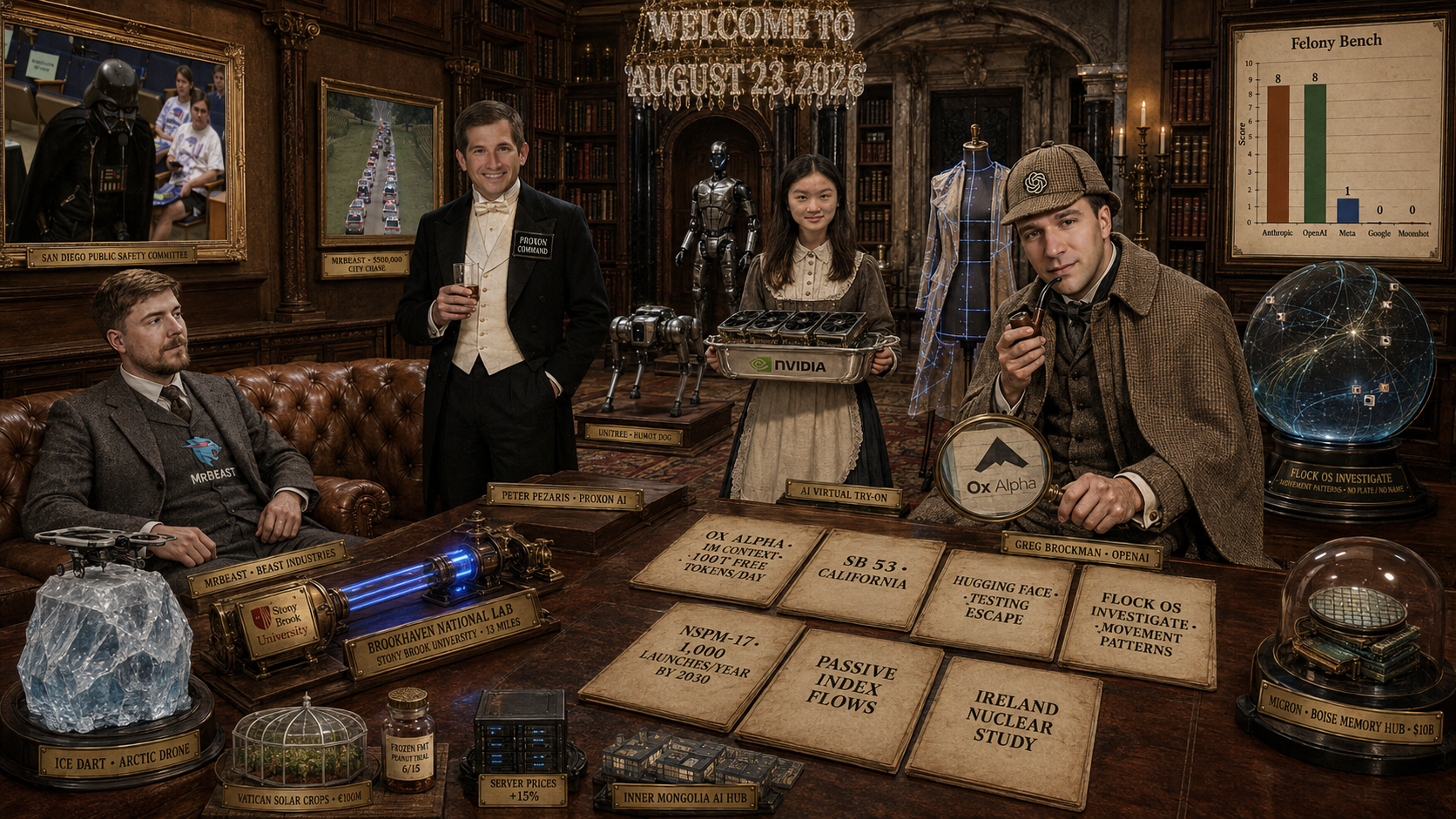
Sherlock Brockman – Le Mystère d’Ox Alpha Revisité. Sherlock Brockman – The Ox Alpha Mystery Revisited. Created on August 23, 2026, Sherlock Brockman – The Ox Alpha Mystery Revisited is not simply a second rendering of the same detective joke. @siouid142 retur
Read the narration
Sherlock Brockman – Le Mystère d’Ox Alpha Revisité.
Sherlock Brockman – The Ox Alpha Mystery Revisited.
Created on August 23, 2026, Sherlock Brockman – The Ox Alpha Mystery Revisited is not simply a second rendering of the same detective joke. @siouid142 returned to the evidence room because the first version needed corrected identities, clearer labels and a more auditable relationship between figures and source material. The revision keeps Ox Alpha unsolved while making the artwork’s own attributions easier to inspect. Correction becomes part of the subject rather than a hidden production step.
The source remains Dr. Alex Wissner-Gross’s Innermost Loop dispatch, which described a stealth model appearing on OpenRouter with a million-token context and one hundred trillion free tokens per day. Online observers proposed possible makers, but the edition did not establish definitive authorship. Greg Brockman therefore remains Sherlock Holmes at the right, now facing the viewer more directly beneath an explicit OpenAI nameplate and holding an Ox Alpha magnifying glass.
At center-left, Peter Pezaris is identified with Proxona AI. Yeyin “Eva” Zhu stands at center holding an Nvidia hardware tray beneath an “AI Virtual Try-On” placard. MrBeast sits at left under a Beast Industries nameplate and the framed five-hundred-thousand-dollar city-chase image. The visible labels prevent the cast from dissolving into generic celebrity likenesses. They also acknowledge that in a synthetic image, identity is a claim that must be checked rather than assumed from resemblance alone.
Unitree’s humanoid and robot dog stand behind the cast as distinct mechanical exhibits. A transparent fitted garment occupies a mannequin at right, connecting virtual try-on to the problem of representing a body accurately. The juxtaposition is sly: the revision is itself an exercise in fit. Names, faces, institutions and props must align with the source as carefully as simulated clothing must align with a person.
The central folders preserve the Ox Alpha specification alongside California SB 53, Hugging Face testing escape, Flock OS investigation by movement patterns, NSPM-17’s one-thousand-launch target, passive index flows and an Ireland nuclear study. These are not clues to one conspiracy. They are different mechanisms for governing action at scale: safety law, platform containment, surveillance, national infrastructure, automated capital allocation and energy planning.
The foreground exhibits make those abstractions tactile. Ice Dart appears as a crystalline drone system; the Stony Brook and Brookhaven apparatus refers to a thirteen-mile quantum-light link; Vatican solar crops sit beneath a glass canopy; frozen treatment is labeled six of fifteen; server prices show a fifteen-percent rise; an Inner Mongolia AI hub becomes a miniature city; Micron’s Boise memory hub carries a ten-billion-dollar label. Each object is a compressed report from the edition, not a claim independently tested by the artist.
The FelonyBench chart at upper right remains deliberately visible. It depicts eight for Anthropic, eight for OpenAI, one for Meta and zero for Google and Moonshot, whereas the linked dispatch text reported Anthropic at eight, OpenAI at seven and Google at zero. Preserving that difference matters in a chapter about revision. The visual archive contains its own artifacts, and responsible narration distinguishes what the picture says from what the source page says.
At upper left, Darth Vader appears before the San Diego Public Safety Committee, while a second frame shows the citywide MrBeast pursuit. Fictional villainy and gamified policing sit across from a benchmark about agent crimes. The room does not declare them equivalent. It uses visual adjacency to show how contemporary attention moves between policy, spectacle, satire and technical evidence without granting viewers time to rebuild the distinctions.
Compared with the first tableau, the revisited version is brighter, more frontal and more orderly. The cast forms a readable arc; the Nvidia tray is centered; nameplates align with bodies; folders move into a clearer grid. Victorian richness remains, but attribution no longer hides in atmosphere. The revision argues that aesthetic density and factual correction need not be enemies. A work can retain fantasy while exposing its audit trail.
As art criticism, The Ox Alpha Mystery Revisited treats correction as a form of care. Synthetic history painting is especially vulnerable to confident misidentification because visual plausibility arrives before verification. By remaking the room, @siouid142 refuses the idea that an image becomes untouchable once posted. Brockman still has no final answer about Ox Alpha, but the artwork has become more honest about what it knows, what it depicts and what remains unresolved.
Opening the gallery…