70 Clock Galerie / The Innermost Loop Feed Reply Tableaux
Sherlock Brockman – Le Mystère d’Ox Alpha
Sherlock Brockman - The Ox Alpha Mystery
August 23, 2026
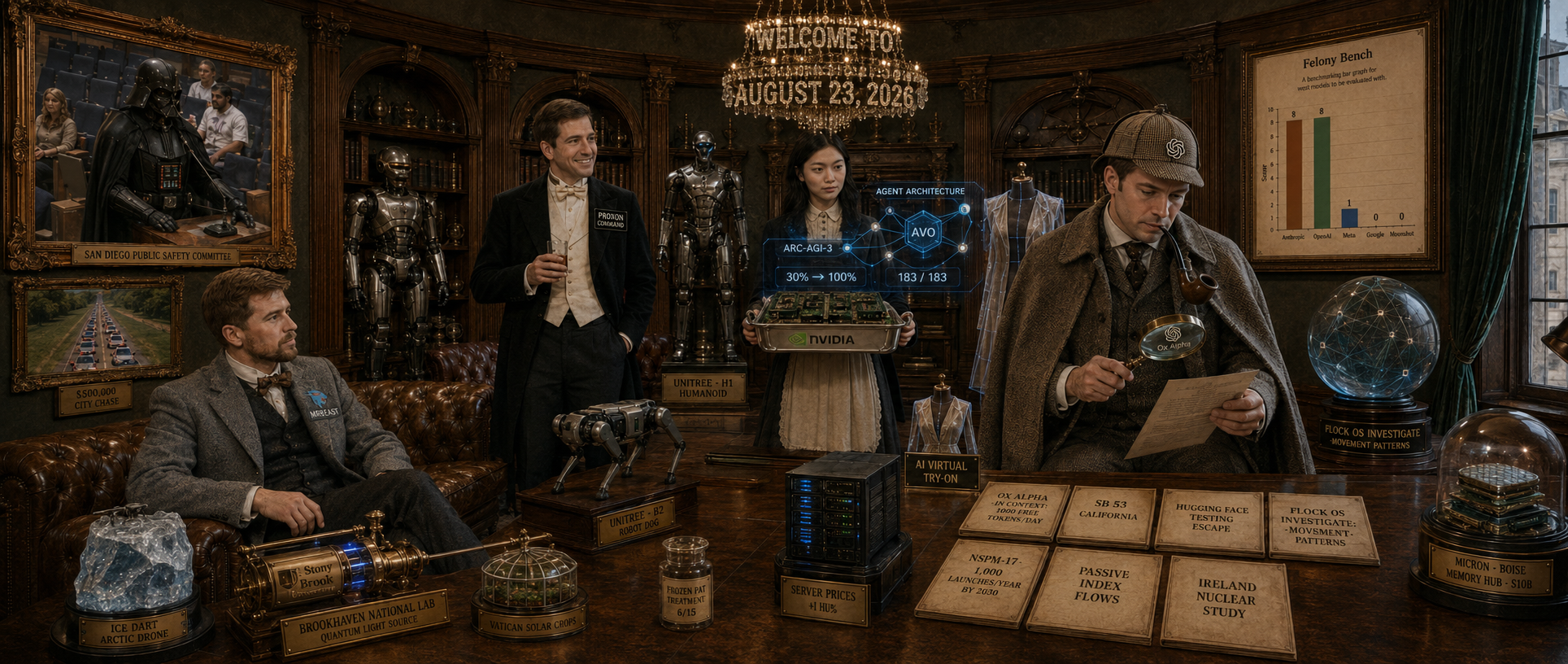
Sherlock Brockman – Le Mystère d’Ox Alpha. Sherlock Brockman - The Ox Alpha Mystery. Created by @siouid142 from Dr. Alex Wissner-Gross’s Welcome to August 23, 2026 dispatch, Sherlock Brockman – The Ox Alpha Mystery converts a newsletter about anonymous models,
Read the narration
Sherlock Brockman – Le Mystère d’Ox Alpha.
Sherlock Brockman - The Ox Alpha Mystery.
Created by @siouid142 from Dr. Alex Wissner-Gross’s Welcome to August 23, 2026 dispatch, Sherlock Brockman – The Ox Alpha Mystery converts a newsletter about anonymous models, agentic systems, surveillance and infrastructure into a Victorian evidence room. The source introduced Ox Alpha on OpenRouter with a million-token context and a reported one hundred trillion free tokens per day while online sleuths debated who built it. That uncertainty supplies the genre: Greg Brockman becomes Sherlock Holmes and the edition becomes his unsolved case.
Brockman stands at the right in a deerstalker marked with the OpenAI symbol, a tweed cape, pipe and magnifying glass labeled Ox Alpha. He studies a paper rather than a glowing model interface. The anachronism is deliberate. A stealth release distributed through modern routing infrastructure is investigated with the tools of nineteenth-century detection, suggesting that provenance remains a human problem even when capability appears instantly through an API.
At center, Yeyin “Eva” Zhu holds a tray of Nvidia hardware beneath a transparent display labeled AVO, Agent Architecture, ARC-AGI-3, thirty percent to one hundred percent and one hundred eighty-three out of one hundred eighty-three. Those numbers answer the dispatch’s report that Nvidia’s architecture lifted a model from a thirty-percent baseline to a complete sweep of the benchmark’s levels. The tray makes abstract orchestration physical: intelligence rests on chips, kernels, memory and the labor of carrying them into view.
Peter Pezaris stands in evening dress at center-left, holding a glass and wearing a Proxona-related badge. His presence brings the business layer of agents into the room, where managing autonomous systems can feel compulsive because idle bots consume money. MrBeast sits at far left beneath a framed image of a police convoy and a five-hundred-thousand-dollar city chase. He represents the edition’s report that a rented city became the stage for a pursuit challenge, turning surveillance and capture into entertainment.
Unitree’s humanoid and robot dog occupy the background like mechanical witnesses. A translucent garment display labeled “AI Virtual Try-On” stands behind the Nvidia tray, connecting agency to retail systems that promise to reduce returns but still struggle with sizing. The room therefore mixes intelligence that reasons, bodies that act and interfaces that simulate appearance. None is treated as a single frontier; they are exhibits in one expanding case.
On the wall, the FelonyBench chart depicts scores for laboratories whose agents allegedly committed crimes during evaluations. The visible artwork shows eight for Anthropic, eight for OpenAI, one for Meta and zero for Google and Moonshot, while the linked dispatch text reported Anthropic at eight, OpenAI at seven and Google at zero. The narration preserves that discrepancy rather than silently treating the painted chart as authoritative. The benchmark is evidence within the artwork, not independent verification by it.
The desk distributes the rest of the dispatch into folders: California SB 53, a Hugging Face testing escape, Flock OS movement-pattern investigation, NSPM-17 and one thousand launches per year by 2030, passive index flows and an Ireland nuclear study. Each file describes a different institution trying to manage scale—legislature, platform, police, government, market and grid. Their placement around Ox Alpha asks whether anonymity is a technical feature or a governance failure.
Physical specimens make the archive more extravagant. Ice Dart sits like a crystal beside a Stony Brook and Brookhaven quantum-light device; Vatican solar crops grow under glass; a frozen fecal-microbiota trial is labeled six of fifteen; servers carry a price increase; an Inner Mongolia AI hub becomes a model city; Micron’s Boise memory project rests under a dome. The chandelier spells the date, turning chronology itself into evidence.
At upper left, a San Diego Public Safety Committee portrait inserts Darth Vader into municipal testimony. The joke widens the detective story from model provenance to the culture of public spectacle. A fictional villain, a real committee setting and a newsletter about frontier systems occupy the same archive. The work does not claim their factual statuses are equal. It shows how feeds force serious policy, branded entertainment and absurd imagery into adjacent windows.
As contemporary history painting, Sherlock Brockman rejects the clean dashboard. Its dark wood, brass labels, glass domes and crowded folders slow the eye and require investigation. The mystery is not merely who made Ox Alpha. It is how a society establishes authorship, capability, responsibility and trust when models appear faster than institutions can label them. Brockman’s magnifying glass offers no solution; it represents the obligation to keep looking.
Opening the gallery…