70 Clock Galerie / The Innermost Loop Feed Reply Tableaux
Accélérationnistes Anonymes
Accelerationists Anonymous
August 21, 2026
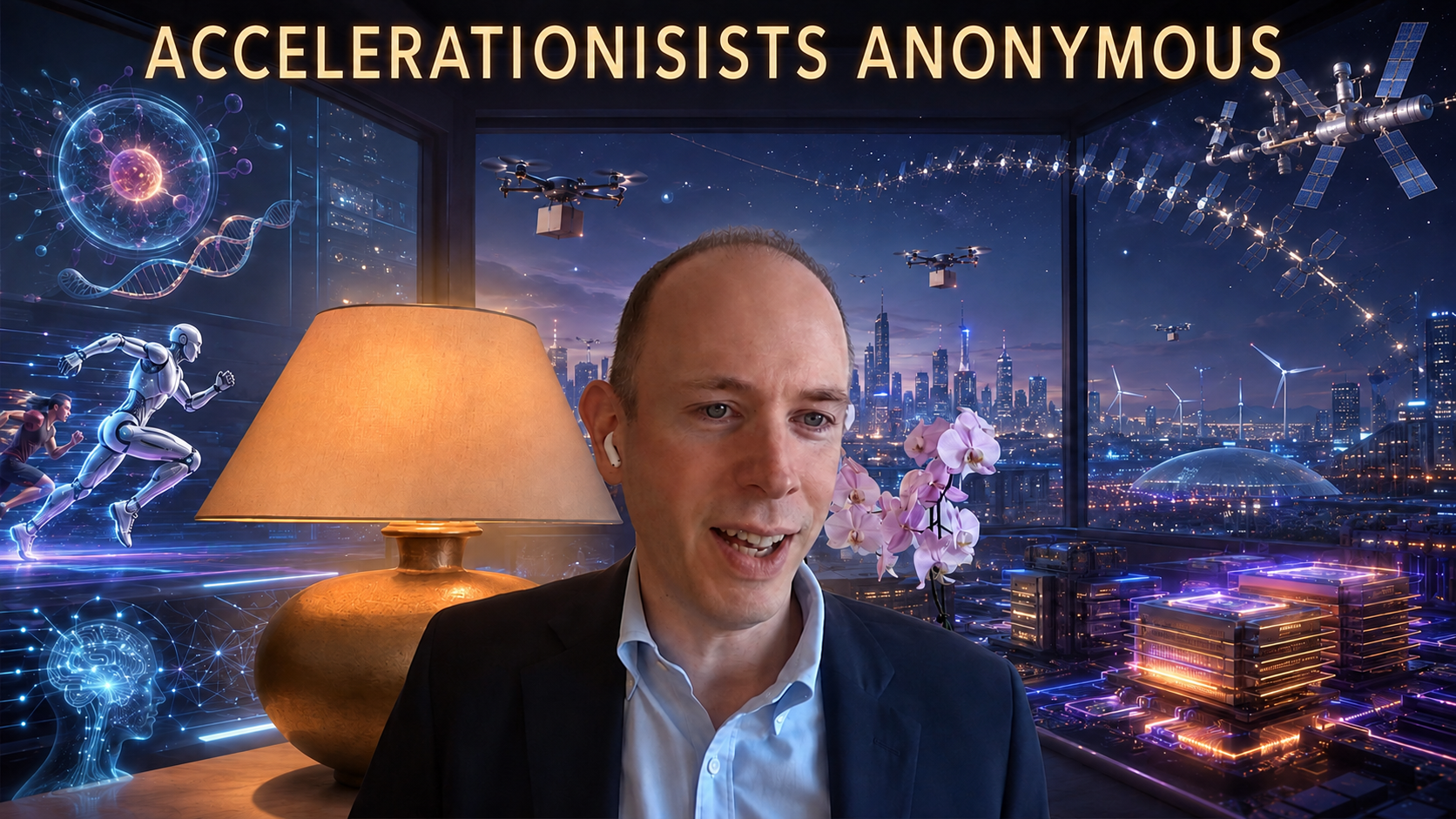
Accélérationnistes Anonymes. Accelerationists Anonymous. Created from Moonshots episode two hundred eighty-two and dated August 21, 2026 in the 70 Clock archive, Accelerationists Anonymous isolates Dr. Alex Wissner-Gross from the five-person composite and tran
Read the narration
Accélérationnistes Anonymes.
Accelerationists Anonymous.
Created from Moonshots episode two hundred eighty-two and dated August 21, 2026 in the 70 Clock archive, Accelerationists Anonymous isolates Dr. Alex Wissner-Gross from the five-person composite and transforms the room behind him. His face, dark jacket, pale shirt, white earbud, warm table lamp and purple orchid remain anchored to the source call. Around those familiar cues, @siouid142 constructs a blue-violet panorama in which technological acceleration has become an entire inhabited landscape.
The title is an invented paradox, not the name of a real organization. It borrows the structure of a recovery fellowship for a panel whose recurring subject is rapid change. Anonymous groups usually begin by admitting that a force has exceeded individual control. Here the surrounding world offers no abstinence: every runner, network, road and orbital line continues forward. The humor identifies acceleration as both the panel’s object of analysis and the condition that keeps producing another episode.
At the far left, a human runner and a silver humanoid robot race along luminous tracks. Their pairing translates the episode’s Unitree-versus-Usain-Bolt headline into an emblem of changing benchmarks. The robot is not shown replacing a particular athlete or winning a documented heat. Instead, the background turns physical comparison into a permanent motif: once machines share the human body plan, each improvement invites measurement against speed, balance, dexterity and endurance that once defined biological limits.
Above the runners float a glowing brain, molecular forms and a double helix. They bind machine learning to wetware and biology without collapsing them into one substance. The brain is rendered as a network, DNA as code-like structure and matter as luminous nodes. This is the visual grammar of the Singularity, where different sciences are made to appear interoperable.
Across the central window, delivery drones travel over a dense city whose towers, roads and domes shine like active circuitry. The machines refer to autonomy leaving laboratories and entering logistics, surveillance and urban service. Yet the August 21 Innermost Loop dispatch had also described a Prime Air parcel landing in a swimming pool. The background’s smooth flight paths therefore carry an unseen last-meter problem: networks can look coherent at city scale while failing at one address.
The lower right is occupied by stacked, server-like structures glowing from within. Wind turbines line the horizon, while satellites and a large orbital station multiply across the sky. Compute, energy and launch are presented as one continuous civic system. The image does not claim these facilities already form a unified network. It visualizes dependency: models require chips and memory; chips require energy and cooling; distributed services require communications; orbital ambition requires industrial repetition on Earth.
The table lamp is the composition’s most important old object. Its amber shade interrupts the synthetic blues and partially blocks the running figures. The orchid does something similar, placing fragile, cultivated life between the speaker and the technological city. These preserved items prevent the work from becoming generic futurism. They mark the actual conditions of the conversation and insist that the accelerated world is still interpreted through rooms, bodies, taste, care and domestic time.
Wissner-Gross occupies the lower center rather than the heroic horizon. He is neither master of the city nor a tiny victim beneath it. The pose resembles a public intellectual speaking through a webcam while the concepts under discussion materialize around him. This placement gives the portrait an ambiguity essential to the series: the commentator is inside the transition he chronicles, yet the visualization exceeds anything one speaker can supervise.
The custom background also appears as a panel within the Moonshots composite. That recursion makes the work function like a model inside a model. A conversation generates an image; the image re-enters the group call; the group image then becomes another archival chapter. Acceleration is therefore not only represented by robots and satellites. It is enacted by the rapid conversion of speech into pictures, pictures into posts and posts into a growing exhibition.
As art criticism, Accelerationists Anonymous tests whether abundance imagery can remain analytical. Its city is bright rather than ruined, and its systems suggest possibility rather than inevitable catastrophe. But the fellowship joke prevents uncomplicated triumph. If acceleration is the shared condition, the unresolved question is who can pause, redirect or refuse it. The lamp and orchid answer modestly: any technological future worth inhabiting must remain accountable to the scales of attention and life it threatens to outpace.
Opening the gallery…