70 Clock Galerie / The Innermost Loop Feed Reply Tableaux
Le PDG de The Boer A Hole Company Défile – Maison de la Boucle la Plus Profonde
The Boer A Hole Company C.E.O. Walks – House Innermost Loop
August 21, 2026
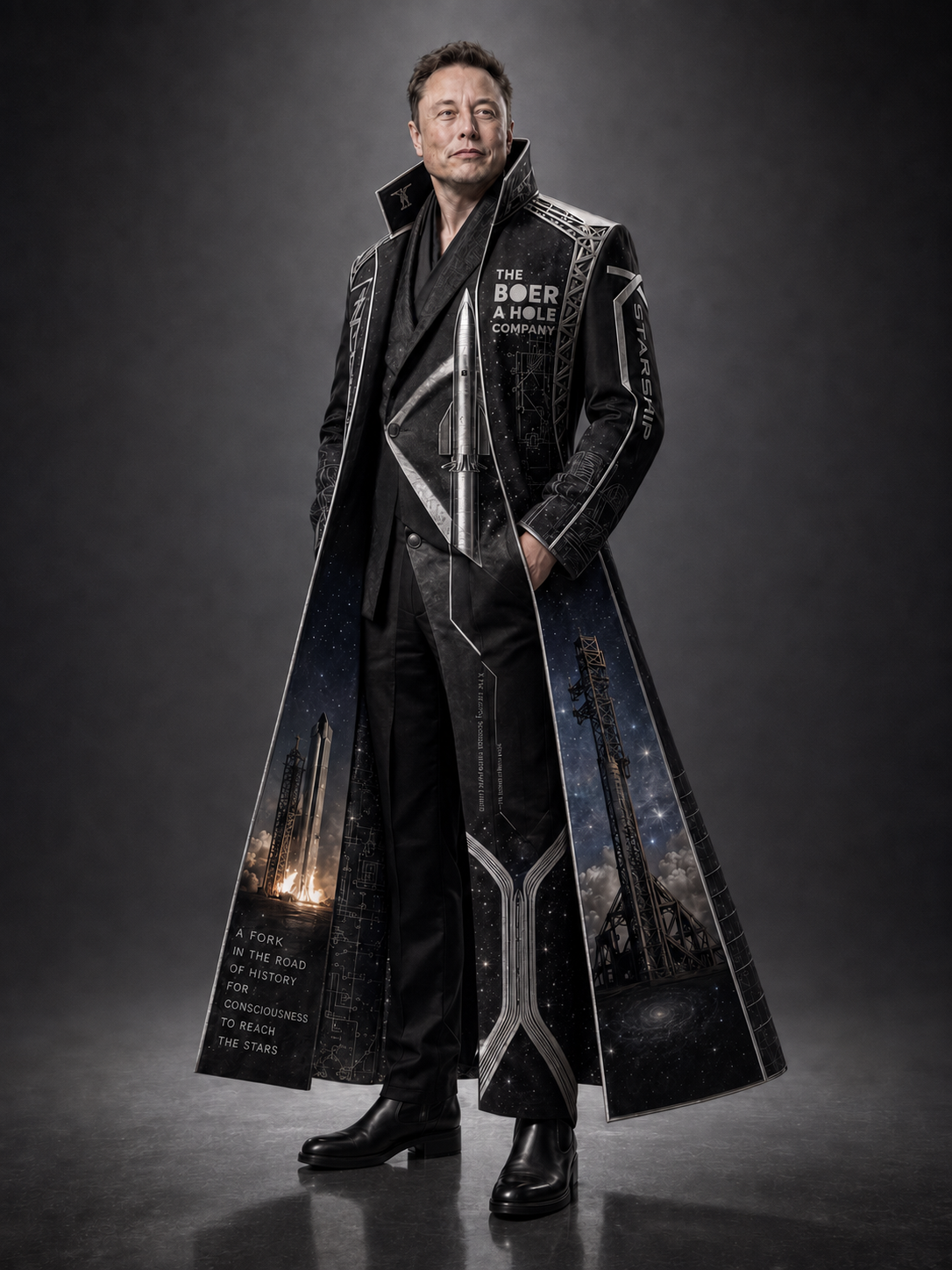
Le PDG de The Boer A Hole Company Défile – Maison de la Boucle la Plus Profonde. The Boer A Hole Company C.E.O. Walks – House Innermost Loop. Created by @siouid142 from Dr. Alex Wissner-Gross’s Welcome to August 21, 2026 dispatch, this individual portrait isol
Read the narration
Le PDG de The Boer A Hole Company Défile – Maison de la Boucle la Plus Profonde.
The Boer A Hole Company C.E.O. Walks – House Innermost Loop.
Created by @siouid142 from Dr. Alex Wissner-Gross’s Welcome to August 21, 2026 dispatch, this individual portrait isolates the final airborne figure from the Fork in the Pool runway. The source ended with Elon Musk calling Starship’s coming reflight, including a tower catch, “a fork in the road of history for consciousness reaching the stars.” The artwork takes that sentence literally, then subjects its grandeur to satire by casting a Musk likeness as the chief executive of the invented Boer A Hole Company.
The name is a deliberate comic mutation of the Boring Company and a reminder that the portrayed office does not exist. The image is not documentation of Musk wearing this garment, of a real company bearing this title, or of a completed mission. Its factual anchor is narrower: the August 21 dispatch reported the reflight claim and its civilizational framing. By making the parody conspicuous, the work separates source from invention while keeping the target of the joke legible.
The figure stands full length against a neutral charcoal field in a black coat whose shoulders resemble launch gantries. “The Boer A Hole Company” fills the chest, and “Starship” runs vertically down one sleeve. The face and pose borrow the confidence of an executive portrait, but the garment refuses ordinary corporate sobriety. It converts a business leader into an infrastructure diagram, as if identity, company, vehicle and historical claim had been consolidated into one investable silhouette.
At the center of the coat, a silver Starship rises through a massive metal fork. The fork is not merely placed beside the rocket; its tines and handle cross the vehicle’s trajectory. Choice therefore becomes part of propulsion. The image visualizes a branch point that cannot be separated from the machine expected to carry civilization through it. A launch is an engineering event, yet the quotation assigns it consequences for consciousness itself. The absurd utensil exposes the distance between those scales.
The lower panels turn rhetoric into material systems. One hem shows a vehicle lifting beside its tower; the other shows launch infrastructure beneath a star-filled sky. Between the legs, a white road divides cleanly into two routes. These are not decorative space motifs. They identify the layers required before a philosophical “road” exists at all: steel, concrete, fuel, testing, range operations, recovery, regulation and repeated flight. The future is pictured as a fork only after enormous capital has built the roadbed.
Along the left train appears the line about a fork in history for consciousness to reach the stars. Printed on fabric, the sentence resembles both mission statement and luxury branding. That ambiguity matters. Civilizational language can enlarge public imagination, but it can also turn one company’s program into the apparent proxy for humanity’s destiny. The coat asks who gets to define the branch, who bears its failures and whether the alternatives remain visible once one route acquires towers, contracts and spectacle.
This portrait also changes the meaning of the larger August 21 tableau. In Fork in the Pool, the same figure hangs from an Amazon delivery drone above water while a dinner fork stands upright at the pool’s edge. There, Starship’s cosmic fork is forced into contact with a package dropped into the wrong place. The juxtaposition connects the last meter with the last frontier. Grand autonomy is still judged by whether a system understands context at the point of delivery.
The black-and-silver palette lends the work the severity of aerospace photography, while the invented company name keeps puncturing that authority. The coat is at once monument, diagram and roast. It admires the real difficulty of reusable launch systems without accepting that technological capability automatically settles a civilizational choice. Reaching orbit, catching a tower and extending consciousness are related ambitions, not interchangeable achievements.
As art criticism, The Boer A Hole Company C.E.O. Walks uses couture to examine how entrepreneurial charisma absorbs infrastructure and history. The wearer appears to own the rocket, the road, the night sky and even the metaphor that interprets them. Yet every seam reveals dependence on systems larger than one person. The final fork is ethical rather than mechanical: whether a society can pursue the stars while keeping agency, evidence and alternative futures visible on the ground.
Opening the gallery…