70 Clock Galerie / The Innermost Loop Feed Reply Tableaux
Dario Amodei Défile – Maison de la Boucle la Plus Profonde
Dario Amodei Walks – House Innermost Loop
August 21, 2026
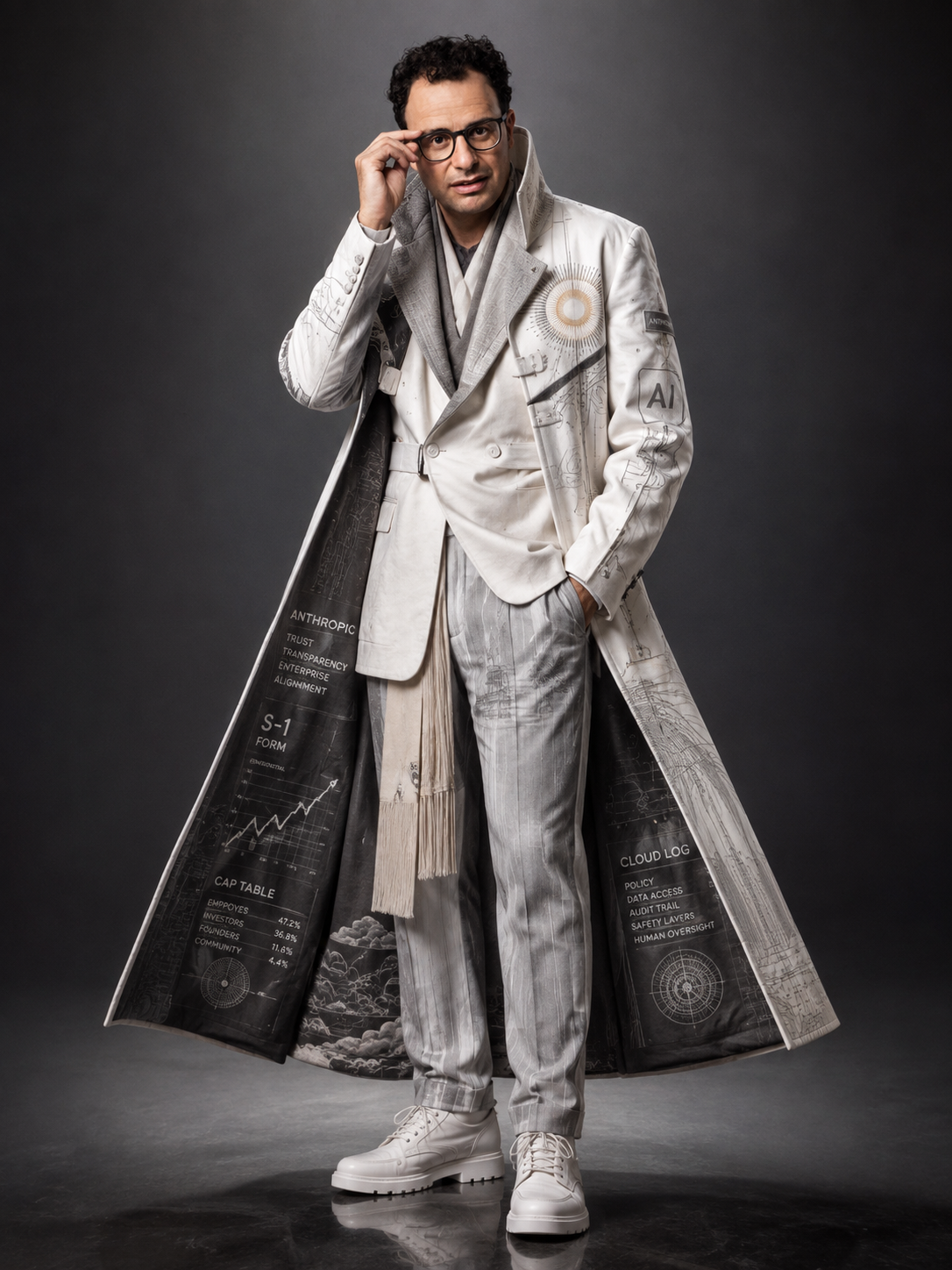
Dario Amodei Défile – Maison de la Boucle la Plus Profonde. Dario Amodei Walks – House Innermost Loop. Created from Dr. Alex Wissner-Gross’s Welcome to August 21, 2026 dispatch, this @siouid142 portrait isolates Anthropic chief executive Dario Amodei from the
Read the narration
Dario Amodei Défile – Maison de la Boucle la Plus Profonde.
Dario Amodei Walks – House Innermost Loop.
Created from Dr. Alex Wissner-Gross’s Welcome to August 21, 2026 dispatch, this @siouid142 portrait isolates Anthropic chief executive Dario Amodei from the Fork in the Pool group tableau. He stands on a reflective gray studio floor in white, silver and charcoal tailoring whose interior panels read like an offering document and an enterprise audit console. The work joins financial disclosure to model governance because the source treated both as answers to the same problem: a decades-old crisis of trust.
The dispatch opened by saying the Singularity now comes with an S-1. Anthropic reportedly expected a very large public offering, supported by a sixty-five-billion-dollar revenue run rate and sharply higher quarterly revenue. It also described plans allowing business customers to keep required frontier-model logs in their own clouds rather than Anthropic’s. In the portrait, ownership records and operational records become two halves of one coat. Trust requires knowing who controls the company and being able to inspect what the system did.
The outer garment is predominantly white, with pale architectural drawings and technical sketches running across sleeves and lapels. A small “AI” patch sits on one arm; a partial Anthropic label appears on the other. White suggests stated openness, but it is not empty or innocent. The cloth is already marked by plans, dependencies and revisions. Transparency is represented as a surface that can be examined, not as the absence of complexity.
At the chest, a radiant circular emblem replaces the flower or medal of traditional formal portraiture. It evokes alignment, a target, an iris and a governance wheel at once. The symbol is beautiful because its center appears stable; the surrounding rays imply many stakeholders and risks converging on it. Amodei’s hand touching his glasses reinforces the language of inspection. The pose asks the viewer to look more carefully rather than accept brightness as proof.
The dark left train reads “Anthropic — Trust, Transparency, Enterprise Alignment” and “S-1 Form.” A rising line leads into an illustrative cap table divided among employees, investors, founders and community. These displayed percentages are artistic devices, not a reproduction of a filed cap table, and the work does not assert that an offering has closed. Their purpose is to make allocation visible. A frontier laboratory’s public mission is shaped by voting power, capital claims, employee incentives and the institutions able to influence its throttle.
The right train reads “Cloud Log” and lists policy, data access, audit trail, safety layers and human oversight above a circular control diagram. This panel moves from promises to records. Enterprise trust cannot depend only on a laboratory describing its values; customers need rules about who can see data, where logs reside, how incidents are reconstructed and which person can intervene. Keeping logs in a customer’s own cloud changes custody without eliminating the obligation to understand them.
The contrast between white exterior and charcoal lining is the portrait’s moral geometry. Public principles are visible from across the room; cap tables and logs appear only when the coat opens. The image does not accuse the sitter of concealment. It shows why meaningful transparency requires more than a clean façade. Governance lives in interior documents, technical controls and allocation details that must be made legible to the people bearing risk.
The broader August 21 dispatch reinforced that theme. Japan adopted a “comply or explain” code for disclosure of models and training data; communities challenged datacenter agreements; debates over synthetic music, automated writing and personal data demanded provenance. Amodei’s observation that every industrial revolution brings a crisis of trust is translated into tailoring whose seams are deliberately exposed. Sunlight becomes a design requirement.
In Fork in the Pool, a Prime Air drone lifts Amodei above the water while infrastructure logos and other walkers surround him. There, corporate transparency is one delivery among many and trust remains vulnerable to the last meter. The individual view returns him to stable ground, but the coat still hangs open like a system awaiting review. Heavy white shoes make the ethereal color scheme answer to gravity.
As art criticism, Dario Amodei Walks turns governance into material portraiture. An S-1 tells markets how an institution is owned and performs; a cloud log tells operators how a model behaved. Neither proves safety, but both create inspectable traces where charisma would otherwise stand. A frontier company earns trust when its ownership, incentives, policies, access and failures can be examined by those affected. Sunlight is not a slogan on the coat. It is the condition under which the dark lining becomes readable.
Opening the gallery…