70 Clock Galerie / The Innermost Loop Feed Reply Tableaux
Wang Xingxing Défile – Maison de la Boucle la Plus Profonde
Wang Xingxing Walks – House Innermost Loop
August 21, 2026
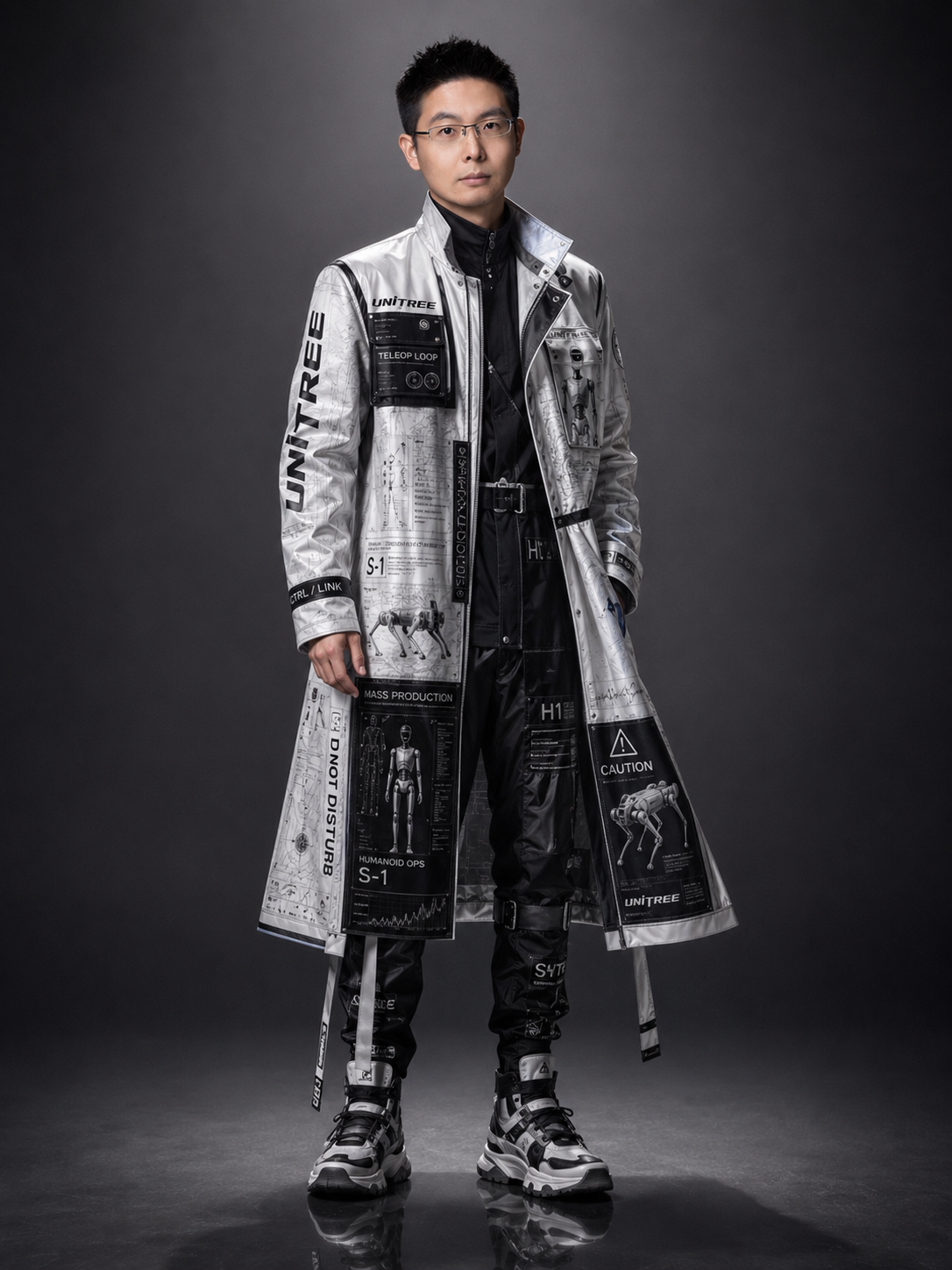
Wang Xingxing Défile – Maison de la Boucle la Plus Profonde. Wang Xingxing Walks – House Innermost Loop. Created from Dr. Alex Wissner-Gross’s Welcome to August 21, 2026 dispatch, this @siouid142 portrait isolates Unitree founder Wang Xingxing from the Fork in
Read the narration
Wang Xingxing Défile – Maison de la Boucle la Plus Profonde.
Wang Xingxing Walks – House Innermost Loop.
Created from Dr. Alex Wissner-Gross’s Welcome to August 21, 2026 dispatch, this @siouid142 portrait isolates Unitree founder Wang Xingxing from the Fork in the Pool drone runway. He stands against a gray studio field in silver-and-black technical clothing marked by robot diagrams, telemetry, control labels and production warnings. The garment resembles an operating manual opened around a human body, turning the business of embodied artificial intelligence into visible layers of instruction and risk.
The source described a circular robotics economy in China. State training centers purchase humanoids, collect human teleoperation experience and sell the resulting data back to manufacturers, helping support Unitree’s rapid rise and anticipated market debut. It also noted that Unitree’s quadrupeds descend with millimeter precision from DARPA-funded ideas that the United States published but did not mass-produce. The coat is built around that difference between invention, operation and industrial repetition.
Unitree’s name runs vertically down the sleeve and across the chest. Over Wang’s heart sits a dark module labeled “Teleop Loop,” with gauges and connection marks. Teleoperation is presented not as an embarrassment before autonomy but as a productive stage: humans demonstrate tasks, machines record movement and outcomes, datasets improve control policies, and new robots return to the field. The loop converts labor into training material while gradually changing the labor required.
Bands around the cuffs read “CTRL / LINK,” locating human command at the boundary between hand and machine. A teleoperator may not stand beside the robot, yet bodily intent still passes through controls, networks and latency. The coat’s black central layer suggests that this human interface remains embedded beneath the bright rhetoric of autonomy. “Uncrewed” or “humanoid” does not necessarily mean without workers; it can mean that work has moved into data collection, remote supervision, annotation, maintenance and exception handling.
On the left lower panel, a quadruped diagram appears above “Mass Production.” Beneath it, a humanoid figure is labeled “Humanoid Ops S-1.” The pairing distinguishes a striking demonstration from a product that can be built, serviced and deployed repeatedly. Production requires suppliers, quality control, batteries, actuators, safety procedures and customers willing to operate machines outside a staged video. Silver cloth evokes hardware; printed schematics expose the discipline needed to make spectacle repeatable.
The right panel carries a triangular “Caution” field and another robot-dog profile. Warning marks acknowledge that embodied systems share space with people, roads, factories and homes. A software error in a chat window can be corrected with text; a control error in a heavy moving body can damage property or injure someone. The garment therefore holds achievement and hazard on the same reflective surface.
A vertical strip reading “Do Not Disturb” introduces ambiguity. It may sound like a laboratory instruction, a protection for a training run or a demand that an operating agent be allowed to complete its sequence. In portraiture it also protects the founder’s controlled image. Yet straps, buckles, modular pockets and exposed labels prevent the system from appearing finished. The wearer looks prepared to enter a test floor rather than a ceremonial ballroom.
In the full runway, Wang hangs from a Prime Air drone above a pool, surrounded by robotaxis, physical-prompt models, chips and delivery networks. That image makes mobility an ecosystem: one autonomous machine carries the representative of another while the last meter remains uncertain. The individual portrait removes the comedy and asks the viewer to inspect the feedback loop that enables apparent autonomy.
The DARPA reference adds geopolitical irony. Public research can seed a design lineage without determining where manufacturing scale will accumulate. Knowledge crosses borders more easily than factories, supply chains and production learning. Wang’s coat wears both the published diagram and the commercial outcome, making Unitree a case study in how open technical inheritance becomes private industrial advantage.
As art criticism, Wang Xingxing Walks rejects the fantasy of a robot awakening alone. Every diagram is connected to a person, a control link, a factory or a warning. Autonomy appears as a layered achievement made from human demonstration, operational data, mechanical reliability and capital discipline. The reflective silver surface promises a machine future, but the black interface at its center keeps the human loop visible. The work’s final question is not simply whether robots can act, but who trains them, who owns the resulting experience and which society learns to manufacture that loop at scale.
Opening the gallery…