70 Clock Galerie / The Innermost Loop Feed Reply Tableaux
Zvezdelina Stankova Défile – Maison de la Boucle la Plus Profonde
Zvezdelina Stankova Walks – House Innermost Loop
August 21, 2026
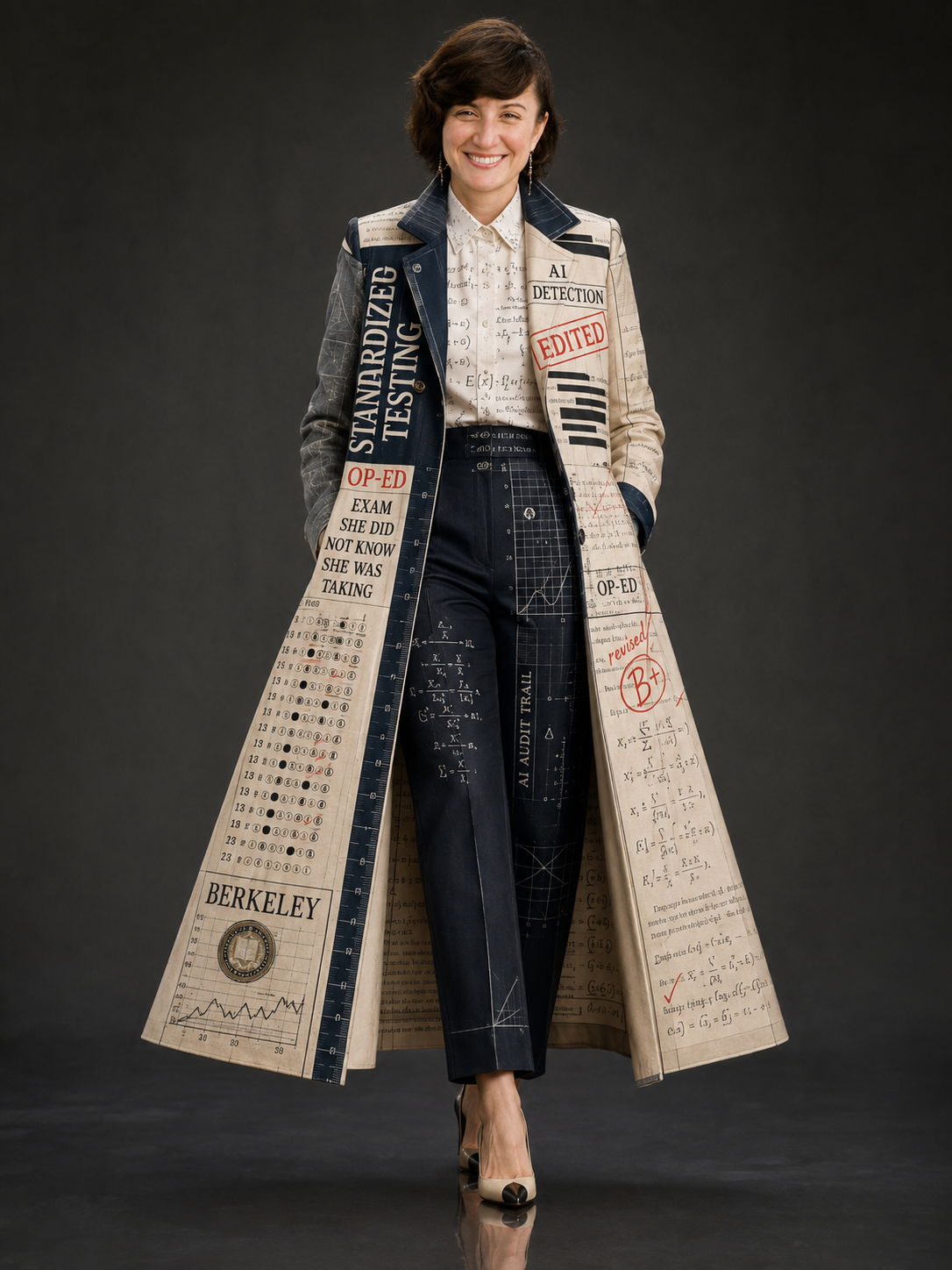
Zvezdelina Stankova Défile – Maison de la Boucle la Plus Profonde. Zvezdelina Stankova Walks – House Innermost Loop. Created in response to Dr. Alex Wissner-Gross’s Welcome to August 21, 2026 dispatch, this @siouid142 portrait turns a controversy about writing
Read the narration
Zvezdelina Stankova Défile – Maison de la Boucle la Plus Profonde.
Zvezdelina Stankova Walks – House Innermost Loop.
Created in response to Dr. Alex Wissner-Gross’s Welcome to August 21, 2026 dispatch, this @siouid142 portrait turns a controversy about writing, artificial intelligence and standardized assessment into a wearable examination. Berkeley mathematician Zvezdelina Stankova walks against a neutral gray field in a cream-and-navy coat covered with equations, answer bubbles, editorial marks and institutional labels. The image does not pronounce a verdict on authorship. It makes the procedure of judgment visible.
The dispatch reported that an artificial-intelligence detector had identified AI editing in an opinion essay advocating more standardized testing, calling it “an exam she did not know she was taking.” That phrase runs vertically down the left front panel beneath “Standardized Testing” and “Op-Ed.” Its placement transforms the garment into both argument and consequence. A writer who supported explicit tests becomes the subject of an implicit one, with neither rubric nor notice established in advance.
At the upper right, “AI Detection” sits above a red “Edited” stamp and thick black bars resembling redactions. The sequence looks official while withholding the evidence that would make it authoritative. Detectors estimate patterns; they do not observe the act of composition directly. False positives, human editing, quotations and stylistic variation can complicate results. The portrait therefore repeats what the dispatch reported without treating an automated score as conclusive proof of intent.
The cream fabric is densely printed with formulas and manuscript fragments. Mathematics, normally associated with demonstrable steps, shares a surface with a probabilistic judgment about language. That contrast is the intellectual center of the piece. A proof can expose its premises and derivation for inspection; an authorship detector may present a score whose training data, thresholds and error rates are difficult for the evaluated person to challenge.
The left train becomes a multiple-choice answer sheet bordered by a ruler. Rows of bubbles descend toward a Berkeley seal and a small graph. The right train resembles a returned paper, covered with red corrections, “Revised” and a circled B-plus. These signs do not reproduce an actual grade. They externalize the social machinery of evaluation: submission, rubric, marking, revision and institutional certification. The woman does not merely wear knowledge; she wears the record by which knowledge is judged.
Her navy trousers continue the equations but add a clear vertical “Audit Trail.” That phrase offers the work’s practical alternative to detection theater. If machine assistance matters, a reliable process might preserve drafts, prompts, revision history, citations and disclosure rather than infer origin from surface style alone. An audit trail records events; a detector interprets traces. The distinction becomes visible where the coat’s cream public document meets the darker operational layer beneath.
Stankova’s smile and composed stride resist the humiliating conventions of a caught-cheating image. She is not placed at a defendant’s table or hidden beneath a censor bar. The portrait grants dignity while surrounding her with the apparatus of scrutiny. That balance matters because the broader governance question extends beyond one essay: institutions are deciding how to recognize assistance without erasing human authorship or converting uncertain classifiers into unappealable judges.
In Fork in the Pool, she is suspended from an Amazon drone while holding the marked paper. There the hidden exam becomes one package among chips, tokens, robots and disclosure. Here the isolated body slows the satire. The viewer can read the marks and notice how completely assessment has colonized the fabric, from collar to hem.
The work also belongs to a long history of portraiture using books, instruments and academic robes to establish intellectual authority. @siouid142 reverses those conventions. The scholar’s robe is no longer a stable sign of expertise; it is a contested document covered by external annotations. Institutional identity appears at the hem rather than above judgment, suggesting that affiliation itself is now part of the evaluated record.
As art criticism, Zvezdelina Stankova Walks asks who controls the rubric when writing becomes collaborative with machines. Standardized testing promises comparable measurement, but undeclared AI detection can produce a test whose subject did not consent, whose questions are invisible and whose score may be probabilistic. The coat does not solve that problem. It makes every layer—essay, edit, detector, grade, revision and audit trail—occupy the same body, forcing the viewer to see that assessment is never merely technical. It is an allocation of trust, voice and due process.
Opening the gallery…