70 Clock Galerie / The Innermost Loop Feed Reply Tableaux
Patrick Collison Défile – Maison de la Boucle la Plus Profonde
Patrick Collison Walks – House Innermost Loop
August 21, 2026
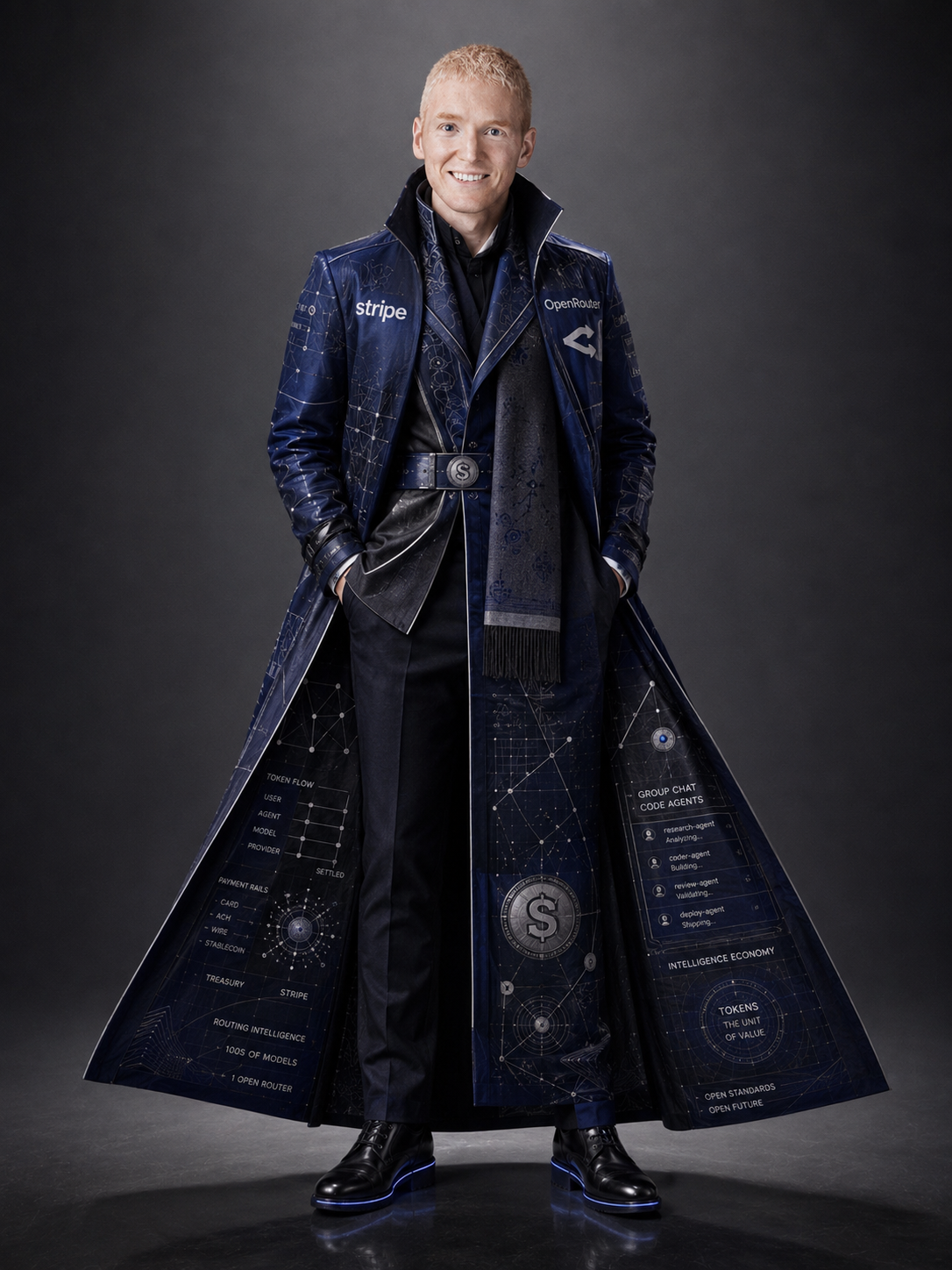
Patrick Collison Défile – Maison de la Boucle la Plus Profonde. Patrick Collison Walks – House Innermost Loop. Created from Dr. Alex Wissner-Gross’s Welcome to August 21, 2026 dispatch, this @siouid142 portrait isolates Stripe cofounder Patrick Collison from t
Read the narration
Patrick Collison Défile – Maison de la Boucle la Plus Profonde.
Patrick Collison Walks – House Innermost Loop.
Created from Dr. Alex Wissner-Gross’s Welcome to August 21, 2026 dispatch, this @siouid142 portrait isolates Stripe cofounder Patrick Collison from the Fork in the Pool group runway. Against a plain gray studio background, his dark-blue coat becomes a diagram of an emerging intelligence economy. Stripe occupies one lapel and OpenRouter the other. Between them, model selection, agent work and monetary settlement are treated as linked routes through a single garment.
The source reported Stripe’s purchase of OpenRouter for more than seven billion dollars, its largest acquisition, describing the ninety-person gateway as a system routing requests across more than four hundred models from more than eighty providers. Collison called tokens “the central currency for companies building with AI.” The coat takes that line seriously while preserving an essential distinction: a model token is a unit of computation and text processing, not legal tender. Payment rails price access to the system; they do not make the token itself a dollar.
At the top, the Stripe wordmark sits opposite OpenRouter’s branching symbol. Their placement turns the collar into a junction between settlement and selection. Fine white networks run across indigo leather like constellations or transaction graphs. Traditional textile ornament is replaced by routes, nodes and interfaces, suggesting that the new luxury material is not cloth alone but the ability to direct a request toward the right machine and account for what happens next.
The left inner panel labels a “Token Flow” moving from user to agent, model, provider and settled result. Beneath it, “Payment Rails” lists card, ACH, wire, stablecoin, treasury and Stripe. The sequence compresses a complex market into a legible stack. A person or company states an objective; an agent decomposes work; a router selects a model or provider; usage is measured; value is transferred; a record remains. Every step requires trust in both software behavior and financial reconciliation.
On the right, a framed “Group Chat Code Agents” panel names research, coding, reviewing and deployment roles. It echoes the dispatch’s report that Slack Code was giving Claude, Devin, Copilot, ChatGPT and Vercel agents channels in which to write, review and ship software, then archive the job. The group chat becomes an organization in miniature. Agents are no longer only tools called one at a time; they appear as named participants whose outputs and costs must be routed, observed and settled.
Dollar medallions appear at the waist and lower train, while a circular inscription calls tokens “the unit of value.” Their repetition intentionally tempts the viewer to collapse computation into money. The surrounding diagrams correct that temptation. Value emerges only after a provider supplies capacity, an agent performs useful work and a settlement layer records exchange. The coat therefore stages a negotiation between metaphor and infrastructure.
The long scarf introduces a quieter band of symbols down the center. It resembles both ceremonial cloth and a concealed protocol layer. Collison’s ordinary black shirt and trousers sit beneath all of it, placing a recognizable entrepreneur inside systems that increasingly automate commercial action. His relaxed smile contrasts with the coat’s dense machinery, presenting routing as easy at the interface even when the backend coordinates many firms, models and liabilities.
In the group tableau, Collison is carried over water by an Amazon Prime Air drone. That absurd suspension connects digital routing to physical delivery: both promise to move a request efficiently through networks, and both encounter a difficult final meter. The isolated portrait removes the joke but retains the same problem. An intelligence market is only as dependable as its handoffs, fallback providers, logs, dispute processes and ability to finish a task in the world.
The image also revises the old portrait of a banker. Ledgers, coins and maps remain, but they have become API routes, agent graphs and token counts. Collison is not shown minting intelligence. He is depicted building a tollbooth and settlement layer around access to many competing producers. OpenRouter’s multi-model structure visually resists a single sovereign model even as Stripe’s presence centralizes payment.
As art criticism, Patrick Collison Walks makes an invisible acquisition wearable. The coat turns corporate strategy into a navigable surface and asks what happens when model choice, delegated labor and payment become one automated flow. Its beauty comes from coherence; its tension comes from concentration. If tokens are the intelligence economy’s central currency, the decisive power may belong not only to the models that generate them, but to the routes that decide where every request, dollar and record will go.
Opening the gallery…