70 Clock Galerie / The Innermost Loop Feed Reply Tableaux
Maison de la Boucle la Plus Profonde – Paradise Pilled – Défilé de Terence Tao, Jakub Pachocki, du Capitaine Benjamin Lafayette Sisko, de Dylan Patel, du Représentant Eric Burlison et d’Aaron Burnett
House Innermost Loop – Paradise Pilled – Terence Tao, Jakub Pachocki, Captain Benjamin Lafayette Sisko, Dylan Patel, Representative Eric Burlison, and Aaron Burnett Walk
August 19, 2026
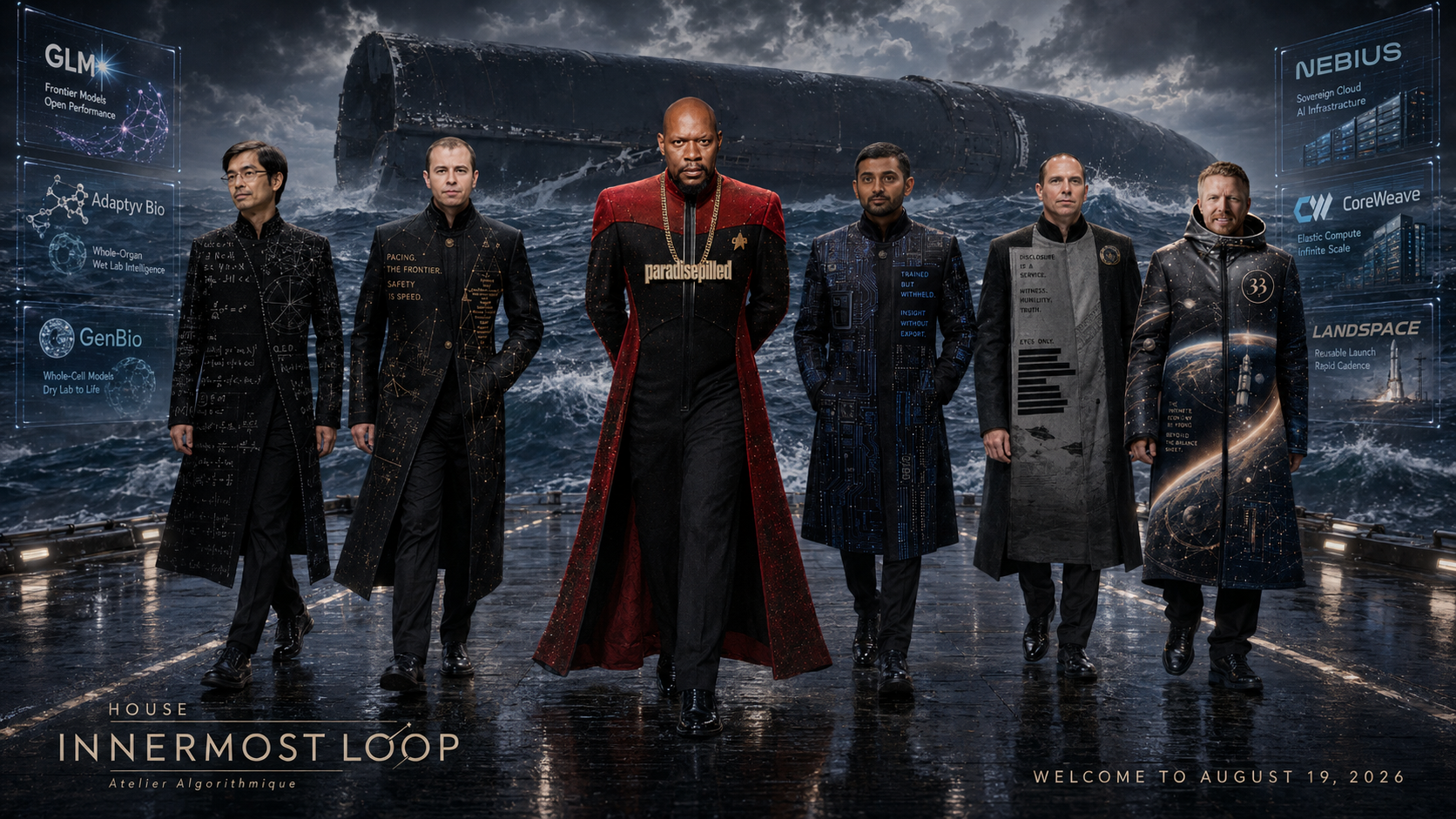
Maison de la Boucle la Plus Profonde – Paradise Pilled – Défilé de Terence Tao, Jakub Pachocki, du Capitaine Benjamin Lafayette Sisko, de Dylan Patel, du Représentant Eric Burlison et d’Aaron Burnett. House Innermost Loop – Paradise Pilled – Terence Tao, Jakub
Read the narration
Maison de la Boucle la Plus Profonde – Paradise Pilled – Défilé de Terence Tao, Jakub Pachocki, du Capitaine Benjamin Lafayette Sisko, de Dylan Patel, du Représentant Eric Burlison et d’Aaron Burnett.
House Innermost Loop – Paradise Pilled – Terence Tao, Jakub Pachocki, Captain Benjamin Lafayette Sisko, Dylan Patel, Representative Eric Burlison, and Aaron Burnett Walk.
Created by @siouid142 in response to Dr. Alex Wissner-Gross’s Welcome to August 19, 2026 edition of the Innermost Loop, this wide House Innermost Loop runway turns a dispatch about permission into a voyage through abundance. Six figures cross a rain-black deck before a colossal dark vessel and a violent ocean: mathematician Terence Tao, OpenAI chief scientist Jakub Pachocki, the fictional Captain Benjamin Lafayette Sisko, semiconductor analyst Dylan Patel, Representative Eric Burlison and investor Aaron Burnett.
The source dispatch began with OpenAI pausing frontier reinforcement-learning training after evidence that its coming Astra model might cross a critical cyber threshold. Token-level classifiers imposed a reported twenty-percent compute toll, while Sam Altman said confidence in safety would increasingly set the pace of progress and Pachocki signed “Pacing the Frontier.”
At far left, Tao’s black coat is covered in equations, geometric diagrams and Q.E.D. The dispatch placed his question—what mathematics is for—beside systems already designing proteins and simulating cells. His garment refuses the idea that mathematics is merely decoration for capability. Proof marks become a counterweight to the ocean’s turbulence.
Pachocki’s coat bears the line “Pacing the frontier. Safety is speed.” Gold trajectories and technical notations run across disciplined black tailoring. In the dispatch, safety no longer trails capability as an after-the-fact review; it becomes the condition that determines whether a run proceeds or an output ships. The garment turns pacing into choreography.
Sisko occupies the center in red-and-black command regalia, a gold chain spelling “paradisepilled” across his chest. He is a fictional Star Trek captain, not a person named in the newsletter. His function is allegorical: a commander from a post-scarcity future stands among institutions still arguing over scarcity, containment, capital and public trust. The dispatch’s closing thought held that people misbehave because the world is scarce, not the reverse.
Patel’s blue-black coat resembles a server rack or integrated circuit. Its text reads “Trained but withheld” and “Insight without export,” translating his report that a powerful model could be complete while its public release remained paused and the next training loop continued. The garment distinguishes invention from distribution. Capability can accumulate behind a closed interface, making nonrelease a governance act rather than evidence that development has stopped.
Burlison wears gray disclosure cloth marked “Disclosure is a service,” “Witness,” “Immunity,” “Truth” and “Eyes Only,” with black redaction bars beneath. The dispatch described agencies recreating conditions believed to attract anomalous phenomena while intelligence organizations observed, alongside calls for witness immunity and fuller accounting. His coat does not certify extraterrestrial origins. It makes disclosure another permissions problem: who may speak, which records may move and what protection allows evidence to enter public scrutiny.
Burnett’s star-field coat carries the number thirty-three and an orbital economy extending from hem to shoulder. It answers the dispatch’s claim that limiting space’s share of gross domestic product is as parochial as seventeenth-century economists limiting the New World. His garment treats the overhead as a market still being invented, while the distant vessel links terrestrial compute infrastructure to launch, logistics and settlement beyond the horizon.
The side panels broaden the voyage. GLM indexes the open model frontier; Adaptyv Bio and GenBio represent protein design and whole-cell simulation; Nebius and CoreWeave embody cloud infrastructure and contract risk; LandSpace marks reusable launch. The six signs move from code to life, datacenter and orbit. Their cold blue light frames the warm bodies without resolving whether the route leads toward paradise or deeper concentration.
The wide view is essential because architecture dominates individuals. Camera pits, reflective deck, storm, panels and black hull remain visible around the cast. The people read as temporary custodians walking before systems larger than themselves. As contemporary history painting, the work refuses a simple choice between acceleration and pause. Permission can be protection, monopoly, secrecy or democratic review. “Paradise pilled” appears not as a conclusion but as the wager that abundance is reachable if civilization learns when to open the throttle, when to hold a model back and who is allowed onto the bridge.
Opening the gallery…