70 Clock Galerie / The Innermost Loop Feed Reply Tableaux
Conversations en Action sur l’Atlantide
Conversations on Atlantis in Action
August 19, 2026
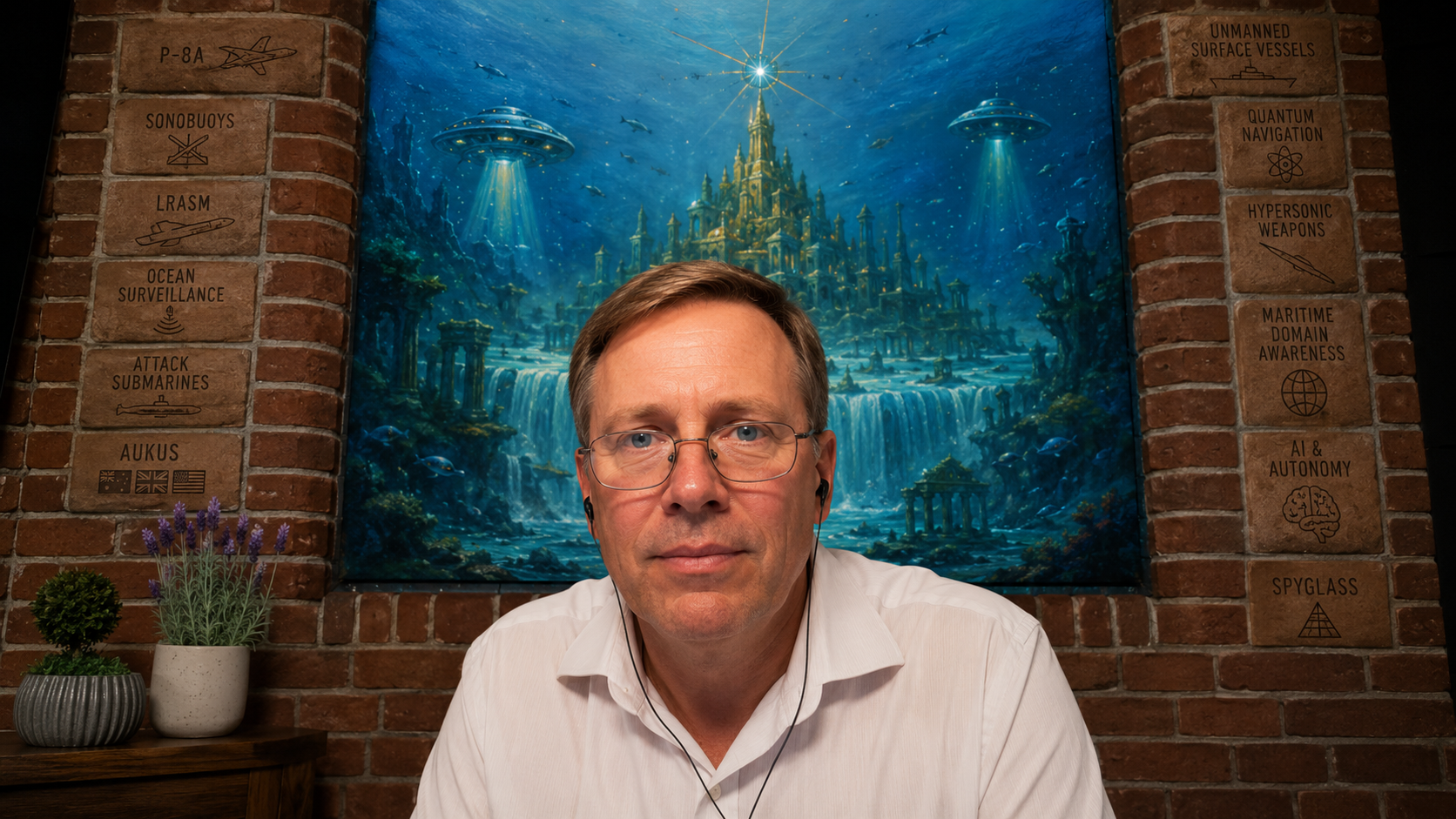
Conversations en Action sur l’Atlantide. Conversations on Atlantis in Action. Dated August 19, 2026 in the 70 Clock archive, this portrait completes @siouid142’s three-part response to the Conversations in Action episode “What Happens When the Oceans Go Autono
Read the narration
Conversations en Action sur l’Atlantide.
Conversations on Atlantis in Action.
Dated August 19, 2026 in the 70 Clock archive, this portrait completes @siouid142’s three-part response to the Conversations in Action episode “What Happens When the Oceans Go Autonomous?” Dr. Alex Wissner-Gross and John K. Werner spoke with Erik Bethel of Mare Liberum about artificial intelligence, geopolitics, national security and the technologies reorganizing maritime power. This panel isolates Werner, preserving the directness of a remote interview while turning the brick wall behind him into an index of the autonomous ocean.
Werner sits close to the camera in a white shirt, glasses and wired earbuds. Two small plants and a pot of lavender remain at the lower left, ordinary evidence of a domestic or office setting. That modest foreground is crucial. It prevents the oceanic future from arriving as anonymous military spectacle. The technologies are being named and interpreted by a person participating in a public conversation, through the familiar apparatus of webcam, headphones and screen.
At center hangs a vast luminous painting of Atlantis. Golden towers rise beneath blue water, waterfalls spill across submerged terraces, fish cross the scene and two disc-like craft direct pale beams toward the lost city. Atlantis is not presented as an archaeological claim. It is a cultural device for asking what kind of civilization might appear once the sea becomes continuously sensed, mapped and navigable by autonomous systems. The painting converts a technical inventory into a question about an entire inhabited world.
The brick plaques at left begin with the P-8A maritime patrol aircraft, then descend through sonobuoys, the Long Range Anti-Ship Missile, ocean surveillance, attack submarines and AUKUS. Together they describe an existing strategic stack: airborne sensing, distributed acoustic listening, long-range strike, persistent awareness, undersea platforms and an alliance framework joining Australia, the United Kingdom and the United States. Their carved, almost archaeological appearance makes contemporary systems look like the inscriptions of a future ruin.
The right column moves from platforms to enabling capacities: unmanned surface vessels, quantum navigation, hypersonic weapons, maritime domain awareness, artificial intelligence and autonomy, and “Spyglass.” Navigation without reliable satellite signals, fusion of distributed observations, high-speed weapons and vessels that can remain at sea without crews all increase the distance between human decision makers and physical action. The list does not claim these programs form one deployed network. It shows the categories that must be understood together.
The two columns also create an ethical symmetry. On the left are instruments historically associated with state power and conflict; on the right are the computational capacities that could make those instruments more persistent and independent. Atlantis interrupts that symmetry with beauty. The city evokes discovery, trade, habitation and knowledge, reminding the viewer that autonomy at sea can also support exploration, environmental monitoring, search and rescue, infrastructure inspection and lower-risk transport.
Mare Liberum gives the episode a deeper legal resonance. The name recalls the free-sea tradition: the ocean as a domain open to navigation rather than possessed like terrestrial property. Cheap, durable autonomous craft could widen access to that commons. The same craft could surround it with proprietary sensing, algorithmic enforcement and continuous surveillance. In this portrait, openness and control are not opposites. They are competing possibilities produced by the same technical ability to remain present offshore.
The work’s synthetic realism carries its own warning. The labels are legible and the city is seductive, but the scene openly exceeds documentary reality. It does not say Werner endorsed every system, that the episode linked them operationally, or that strange craft have been observed above Atlantis. By keeping the invention conspicuous, @siouid142 distinguishes visual interpretation from evidence while still allowing fantasy to reveal the stakes of infrastructure.
As art criticism, Conversations on Atlantis in Action turns a speaker’s background into a layered model of maritime autonomy. Brick suggests inherited institutions; engraved plaques suggest a technical canon; living plants preserve human scale; the glowing city supplies a horizon larger than national strategy. The sea does not literally become autonomous. People distribute agency among sensors, vessels, models, alliances and laws. Atlantis is the work’s final provocation: if those systems make a new oceanic civilization possible, what values will be built into its foundations before it rises?
Opening the gallery…