70 Clock Galerie / The Innermost Loop Feed Reply Tableaux
Octobre Rouge Autonome : Le Capitaine-Homard Marko Ramius. Mare Liberum !
Autonomous Red October: Lobster Captain Marko Ramius. Mare Liberum!
August 19, 2026
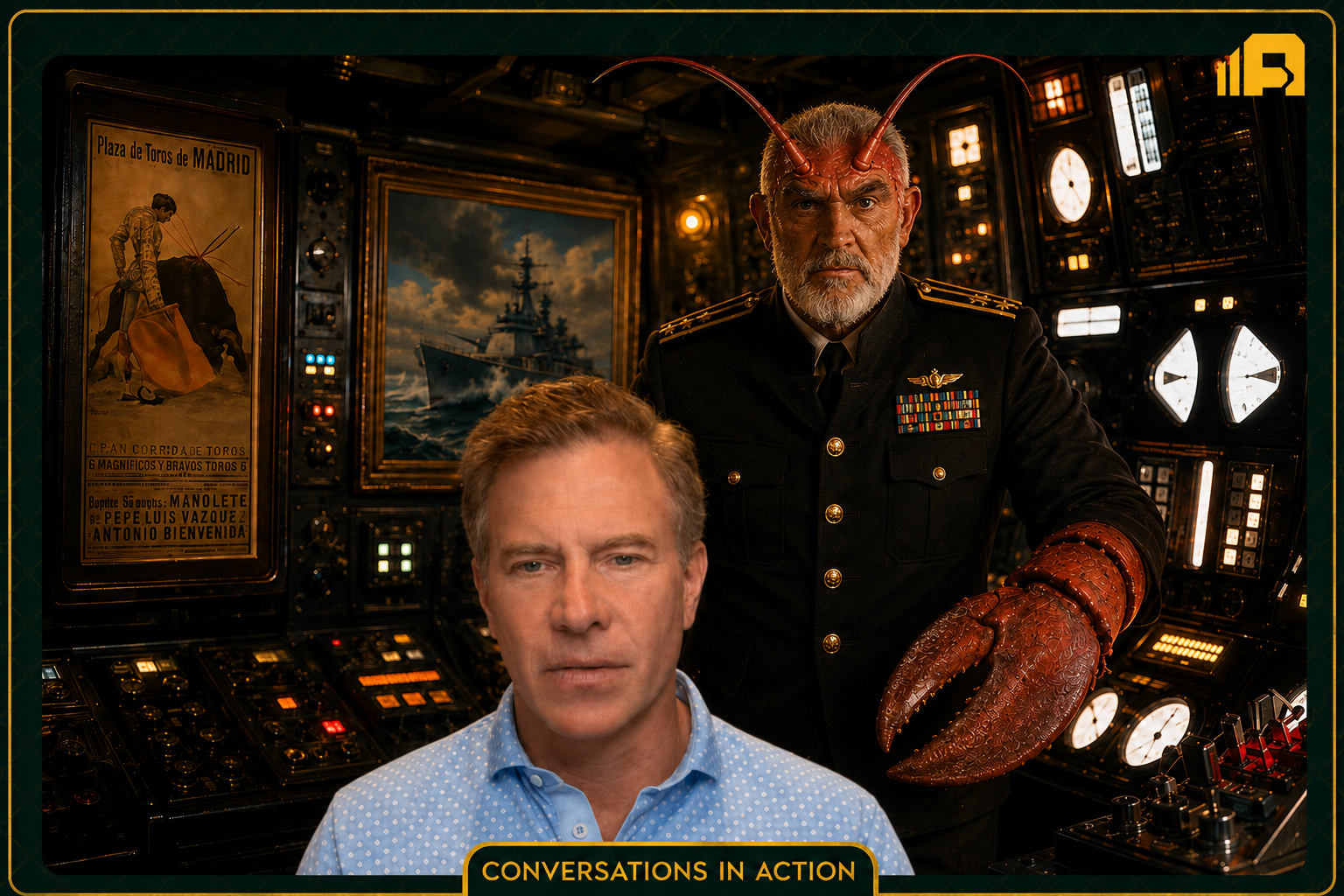
Octobre Rouge Autonome : Le Capitaine-Homard Marko Ramius. Mare Liberum !. Autonomous Red October: Lobster Captain Marko Ramius. Mare Liberum!. Dated August 19, 2026 in the 70 Clock archive, this work isolates the central panel of the Conversations in Action e
Read the narration
Octobre Rouge Autonome : Le Capitaine-Homard Marko Ramius. Mare Liberum !.
Autonomous Red October: Lobster Captain Marko Ramius. Mare Liberum!.
Dated August 19, 2026 in the 70 Clock archive, this work isolates the central panel of the Conversations in Action episode with Dr. Alex Wissner-Gross, John K. Werner and Erik Bethel of Mare Liberum. Bethel remains the real interview guest in the foreground. Behind him, @siouid142 invents a captain who combines Sean Connery’s Marko Ramius from The Hunt for Red October with the recurring lobster agent of the exhibition. The hybrid is a cultural analogy, not a Mare Liberum employee or a documentary submarine commander.
Bethel faces the camera in a pale blue patterned shirt, calm and evenly lit against an environment of compressed command. The surrounding room is crowded with analog gauges, illuminated switches, circular dials, black panels and amber warning lamps. A framed warship cuts through heavy seas on the rear wall. The physical density contrasts with the clean abstraction of software: autonomy may be described as an algorithm, but at sea it inhabits hulls, power systems, sensors, maintenance schedules and rooms built for consequential decisions.
The fictional captain stands over Bethel’s shoulder in a black naval uniform covered with ribbons. Gray beard, stern gaze and raised collar evoke Connery’s portrayal, while two red antennae rise from his forehead and a vast articulated claw replaces one hand. The claw is rendered as ornamental armor, too large for the nearby controls. It makes nonhuman agency impossible to ignore and turns a familiar command portrait into a problem of interface design.
The Hunt for Red October is an exact source because its plot depends on uncertainty about intent. A submarine moves through a low-visibility environment under a captain whose purpose must be inferred by distant institutions. The suspense comes from the gap between what the vessel can do and what its commander means to do. Autonomous maritime systems redistribute that gap. Intent may reside in mission software, rules of engagement, remote operators, owners, sensor models and local adaptations rather than in one charismatic person.
Calling the image an autonomous Red October therefore shifts the old question. Instead of asking whether Ramius is defecting, allies and adversaries would need to ask whether the system is behaving as designed, whether its observations are reliable, whether communications have failed, and who can alter its objective. Underwater and over-the-horizon operation magnify those problems because continuous human supervision is difficult. Autonomy is not merely convenience; it is authority exercised in conditions of partial contact.
The lobster connects this maritime dilemma to the exhibition’s larger mythology of nonhuman agents. Its lineage reaches toward Charles Stross’s Accelerando, where uploaded crustacean intelligences become actors with claims, assets and institutional consequences. In earlier tableaux lobsters entered courtrooms, markets and cockpits. Here the creature receives naval rank. The recurring body asks whether inherited offices can accommodate agents whose cognition, replication and relationship to responsibility differ from those of a human occupant.
At left, a vintage Plaza de Toros de Madrid poster shows a matador facing a bull. It creates a second ritual of command and danger: one encounter with nonhuman force is traditional and bodily, the other computational and infrastructural.
The phrase Mare Liberum gives the joke a legal and philosophical horizon. The free-sea principle imagines oceans as open to navigation rather than available for possession like territory. Autonomous craft could extend access by lowering cost and risk, surveying fisheries, delivering aid or monitoring hazards. The same persistence could create a private surveillance layer or a new instrument of strategic enclosure. Freedom of movement and expansion of control arrive in the same hull.
The image’s hierarchy separates evidence from fantasy. Bethel’s portrait anchors the actual conversation. The impossible antennae and claw announce the invention. Analog consoles and the film citation supply a command mythology through which the technical issue can be understood.
As art criticism, the tableau uses parody to expose how much autonomy destabilizes the figure of the captain. Maritime culture concentrates responsibility in a person whose judgment unifies crew and vessel. Distributed systems dissolve that clarity. The lobster Ramius is memorable because he is simultaneously absurd and institutionally plausible: rank, uniform and posture ask the viewer to accept him before anatomy refuses. The work leaves the central question suspended among the gauges—when the sea is filled with agents, who commands, who interprets intent, and who answers when the vessel acts alone?
Opening the gallery…