70 Clock Galerie / The Innermost Loop Feed Reply Tableaux
Que se Passe-t-il Lorsque les Océans Deviennent Autonomes ? – Remix de Conversations in Action
What Happens When The Oceans Go Autonomous? Conversations in Action Remix
August 19, 2026
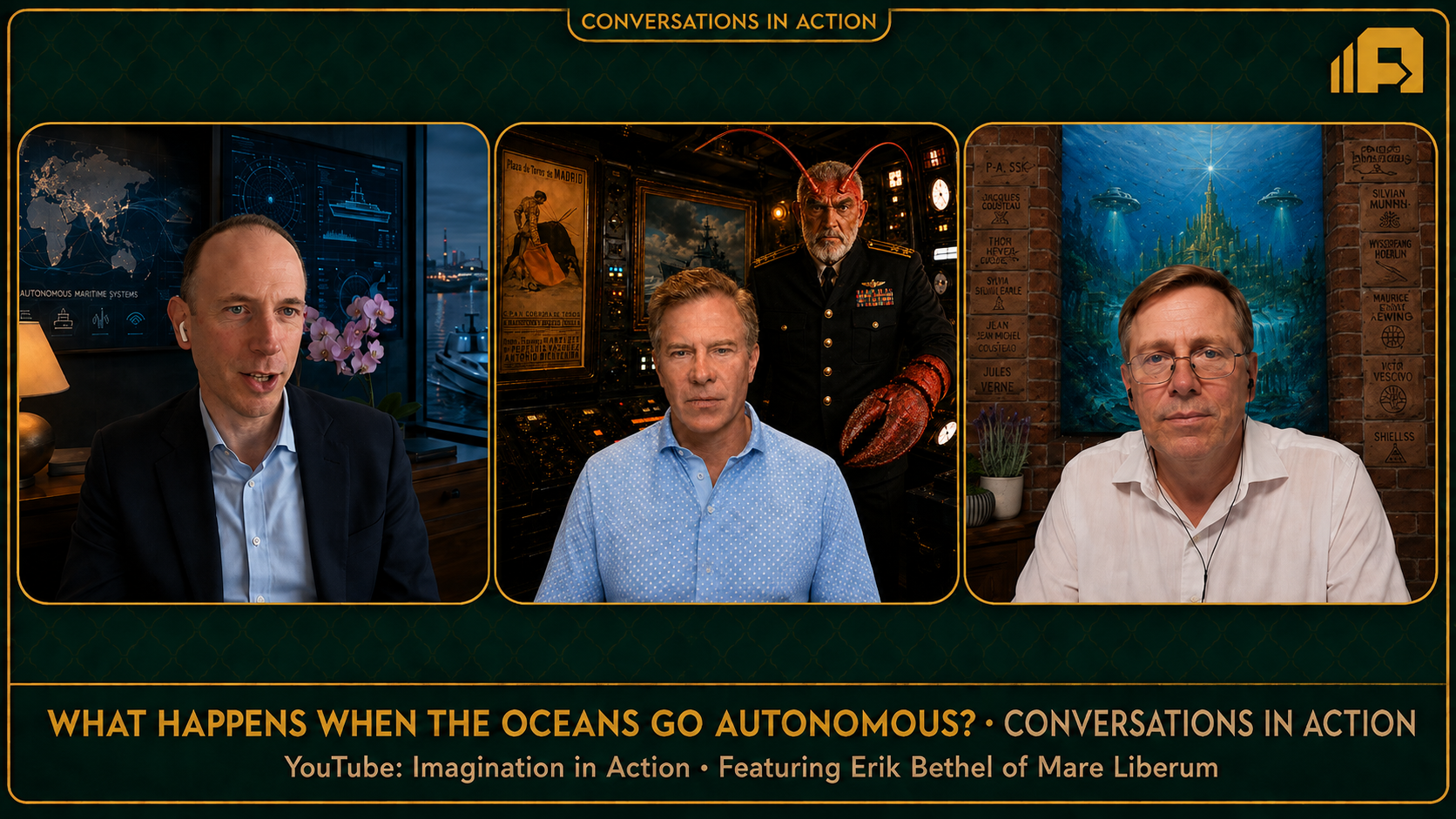
Que se Passe-t-il Lorsque les Océans Deviennent Autonomes ? – Remix de Conversations in Action. What Happens When The Oceans Go Autonomous? Conversations in Action Remix. Dated August 19, 2026 in the 70 Clock archive, this three-window remix was created from e
Read the narration
Que se Passe-t-il Lorsque les Océans Deviennent Autonomes ? – Remix de Conversations in Action.
What Happens When The Oceans Go Autonomous? Conversations in Action Remix.
Dated August 19, 2026 in the 70 Clock archive, this three-window remix was created from episode three of Conversations in Action. Dr. Alex Wissner-Gross appears at left, Erik Bethel of Mare Liberum at center, and John K. Werner at right. The real episode ranged across artificial intelligence, geopolitics, national security, technological leadership and the decisions likely to shape competition for decades. @siouid142 preserves the video-call structure but gives each participant a different oceanic world.
The gold-trimmed dark-green frame announces the Imagination in Action series and names Bethel’s organization in the footer. That broadcast apparatus is the factual anchor. The backgrounds are declared acts of interpretation, not evidence that the three men occupied a shared room. Treating the call as a triptych allows the artwork to separate three layers of autonomy—network, command and cultural history—while keeping them synchronized within one public conversation.
Wissner-Gross’s left panel is a systems map. His familiar lamp and purple orchid remain beside world routes, radar displays, vessel telemetry and a harbor craft glowing outside the window. The panel defines ocean autonomy as distributed perception and coordination. Before a boat acts, the sea must be translated into positions, signals, models, objectives and communication links. The map is not merely background; it is the computational ocean on which physical craft depend.
Bethel’s central panel descends inside a submarine command room. Analog dials, amber warning lights, dense consoles, a warship painting and a Spanish bullfighting poster surround his calm front-facing portrait. Behind him stands an invented captain combining Sean Connery’s Marko Ramius with lobster antennae and one monumental claw. Bethel remains the real guest; the captain is a cinematic and exhibition-specific response to the discussion, not a member of Mare Liberum.
The Hunt for Red October supplies a precise analogy. Its dramatic problem is how institutions infer the intent of a submarine commander operating beneath limited communication. Autonomous vessels intensify that problem by relocating intent from one charismatic captain into software, rules, remote operators and organizations. The lobster Ramius turns the old command myth into a nonhuman agent: visibly authoritative, culturally familiar and anatomically impossible.
Werner’s right panel opens toward Atlantis. A luminous undersea city rises beneath descending beams or hovering craft, framed by bricks inscribed with names from the history and imagination of marine technology. Jules Verne, Victor Vescovo and other legible references place current autonomy inside centuries of descent, exploration and speculative world-building. Werner’s direct-to-camera posture and earbud preserve the role of conversation even as the wall becomes a submerged archive.
Together, the panels form an operating stack. The left supplies global awareness, routing and network control. The center supplies onboard decision, authority and the anxiety of hidden intent. The right supplies the stories through which people make the deep ocean culturally intelligible. None is sufficient alone. A technically autonomous vessel still enters waters governed by law, strategy, commerce, ecology and inherited myth.
Mare Liberum adds a further historical argument. The name evokes the free sea: an open domain that resists sovereign enclosure. Persistent autonomous craft could expand that freedom by lowering the cost of transport, observation and access. They could also fill open water with proprietary sensors, private enforcement and continuous surveillance. The triptych does not resolve that contradiction. Its equal windows make openness, security and imagination coexist without granting one final authority.
As contemporary history painting, the remix treats the webinar interface as exhibition architecture. Remote conversations are among the places where technical futures are negotiated before they become policy or infrastructure. The gold frame gives that transient medium ceremonial weight, while the synthetic environments disclose the conceptual worlds already surrounding the speakers.
The answer to the episode’s question is therefore not a fleet without humans. It is a denser relationship among people, networks, vessels, law and narrative. Autonomy redistributes agency rather than abolishing responsibility. In the left panel the ocean becomes data; in the center it becomes a command dilemma; in the right it becomes a civilization imagined below the surface. The triptych holds all three long enough for the viewer to see that the future of the sea will be decided as much by institutions and stories as by navigation code.
Opening the gallery…