70 Clock Galerie / The Innermost Loop Feed Reply Tableaux
Que se Passe-t-il Lorsque les Océans Deviennent Autonomes ? – Remix du Dr Alex Wissner-Gross
What Happens When The Oceans Go Autonomous? Doctor Alex Wissner-Gross Remix
August 19, 2026
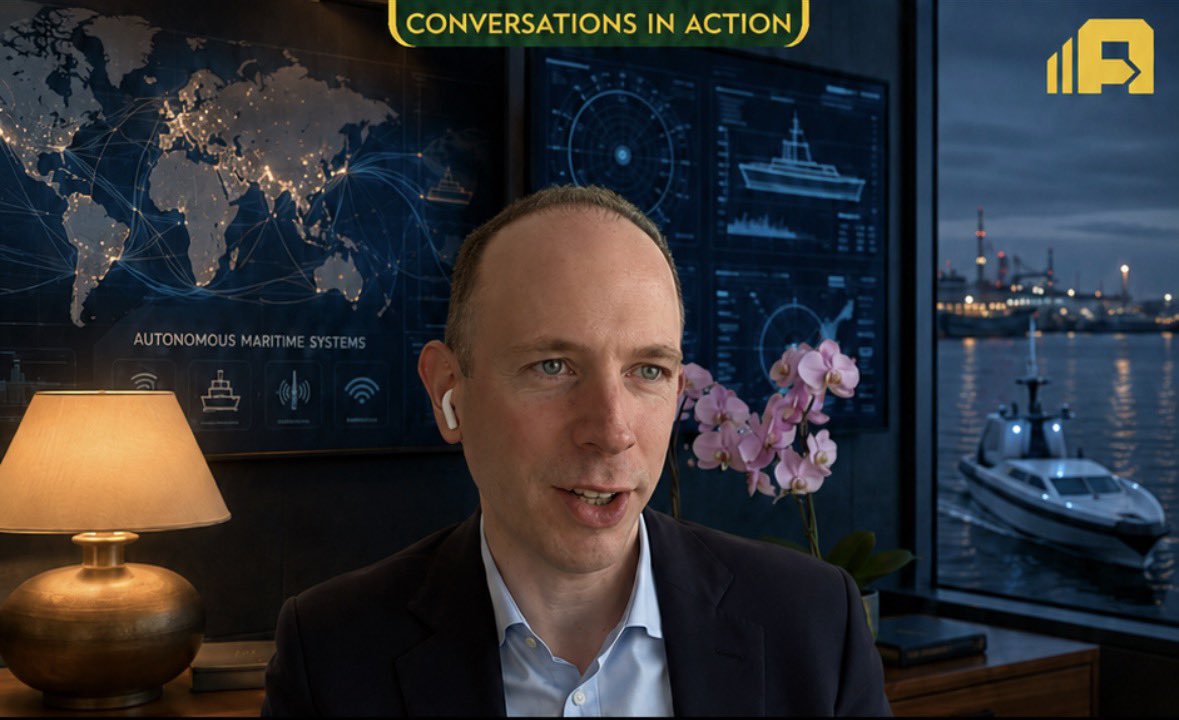
Que se Passe-t-il Lorsque les Océans Deviennent Autonomes ? – Remix du Dr Alex Wissner-Gross. What Happens When The Oceans Go Autonomous? Doctor Alex Wissner-Gross Remix. Dated August 19, 2026 in the 70 Clock archive, this portrait responds to episode three of
Read the narration
Que se Passe-t-il Lorsque les Océans Deviennent Autonomes ? – Remix du Dr Alex Wissner-Gross.
What Happens When The Oceans Go Autonomous? Doctor Alex Wissner-Gross Remix.
Dated August 19, 2026 in the 70 Clock archive, this portrait responds to episode three of Conversations in Action. Dr. Alex Wissner-Gross and John K. Werner spoke with Erik Bethel of Mare Liberum about artificial intelligence, geopolitics, national security and the technological systems reshaping maritime power. @siouid142 isolates Wissner-Gross’s window and rebuilds his familiar call background as a command environment for an ocean increasingly sensed and navigated by machines.
The human portrait remains deliberately ordinary. Wissner-Gross wears a dark jacket and white earbuds. His warm brass lamp rests at lower left and a purple orchid rises at right. Those recurring objects function as provenance across the exhibition: they identify a real speaker and a recognizable remote-conversation frame. Behind them, however, the room has opened into a global maritime operating picture.
A luminous world map fills the left wall with ports, routes and crossing communication lines. Beneath it, the label “Autonomous Maritime Systems” sits above icons for vessels, sensing and wireless connection. The map does not specify a real mission. It compresses several oceanic functions—navigation, trade, surveillance, weather, infrastructure and strategic awareness—into a single field. Autonomy begins here not as a robot boat, but as a network able to locate and coordinate many moving actors.
The central monitor shows a vessel profile surrounded by radar circles, telemetry and diagnostic graphs. It turns the ship into data before the physical craft appears. This ordering matters. An autonomous ocean is first produced by models, maps, sensors and communications that make water legible to computation. Hull and propeller arrive later as actuators attached to that representation. The command screen is therefore both instrument and worldview.
Outside the window, a compact uncrewed vessel glows blue in a dark harbor while a larger ship sits farther away beneath towers and cranes. The small craft looks modest beside the global map, but it is the picture’s decisive body. It makes machine agency physical: a system can leave the screen, enter weather and traffic, avoid obstacles, gather information and act at distances where continuous human control may be costly or impossible.
The title’s “oceans go autonomous” is intentionally provocative because oceans themselves do not become agents. Companies, governments, fleets and software systems assign agency to craft operating on them. The personification exposes a governance problem: when distributed vessels make local decisions, who writes their objectives, owns their observations, grants passage, answers for collisions or constrains surveillance? The sea may appear open, but authority remains layered.
Mare Liberum’s name adds historical pressure. It recalls the idea of the free sea, a domain that cannot be possessed like land and should remain open to navigation. Autonomous systems complicate that freedom. Low-cost persistent craft could widen access, monitor fisheries, map hazards and improve logistics; they could also turn every route into a sensor network and every unobserved space into a target for observation. Openness and control grow together.
The remote-call format sharpens the contrast of scale. A global map, harbor and autonomous vessel are contained inside a room still marked by a household lamp and living flower. The Singularity is not introduced from a cinematic bridge; it is discussed through earbuds and webcams. The remix honors that mediation instead of erasing it, showing how planetary claims first become public through ordinary screens.
Color organizes the ethics. Amber light around the lamp and skin creates a human zone of warmth, memory and conversation. Deep blue monitors, sea and telemetry create a machine zone of distance and continuous operation. The orchid crosses the boundary: a living organism illuminated by the screens, it prevents nature from becoming merely background to the technical system.
As a portrait, the work updates the old image of a navigator before maps and instruments. Wissner-Gross does not touch a wheel or command a crew. He occupies the analytic position between representation and action. The artwork makes that distinction explicit: it does not claim he controls the harbor craft or that the displayed room exists. Instead, it turns the subjects of the interview into attributes surrounding the speaker.
The result treats autonomy as an ecology rather than a single vehicle. Satellites, ports, sensors, maps, models, radio links, law and human judgment must coordinate before an uncrewed craft can act meaningfully at sea. By keeping the lamp and orchid inside that ecology, @siouid142 refuses a simple story of humans disappearing from the loop.
Opening the gallery…