70 Clock Galerie / The Innermost Loop Feed Reply Tableaux
Maison de la Boucle la Plus Profonde – Fidji Simo, Simon Willison, le Professeur Avi Loeb, Greg Brockman et Naval Ravikant
House Innermost Loop – Fidji Simo, Simon Willison, Professor Avi Loeb, Greg Brockman, and Naval Ravikant
August 17, 2026
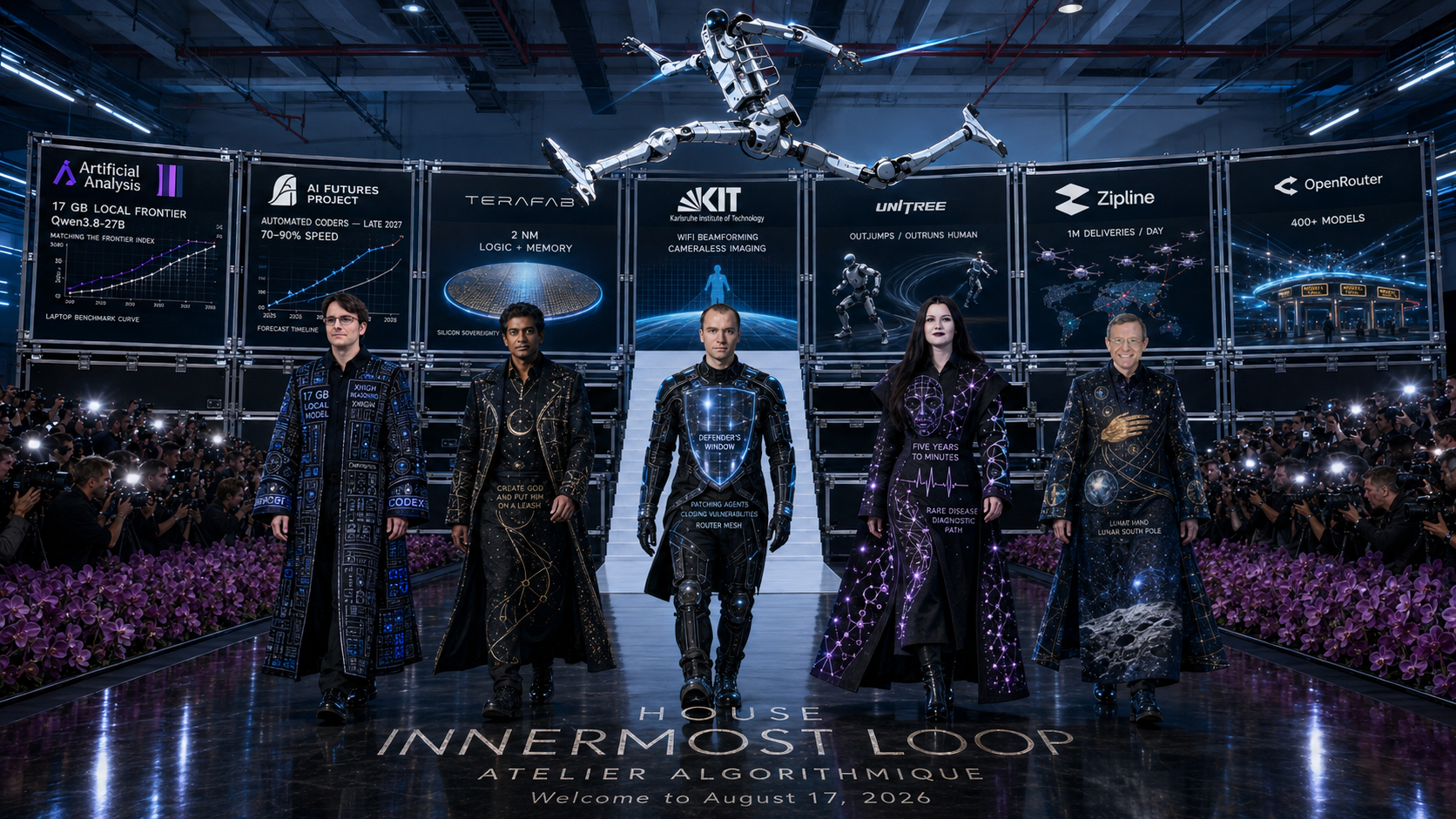
Maison de la Boucle la Plus Profonde – Fidji Simo, Simon Willison, le Professeur Avi Loeb, Greg Brockman et Naval Ravikant. House Innermost Loop – Fidji Simo, Simon Willison, Professor Avi Loeb, Greg Brockman, and Naval Ravikant. On August 17, 2026, @siouid142
Read the narration
Maison de la Boucle la Plus Profonde – Fidji Simo, Simon Willison, le Professeur Avi Loeb, Greg Brockman et Naval Ravikant.
House Innermost Loop – Fidji Simo, Simon Willison, Professor Avi Loeb, Greg Brockman, and Naval Ravikant.
On August 17, 2026, @siouid142 built this House Innermost Loop runway from Dr. Alex Wissner-Gross’s dispatch announcing that the frontier had gone local. Simon Willison, Naval Ravikant, Greg Brockman, Fidji Simo and Professor Avi Loeb walk beneath an airborne Unitree humanoid. They never shared this stage. The image turns five separate signals—local models, philosophical danger, cyber defense, medical diagnosis and anomalous aerospace observation—into garments inside one systems theater.
Willison appears at far left in a blue coat densely printed with code, benchmarks and “17 GB local model.” His hands-on test of Alibaba’s Qwen3.8-27B supplied the dispatch’s opening proof: a frontier-class, Apache-licensed model could drive a coding agent from a laptop and produce an SVG, though its highest reasoning mode once spent twenty-one minutes contemplating the task. The coat treats local inference as a new kind of portability. Frontier capability is no longer visible only through a sealed datacenter door.
The panel behind him compares the model on the Artificial Analysis index, while the neighboring AI Futures display projects automated coders around late 2027 with scenario progress estimated at seventy to ninety percent speed. The two charts place present hardware beside forecast time. Willison’s human-scale laptop is the hinge: what had been a macro prediction becomes something a practitioner can download, inspect and run in a room.
Naval Ravikant wears black and gold beneath the words “Create God and put him on a leash.” The line condenses a contradiction at the center of alignment discourse. A system imagined as godlike is defined by escaping ordinary limits; a leash imagines control as an accessory held by its maker. The garment turns that provocation into celestial geometry, so the constraint appears woven into the same fabric as the power it is meant to restrain.
Greg Brockman occupies the center in tactical armor marked “Defender’s Window.” His dispatch role concerned a temporary advantage: security teams should deploy agents against existing vulnerabilities before near-frontier open-weight cyber systems diffuse more widely. The blue shield on his chest converts time into protective equipment. “Patching agents closing vulnerabilities faster” becomes the ideal, while the surrounding runway reminds us that defense and attack draw from the same rapidly localizing capability.
Fidji Simo’s violet constellation coat carries a human timescale: “Five years to minutes.” The source described AI-assisted rare-disease diagnosis through facial analysis and electrocardiogram patterns, a compression Simo connected to her own long diagnostic search. Molecular networks and a glowing heartbeat move across her body. Unlike a benchmark, the gain is measured in years of uncertainty removed from a life, making medical relief the work’s clearest claim for legitimacy.
Avi Loeb at far right wears lunar and deep-space imagery, including a hand reaching toward the Moon’s south polar terrain. The dispatch placed the 2026 United States–China lunar race beside European monitoring of anomalous aerial phenomena and Loeb’s account of a science advisory council formed at the request of national-security sources. His recommendation to determine intent passively before attempting to bring anything down turns observation into an ethics of first contact.
Across the evidence wall, Terafab promises two-nanometer logic and memory under one roof; Karlsruhe Institute of Technology turns ordinary Wi-Fi beamforming into camera-less imaging; Zipline maps a target of one million deliveries per day; OpenRouter offers access to more than four hundred models. These panels move from fabrication to surveillance, logistics and market coordination. The local model is never truly solitary. It is enabled by an international material and service stack.
Above the cast, a Unitree robot performs an impossible split while projecting blue trails from its limbs. The dispatch claimed a machine developed in three months could outjump and outrun any human. Suspending it over the runway prevents physical AI from becoming another flat panel. The robot literally exceeds the walkers’ vertical range, while its theatrical pose turns performance data into circus spectacle.
As contemporary history painting, the work connects local computation to global consequence. A model fits on a laptop, but its derivatives reach cyber defense, medical triage, robotic labor, lunar competition and surveillance through Wi-Fi. The five walkers carry different promises and risks. The airborne robot is the punctuation: machines may already be lapping us in bounded tasks, while the human procession still decides what those victories mean.
Opening the gallery…