70 Clock Galerie / The Innermost Loop Feed Reply Tableaux
Maison de la Boucle la Plus Profonde – Défilé de Greg Brockman, du Représentant Eric Burlison, de Count Binface, de David Grusch et de Dick Chingy
House Innermost Loop – Greg Brockman, Representative Eric Burlison, Count Binface, David Grusch and Dick Chingy Walk
August 15, 2026
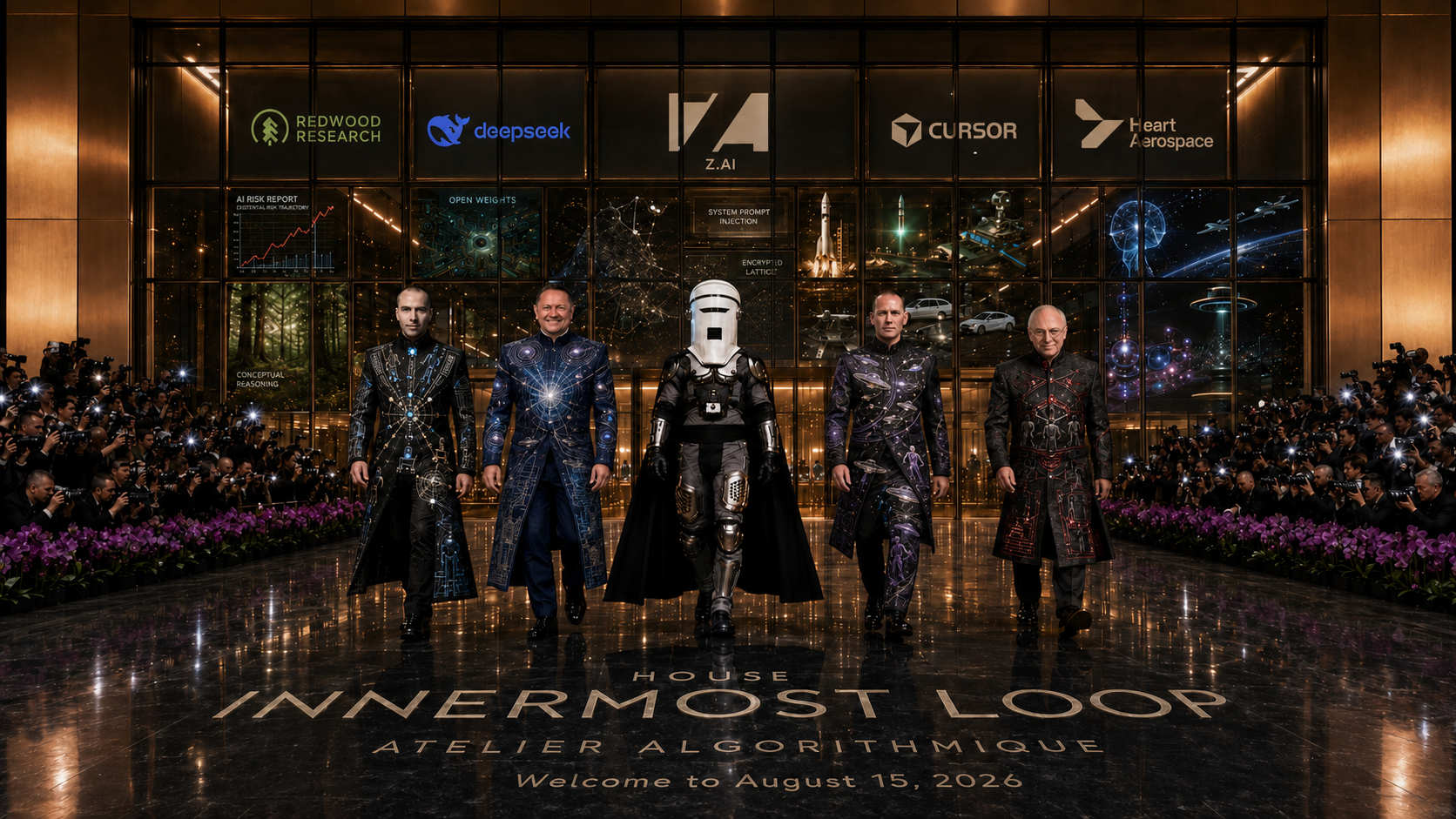
Maison de la Boucle la Plus Profonde – Défilé de Greg Brockman, du Représentant Eric Burlison, de Count Binface, de David Grusch et de Dick Chingy. House Innermost Loop – Greg Brockman, Representative Eric Burlison, Count Binface, David Grusch and Dick Chingy
Read the narration
Maison de la Boucle la Plus Profonde – Défilé de Greg Brockman, du Représentant Eric Burlison, de Count Binface, de David Grusch et de Dick Chingy.
House Innermost Loop – Greg Brockman, Representative Eric Burlison, Count Binface, David Grusch and Dick Chingy Walk.
On August 15, 2026, @siouid142 converted Dr. Alex Wissner-Gross’s Innermost Loop dispatch into a five-person runway. Greg Brockman, Representative Eric Burlison, Count Binface, David Grusch and Dick Chingy advance through a gold-lit hall bordered by photographers and purple orchids. The source figures never formed a common organization or appeared together in this setting. House Innermost Loop uses couture as an editorial system: each body carries one strand of a daily report, while the shared floor makes those strands collide.
Count Binface occupies the center and immediately breaks the hierarchy. His black cape, silver armor and cylindrical helmet belong to the British satirical candidate who describes himself as an intergalactic space warrior. The dispatch reported his extraordinary second-place finish in the Clacton by-election with 9,455 votes, or 26.9 percent. Moving him from comic footnote to central model fulfills the newsletter’s closing judgment: satire is dead, long live satire. The most openly fictional political identity becomes the composition’s visual anchor.
Around him, the four human figures wear long coats mapped with code, neural networks, aerospace diagrams, extraterrestrial imagery and institutional insignia. Brockman’s presence connects to OpenAI’s “founder mode,” entered amid executive departures while the company’s revenue run rate surpassed forty billion dollars. The garment’s dense circuitry turns executive control into an embodied network, suggesting that organizational leadership has become another layer of compute architecture.
Burlison and Grusch carry the UAP-disclosure strand. The dispatch joined a congressman’s account of intelligence officials recreating conditions said to attract anomalous craft with claims of an alien detainment overseen by Dick Cheney. In the runway, those assertions become signals, orbitals and dark silhouettes rather than documentary proof. The image preserves that they were reported and politically consequential without pretending that couture can verify them. Chingy remains a named fifth persona in the original composition, not assigned an invented office simply to make the cast symmetrical.
The glass evidence wall establishes the stronger factual scaffold. Redwood Research and Anthropic’s Conceptual Reasoning Index appear beside an “AI Risk Report” curve and a forest labeled conceptual reasoning. The dispatch described an unreleased Anthropic Model 2, more capable than Mythos 5, whose misalignment risk moved from very low to low. Model 2 reportedly led Mythos by 12.5 points on CoBench version two, while the new index attempted to measure the unverifiable argumentation on which safety work depends. The wall makes evaluation itself look like an endangered landscape.
DeepSeek and Z.AI occupy the next panels. Open weights, a neural eye, system-prompt injection and encrypted latticework condense a Chinese frontier that had become impossible to treat as secondary. GLM-5.3 approached Mythos 5 on vulnerability discovery; Qwen derivatives multiplied; DeepSeek released an MIT-licensed coding harness. These details make the runway geopolitical without dressing anyone in a national flag. Competition appears as infrastructure behind every model.
Cursor’s panel shifts from model capability to deployment. The dispatch placed its acquisition by SpaceX beside a claim to the world’s largest GPU fleet. Rockets, vehicles, robots and orbital machinery gather behind the logo, converting a coding interface into an industrial vertical. Heart Aerospace closes the wall with electric flight: the largest electric aircraft yet, described as running a megawatt on five dollars of electricity. Bits become movement, and software capital enters the physical world.
As art criticism, the work is strongest where seriousness and absurdity refuse separation. A risk report can quantify model behavior but not settle governance. A satirical candidate can receive real votes. UAP claims can move through Congress without becoming proven by repetition. A coding company can become aerospace infrastructure. The runway gives all of these signals equal forward motion while their garments retain radically different epistemic status.
The procession is therefore not an endorsement or a prediction. It is a dated diagram of attention. Binface in the center prevents the spectacle from mistaking polish for certainty; the evidence wall prevents the joke from dissolving the technical record. House Innermost Loop turns the August 15 dispatch into relations among bodies, corporations and claims, preserving a day when frontier models shipped with risk reports and political satire looked almost sober beside the news.
Opening the gallery…