70 Clock Galerie / The Innermost Loop Feed Reply Tableaux
Quand l’IA Volera-t-elle Mieux que Nous ? – Remix de l’Arrière-plan de John K. Werner
When Will AI Out-Fly Us? John K Werner Background Remix
August 14, 2026
Quand l’IA Volera-t-elle Mieux que Nous ? – Remix de l’Arrière-plan de John K. Werner. When Will AI Out-Fly Us? John K Werner Background Remix. Dated August 14, 2026 in the 70 Clock archive, this work isolates John K. Werner from the three-person Conversations
Read the narration
Quand l’IA Volera-t-elle Mieux que Nous ? – Remix de l’Arrière-plan de John K. Werner.
When Will AI Out-Fly Us? John K Werner Background Remix.
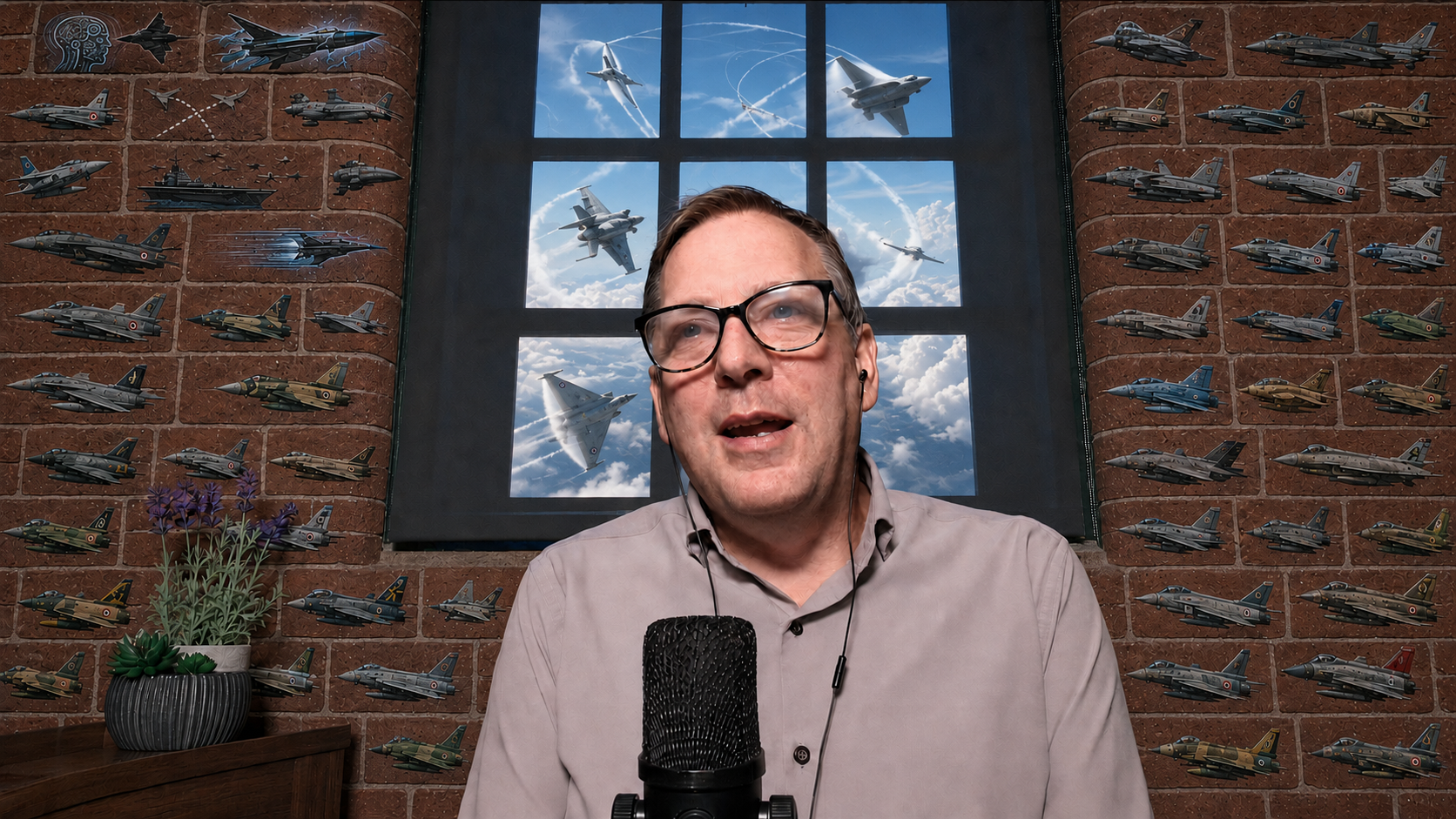
Dated August 14, 2026 in the 70 Clock archive, this work isolates John K. Werner from the three-person Conversations in Action episode with Dr. Alex Wissner-Gross and Tucker “Cinco” Hamilton. @siouid142 keeps Werner’s glasses, earbud cable, pale shirt, broadcast microphone and small potted plants, but transforms the brick room into an aircraft archive. The portrait makes his role in the conversation visible: to hold a public and historical frame around a technical argument whose endpoint remains unsettled.
Dozens of aircraft are mounted directly onto the brickwork in orderly horizontal rows. Propeller planes, transports, fighters, flying wings and unmanned forms share the same shallow relief. National roundels and changing silhouettes suggest generations of engineering rather than one product catalog. At the upper left, a diagrammatic head filled with circuitry sits beside a modern jet, making the new variable explicit. Intelligence has joined lift, thrust, materials and aerodynamics as a design component.
The central window refuses museum stillness. Jets bank across blue sky and leave looping contrails that cut through the rectilinear panes. The wall offers taxonomy; the window offers performance. Werner sits between the two, speaking into a microphone as if translating motion into public argument. Aircraft history becomes not a march toward one perfect machine but a record of successive compromises among mission, pilot, doctrine, infrastructure and available technology.
That history complicates the episode’s question. Machines have repeatedly outflown their predecessors by measurable criteria. Jets surpassed propeller aircraft in speed; fly-by-wire stabilized forms a person could not manage directly; automatic systems maintain trajectories with relentless precision. Yet “better” is never one number. Range, survivability, cost, endurance, judgment, adaptability and political legitimacy can point in different directions. The archive’s variety prevents a dogfight benchmark from becoming a universal definition of flight.
Werner’s microphone is therefore as important as any plane. Conversations in Action is not a weapons test but a public forum in which expertise is narrated, challenged and connected to larger institutions. Remote media can look ephemeral, yet the work gives the call the dignity of a commissioned portrait. The sitter’s ordinary tools—microphone, earbuds, camera and room—become the apparatus through which society decides what technological performance means.
The brick itself carries an argument about institutional inertia. New aircraft are fast; walls are slow. Procurement, training, regulation, doctrine and trust accumulate like masonry. Tucker Hamilton’s account of Automatic Ground Collision Avoidance demonstrates the point: a system capable of seizing control to prevent a crash existed before pilots and institutions were prepared to embrace it. Once mandated and experienced, it became a life-saving expectation. Adoption, not invention alone, defined the historical threshold.
The synthetic archive also teaches caution. Every miniature looks plausible, but the rows are not offered as a verified inventory, and the window is not documentary footage from the call. The obvious replacement background declares itself as interpretation. In a period when realistic media can manufacture evidence, that transparency becomes part of the work’s form. It asks the viewer to distinguish a useful visual argument from a claim that these objects physically surrounded Werner.
As portraiture, the image updates the traditional scholar before a library. Books have become aircraft; the reading room has become a wall of platforms; the open window is an experiment still in progress. Werner is not depicted as controlling the machines. He is positioned as their interlocutor, translating specialist experience into a social record while the aircraft circulate behind him.
The work’s deeper achievement is to make technological succession look contingent. No plane occupies the throne, and no single line of development dominates every row. Artificial intelligence enters this archive as another force that may reorganize design, skill and authority. Whether it “outflies” humanity will depend not only on what a control system can do, but on which missions institutions grant it, which failures they tolerate, and which stories persuade people to trust it. The microphone in front and the contrails behind keep that negotiation visibly open.
Opening the gallery…