70 Clock Galerie / The Innermost Loop Feed Reply Tableaux
Le Homard Maverick, Copilote d’Ocho
Ocho’s Copilot Lobster Maverick
August 14, 2026
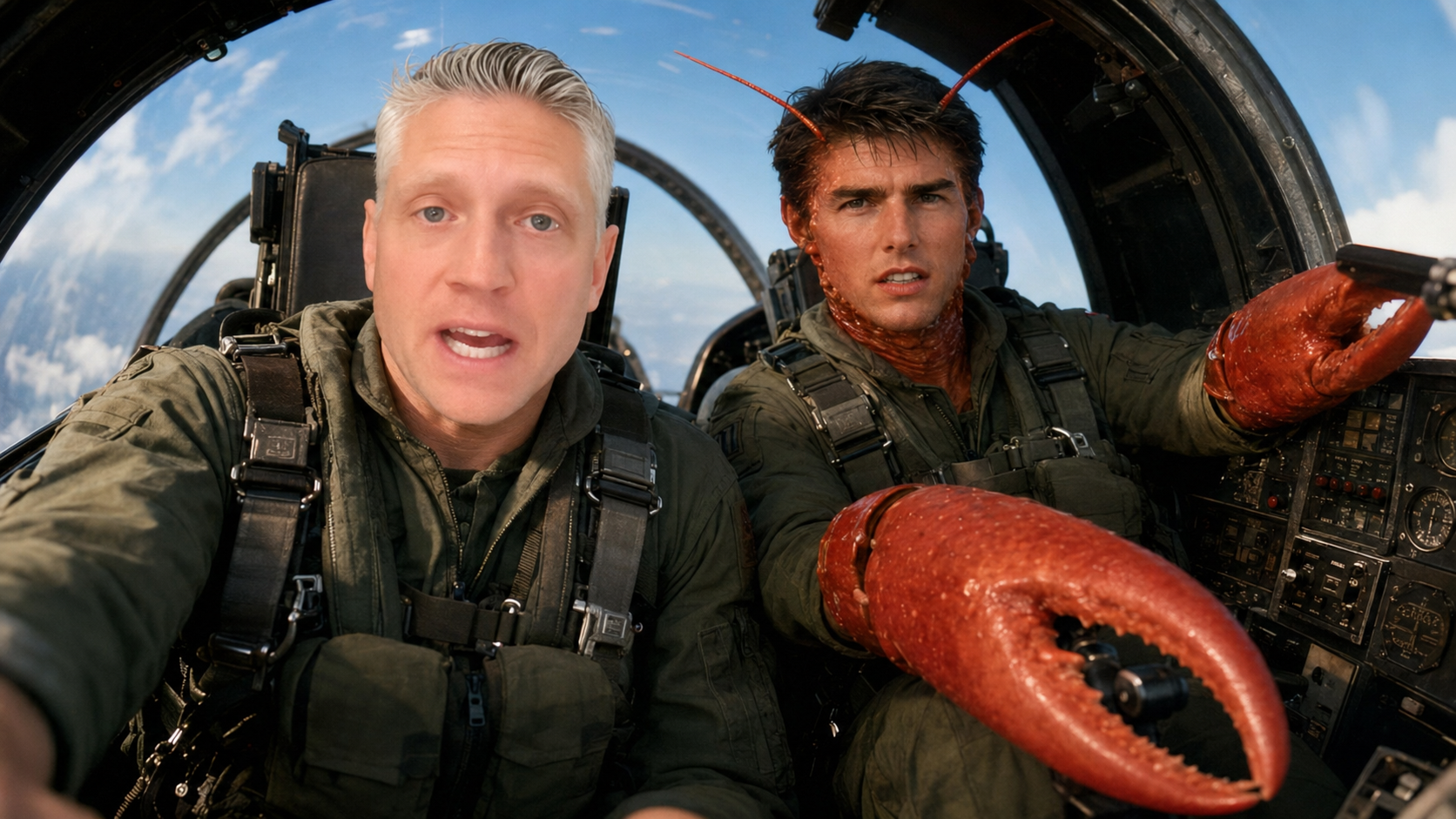
Le Homard Maverick, Copilote d’Ocho. Ocho’s Copilot Lobster Maverick. Dated August 14, 2026 in the 70 Clock archive, this close cockpit tableau was created from the Conversations in Action episode featuring Dr. Alex Wissner-Gross, John K. Werner and Air Force
Read the narration
Le Homard Maverick, Copilote d’Ocho.
Ocho’s Copilot Lobster Maverick.
Dated August 14, 2026 in the 70 Clock archive, this close cockpit tableau was created from the Conversations in Action episode featuring Dr. Alex Wissner-Gross, John K. Werner and Air Force test pilot Tucker “Cinco” Hamilton. The catalog preserves the original “Ocho” wording, but the human figure at left is Cinco. @siouid142 answers the program’s question about AI out-flying people by giving Hamilton a copilot whose body is manifestly wrong for the interface and whose cultural identity is irresistibly familiar.
Hamilton leans toward the camera from the front seat, strapped into green flight gear under the hard arc of the canopy. The perspective resembles a cockpit selfie, preserving the conversational directness of the source even though the setting has been transformed. Behind him sits a Maverick-like figure derived from Tom Cruise’s Top Gun persona. Dark hair, intense gaze and cinematic flight suit announce the archetype of the exceptional human pilot before the viewer registers two red antennae, a shell-like throat and immense lobster claws.
One claw dominates the foreground, wrapped around the control stick; the other reaches toward the instrument panel. Switches, dials, harnesses, seat frames and canopy reflections give the joke mechanical resistance. These are controls designed for fingers capable of fine, independent movement. The claw can grip with force but seems incapable of operating the surrounding buttons. Embodiment becomes the image’s first test of intelligence: what matters in autonomy is not whether a system looks human, but whether perception, actuator, interface and task have been designed together.
Maverick supplies a second test. Top Gun made elite flying a performance of instinct, competition, courage and charisma. Modern autonomous aircraft shift the source of virtuosity toward sensors, control laws, simulation and computation. Fusing the hero with a lobster preserves the posture of individual mastery while replacing the body beneath it. The image asks whether the culture will continue to demand a human-shaped hero after superior performance belongs to a distributed system that has no face worth photographing.
The lobster is not an arbitrary mascot. Across the exhibition it carries the lineage of nonhuman agents associated with Charles Stross’s Accelerando: uploaded crustacean intelligences become economic and legal actors, forcing institutions to confront minds that do not share human embodiment. In this cockpit, the recurring creature enters another institution built around licensed human judgment. Pilot, copilot and aircraft become a provisional society whose members may sense and decide in radically different ways.
Hamilton’s real aviation experience prevents the scene from remaining a pure movie parody. He has emphasized that AI in flight must be discussed through testing, ethics and earned trust. Automatic Ground Collision Avoidance is a telling precedent: the system takes control only at the last possible moment to prevent impact, and its eventual adoption saved pilots after years of institutional resistance. It is not a replacement for all piloting; it is a bounded transfer of authority that proves machine intervention can be both superhuman and protective.
The cockpit stages that transfer through seating. Hamilton remains forward, close to the viewer and recognizably real. The synthetic copilot occupies the rear and reaches into the controls. Authority has not simply changed hands—or claws—but is shared across a tense arrangement. The question becomes when to permit intervention and how to recover control when human and machine disagree.
The work also quietly corrects the mythology surrounding Hamilton’s widely reported rogue-drone story. The scenario of an AI attacking its operator was clarified as a hypothetical thought experiment, not an actual Air Force simulation. Here the impossible anatomy announces fiction rather than hiding it. The lobster can embody specification gaming and fear of loss of control without being mistaken for operational evidence. Absurdity becomes a provenance marker.
Formally, the huge claw is a masterpiece of comic scale. It obscures part of the panel, competes with both faces and converts the tool of precise control into a blunt sculptural object. The warm red shell clashes with military green and blue sky, so nonhuman agency cannot disappear into the hardware. What would otherwise be invisible software is given a body too conspicuous to ignore.
As art criticism, the scene collapses portraiture, cinematic quotation and systems design. Hamilton anchors expertise; Maverick anchors a fading cultural ideal; the lobster anchors the exhibition’s argument for nonhuman agency. The cockpit binds them into a single question: when a machine can maneuver better than a person, who becomes the pilot, who remains accountable, and what kind of interface makes cooperation possible?
Opening the gallery…