70 Clock Galerie / The Innermost Loop Feed Reply Tableaux
Quand l’IA Volera-t-elle Mieux que Nous ? – Remix de l’Arrière-plan du Dr Alex Wissner-Gross
When Will AI Out-Fly Us? Doctor Alex Wissner-Gross Background Remix
August 14, 2026
Quand l’IA Volera-t-elle Mieux que Nous ? – Remix de l’Arrière-plan du Dr Alex Wissner-Gross. When Will AI Out-Fly Us? Doctor Alex Wissner-Gross Background Remix. Dated August 14, 2026 in the 70 Clock archive, this portrait isolates Dr. Alex Wissner-Gross’s pa
Read the narration
Quand l’IA Volera-t-elle Mieux que Nous ? – Remix de l’Arrière-plan du Dr Alex Wissner-Gross.
When Will AI Out-Fly Us? Doctor Alex Wissner-Gross Background Remix.
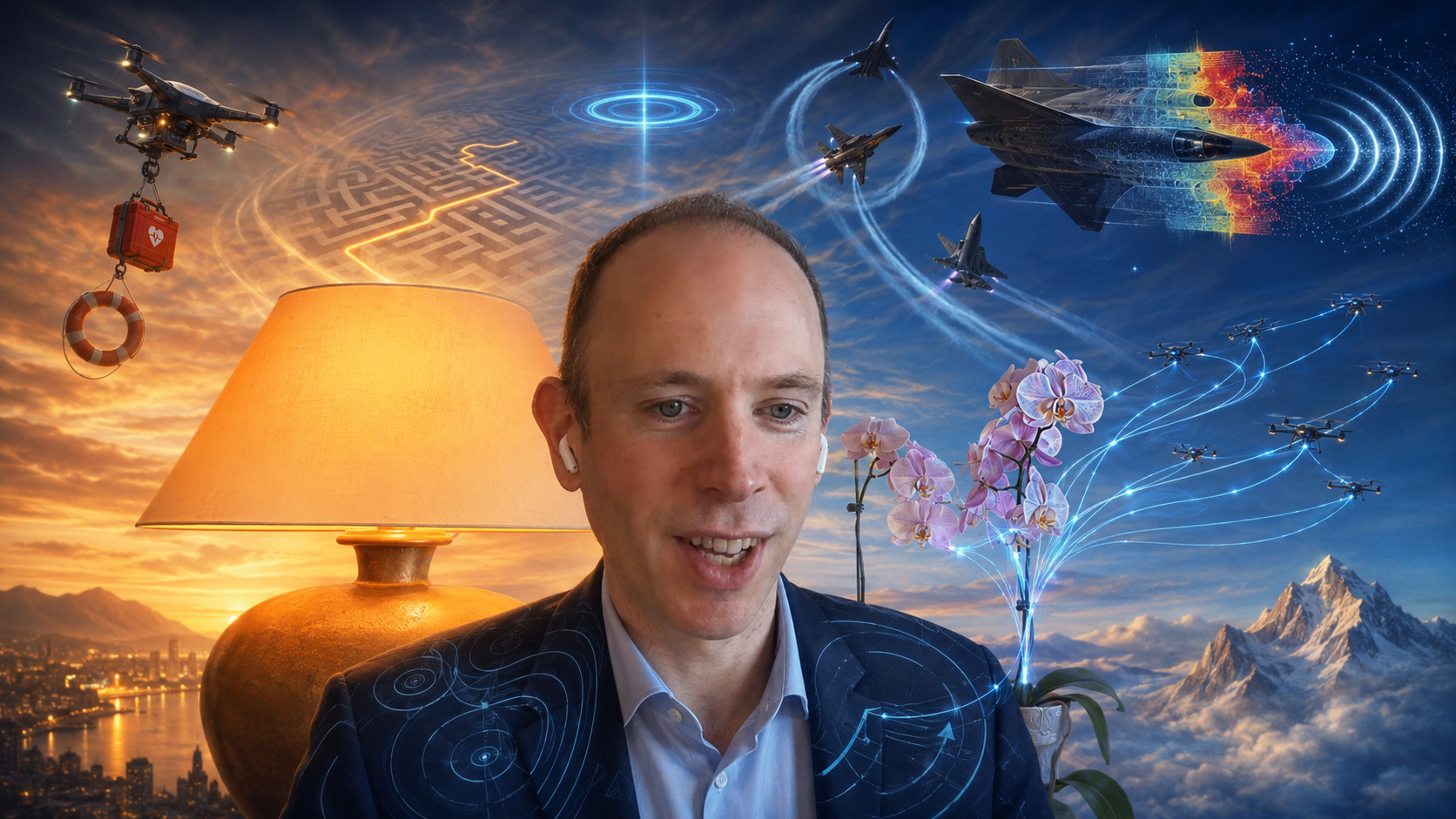
Dated August 14, 2026 in the 70 Clock archive, this portrait isolates Dr. Alex Wissner-Gross’s panel from the Conversations in Action episode with Tucker “Cinco” Hamilton and John K. Werner. @siouid142 preserves the familiar remote-call portrait—business jacket, white earbuds, warm lamp and purple orchid—but replaces the ordinary room with an impossible airspace. The result is not a photograph of a command center. It is a visual model of the episode’s central comparison between human pilots and increasingly autonomous aircraft.
The composition is divided by color before it is divided by technology. At left, orange sunset falls over a city, mountain ridges and a monumental maze. At right, cold blue sky surrounds high peaks, jets and coordinated swarms. Wissner-Gross sits across the boundary, so his face becomes the hinge between urgent operations near the ground and experimental performance at altitude. The domestic lamp reinforces the orange field; the orchid’s pink and violet blossoms mediate the transition toward blue.
Above the lamp, a heavy rescue drone carries a red medical case, an orange life ring and a suspended hook. Its payload turns autonomy away from the abstract spectacle of dogfighting and toward a legible civilian objective: find a route through dangerous terrain, reach a person and deliver aid. The maze below makes route planning visible as geometry. A single illuminated path moves through branching dead ends, while a blue target radiates above the grid. Search, obstacle avoidance and goal selection are translated into one landscape.
The right side raises the difficulty. Multiple aircraft bank through concentric contrails, while a large stealth-shaped jet dissolves into translucent structure, a heat-map core and radiating waves. Perception is shown as more than eyesight. Radar, infrared, spectral imaging, telemetry and fused sensor data pass through the aircraft’s body, suggesting that a machine may “see” variables unavailable to a human pilot. Beneath it, small drones follow luminous trajectories around the orchid, turning the flowers into both domestic objects and nodes in a coordination field.
Wissner-Gross’s jacket is patterned with circular tracks, arrows and tactical diagrams. The graphics prevent him from standing outside the system as a neutral presenter; analysis has entered the clothing of the analyst. Yet his lamp and plant remain stubbornly recognizable. The work’s method is to preserve the human layer while externalizing the computational layer. A viewer can still locate the speaker even as the environment scales from a home call to an integrated theater of sensing and action.
The source conversation framed autonomy as a progression from assistance toward performance beyond human limits. Aviation already contains narrow examples of that progression. Automatic ground-collision avoidance can intervene when a pilot is disoriented or unconscious. Autonomous test aircraft can execute maneuvers through control loops operating faster than deliberate human response. These achievements do not settle questions of mission intent, ambiguous rules, adversarial deception or accountability. The image therefore offers no score and no date.
That refusal is visible in the coexistence of maze and target. Optimization requires a defined objective, but a glowing destination does not explain who chose it or what must be sacrificed to reach it. Rescue and combat aircraft share the same sky. The same capacities—rapid sensing, path selection, coordination and persistence—can protect life or project force. The portrait makes capability radiant while keeping purpose ethically unresolved.
As a portrait, the work belongs to a tradition in which objects surrounding a sitter establish intellectual office. Books, globes and instruments once certified scholarship; here the attributes are drones, sensor fields, contrails and planning diagrams. The orchid and lamp personalize that office, while the immense airspace reveals its contemporary scale. Wissner-Gross appears less as a pilot than as a reader of systems, positioned where optimization meets uncertainty.
The portrait’s answer to the episode’s question is therefore conditional. Machines outfly humans when the task can be sensed, formalized, tested and bounded; humans remain implicated wherever the meaning of the task is contested. By embedding both claims in one synthetic sky, the work makes autonomy look neither inevitable nor imaginary. It looks like a succession of thresholds advancing through the very ordinary frame of a conversation.
Opening the gallery…