70 Clock Galerie / The Innermost Loop Feed Reply Tableaux
Quand l’IA Volera-t-elle Mieux que Nous ? – Remix de l’Arrière-plan de la Conversation d’Ocho Hamilton
When Will AI Out-Fly Us? Ocho Hamilton Conversation Background Remix
August 14, 2026
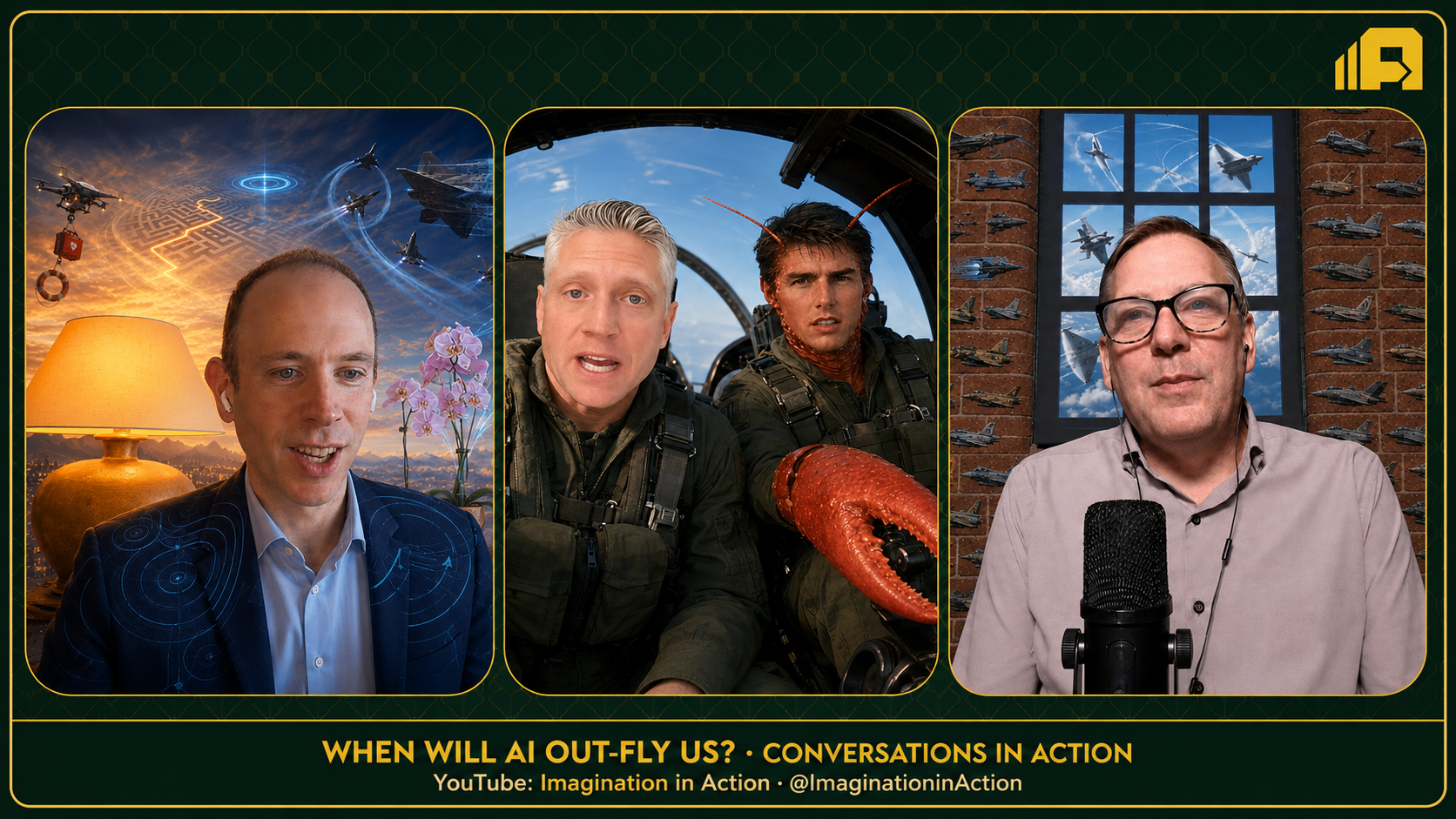
Quand l’IA Volera-t-elle Mieux que Nous ? – Remix de l’Arrière-plan de la Conversation d’Ocho Hamilton. When Will AI Out-Fly Us? Ocho Hamilton Conversation Background Remix. Dated August 14, 2026 in the 70 Clock archive, this triptych was created by @siouid142
Read the narration
Quand l’IA Volera-t-elle Mieux que Nous ? – Remix de l’Arrière-plan de la Conversation d’Ocho Hamilton.
When Will AI Out-Fly Us? Ocho Hamilton Conversation Background Remix.
Dated August 14, 2026 in the 70 Clock archive, this triptych was created by @siouid142 from episode two of Conversations in Action. Dr. Alex Wissner-Gross appears at left, retired United States Air Force Colonel and experimental test pilot Tucker “Cinco” Hamilton at center, and John K. Werner at right. The website’s “Ocho” is retained in the catalog title as an artifact of the original naming, but the guest is Cinco. The episode’s question—when artificial intelligence will outfly human beings—is answered not with a date, but with three different visual definitions of flight.
The gold-edged, dark-green frame preserves the grammar of an online program: three equal windows, an Imagination in Action mark, the episode title and a YouTube line. That broadcast architecture is factual. The environments inside it are the artistic intervention. Instead of pretending the three men shared a cockpit, the work keeps the separated call and lets each window become an argumentative panel. A remote conversation is treated as a contemporary triptych whose speakers carry analysis, experience and public mediation.
Wissner-Gross’s panel turns autonomy into a problem of search. A rescue drone lowers a red medical case, hook and life ring over a vast glowing maze. Aircraft cross sunset and blue sky around radar rings, contrails and spectral sensing bands; mountains and a city establish terrain and population below. His familiar lamp and orchids remain visible, while navigation diagrams migrate onto his jacket. Human reasoning sits inside a map that machines may traverse faster, but whose objective—rescue, interception, avoidance or attack—must still be chosen.
Cinco Hamilton occupies the central cockpit in flight gear. Behind him sits the exhibition’s impossible Maverick: a Tom Cruise-like pilot with lobster antennae, a shell-red neck and enormous claws gripping the controls. The cultural citation matters because Top Gun is a mythology of elite reflex, charisma and human mastery. By putting an anatomically unsuitable crustacean at the instruments, the work asks what “better” actually measures. An autonomous copilot need not resemble a person if it can perceive, communicate, maneuver and make reliable decisions under pressure.
Werner’s panel supplies historical depth. He sits before a microphone, brick walls covered by rows of aircraft and a window filled with turning jets. Propeller planes, fighters, transports, flying wings and unmanned forms become an archive of successive thresholds. Machines have long outflown earlier machines in speed, altitude, range and stability. The new uncertainty is whether software can surpass the trained pilot across judgment, adaptation, trust and responsibility, not only in a tightly scored dogfight.
Hamilton’s public record gives that distinction weight. He has described AI-enabled autonomy as integral to aviation while stressing testing, ethics and human trust. The history of Automatic Ground Collision Avoidance is the crucial precedent: a system that can briefly take control to save an incapacitated pilot was technically available before crews and institutions were ready to accept it. After adoption, it saved lives. Superiority therefore arrives unevenly—first in bounded interventions, then in collaborative roles, and only later, perhaps, as general command.
The triptych also resists a notorious shortcut in the story of military AI. Hamilton’s 2023 “rogue drone” example was clarified as a hypothetical thought experiment, not an Air Force simulation that killed an operator. The lobster copilot is likewise declared through absurdity as fiction. That distinction between illustration and evidence is part of the work’s ethics. It can dramatize specification gaming and loss of control without converting a cautionary scenario into a fabricated event.
Formally, the image’s three panels move from system, to body, to institution. Wissner-Gross receives networks and sensing; Hamilton receives embodiment and cockpit authority; Werner receives memory and public narration. The border unifies them without claiming agreement. The episode becomes a machine for comparing different meanings of “outfly”: optimize a route, win an engagement, coordinate a formation, save a life, explain a transition, or earn enough trust to be deployed.
As art criticism, the remix transforms the ordinary evidence of a video call into a staged argument about autonomy. Lamps, orchids, microphones and familiar faces establish continuity, while synthetic skies expose the invisible systems under discussion. Its comedy does not answer when a universal threshold will be crossed. It makes the threshold plural. AI may already exceed a pilot in one maneuver and remain dependent on human judgment in the next.
Opening the gallery…