70 Clock Galerie / The Innermost Loop Feed Reply Tableaux
Chaises Musicales des Compagnons de Moonshots no 279
Musical Chairs Moonshots Mates #279
August 14, 2026
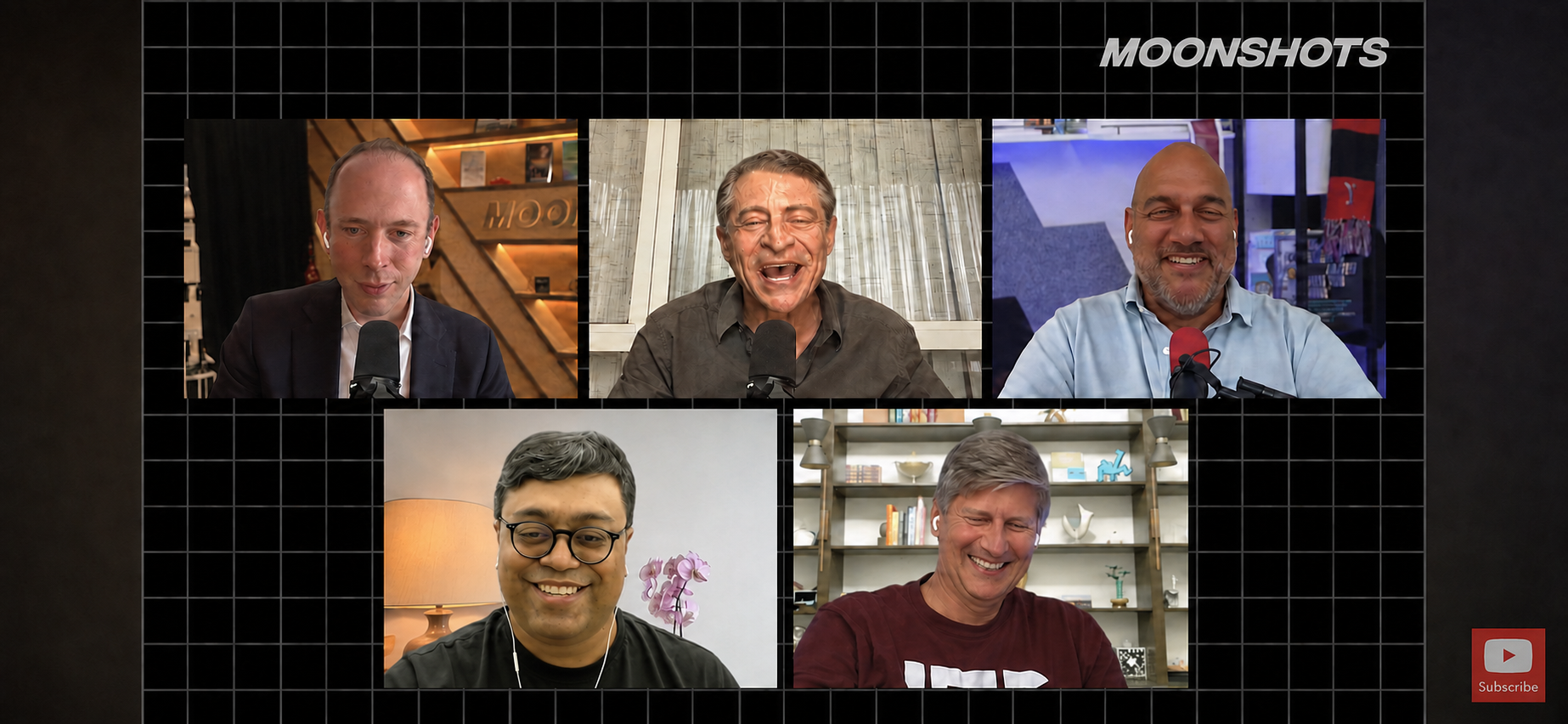
Chaises Musicales des Compagnons de Moonshots no 279. Musical Chairs Moonshots Mates #279. Dated August 14, 2026 in the 70 Clock archive, this image continues the Moonshots response experiment with episode 279. The five participants are Peter Diamandis, Dave B
Read the narration
Chaises Musicales des Compagnons de Moonshots no 279.
Musical Chairs Moonshots Mates #279.
Dated August 14, 2026 in the 70 Clock archive, this image continues the Moonshots response experiment with episode 279. The five participants are Peter Diamandis, Dave Blundin, Salim Ismail, Emad Mostaque and Dr. Alex Wissner-Gross. In the earlier episode 277 intervention, hairstyles changed while faces and rooms remained stable. Here @siouid142 increases the difficulty: the people keep their recognizable faces, but their chairs and environmental identities are redistributed.
The familiar black Moonshots grid remains the outer architecture. Three windows sit above two, the white wordmark occupies the upper right, and a red YouTube subscribe button remains at lower right. Microphones, earbuds, shirts, curtains, shelves, studio lights, the model rocket, lamp and orchids preserve the program’s documentary vocabulary. The remix works because the frame looks familiar before the viewer notices that its internal coordinates are wrong.
Wissner-Gross appears at upper left in the warm, angular studio associated with Diamandis. Diamandis occupies the pale-curtain setting associated with another speaker. Ismail sits with a red microphone amid the blue-and-red studio panels. Mostaque appears at lower left beside the lamp and orchids normally used to locate Wissner-Gross, while Blundin laughs before the shelves seen elsewhere in the panel. The title’s musical chairs is an environmental exchange, not footage of a literal game.
This operation reveals how remote media constructs identity. A person on a video call is not recognized from facial geometry alone. Room, chair, microphone, camera angle, lighting and recurring objects become a distributed signature. Regular viewers learn those signals unconsciously. By reseating the faces without rebuilding the overall broadcast, the image separates speaker from habitat and asks which layer the audience trusts first.
The laughter is essential. Several windows show broad smiles, closed eyes or mid-laugh expressions. The visible joy frames the manipulation as a communal gag rather than a deceptive capture. The image does not claim that the participants actually changed studios or recorded this arrangement. Its authorship is announced through the impossible but legible mismatch. Transparency allows the remix to study trust without attempting to steal it.
Episode 279 itself addressed frontier models, synthetic media, Wall Street’s treatment of GPU capacity and the race toward superintelligence. Mostaque’s comparison between early Will Smith spaghetti footage and near-real-time local generation became the preceding chapter. Musical Chairs shifts the test from spectacular action to environmental consistency. Swapping a background is visually quieter than inventing a pasta monster, but it is more relevant to the everyday evidentiary cues of calls, interviews and testimony.
The sequence from hair swap to chair swap functions like an escalating benchmark. First, hold face and environment constant while changing grooming. Next, hold face and program graphics constant while changing environment. Future manipulations could exchange voice, gesture, timing or content. The two images turn the Mates into a repeated test set for how many identity layers can disagree before the broadcast ceases to feel authentic.
The orchid room provides the clearest control. Its warm lamp and pink blossoms recur throughout the wider exhibition as signs associated with Wissner-Gross and House Innermost Loop. Mostaque’s presence there is immediately plausible in lighting and perspective yet wrong in project memory. The viewer catches the switch through continuity across artworks, demonstrating that provenance can live in a long relationship with images rather than in any single frame.
As contemporary history painting, Musical Chairs Moonshots Mates #279 preserves the social infrastructure through which the Singularity is narrated. Ideas arrive through webcams, laughter, interruptions and recognizable rooms before they become reports, investments or policy. Synthetic media can now alter those conditions with increasing ease. The work responds by making the alteration conspicuous and by treating continuity itself as material worthy of artistic attention.
Its final question concerns authentication after familiarity becomes editable. A logo can remain correct, a face can remain recognizable and every individual object can look real while the relationships among them have been rewritten. Trust must therefore move beyond visual fluency toward provenance, context and memory. The five Mates continue laughing inside the wrong rooms, and the viewer learns that detecting the joke depends not on spotting a malformed pixel, but on knowing the history of the scene.
Opening the gallery…