70 Clock Galerie / The Innermost Loop Feed Reply Tableaux
Maison de la Boucle la Plus Profonde – Défilé de Fei-Fei Li, d’un Dénisovien, de Sergey Brin, du Dr Shanmu Jin et de Michel Crouzeix
House Innermost Loop – Fei-Fei Li, Denisovan, Sergey Brin, Dr. Shanmu Jin, and Michel Crouzeix Walk
August 14, 2026
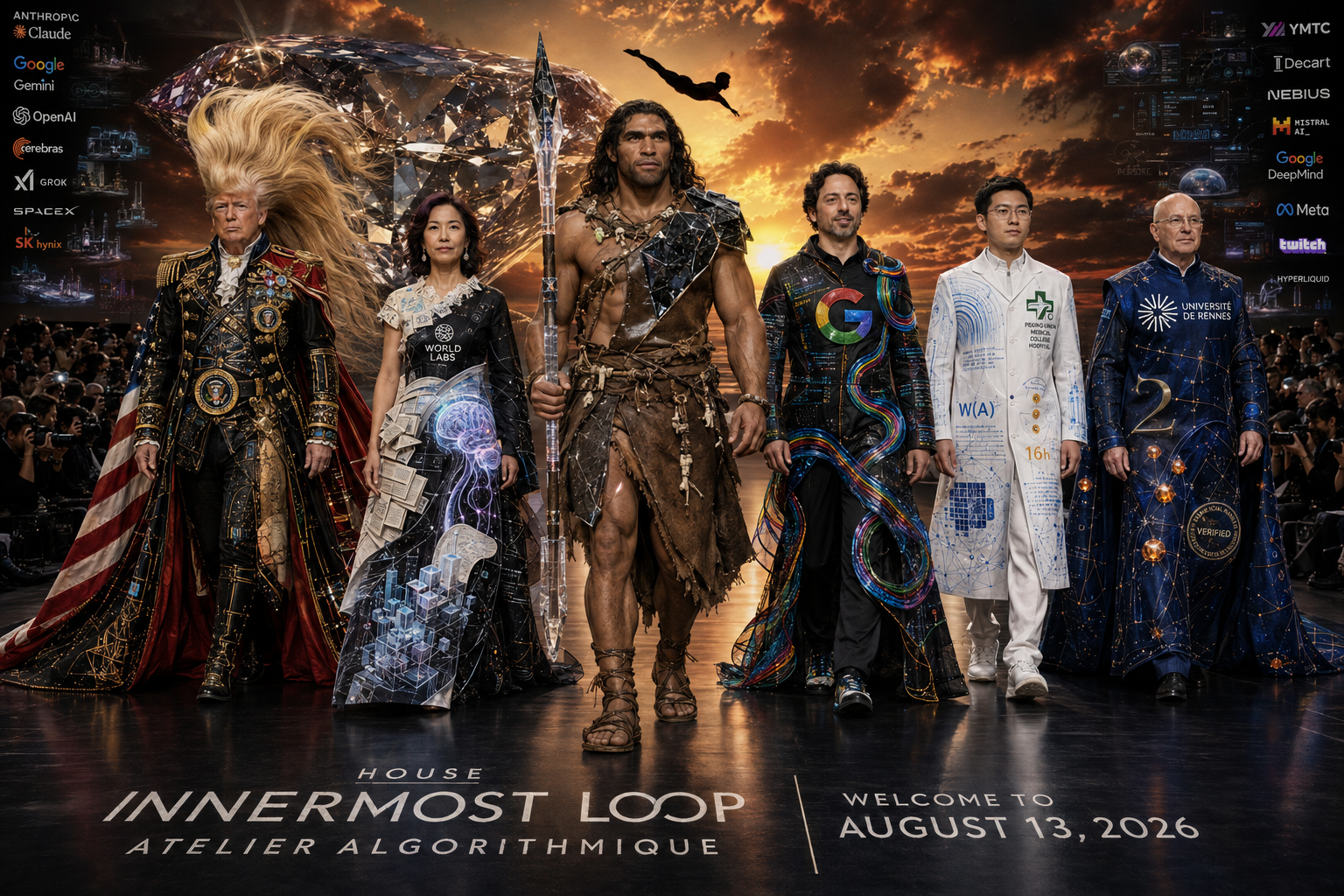
Maison de la Boucle la Plus Profonde – Défilé de Fei-Fei Li, d’un Dénisovien, de Sergey Brin, du Dr Shanmu Jin et de Michel Crouzeix. House Innermost Loop – Fei-Fei Li, Denisovan, Sergey Brin, Dr. Shanmu Jin, and Michel Crouzeix Walk. The work responds to Dr.
Read the narration
Maison de la Boucle la Plus Profonde – Défilé de Fei-Fei Li, d’un Dénisovien, de Sergey Brin, du Dr Shanmu Jin et de Michel Crouzeix.
House Innermost Loop – Fei-Fei Li, Denisovan, Sergey Brin, Dr. Shanmu Jin, and Michel Crouzeix Walk.
The work responds to Dr. Alex Wissner-Gross’s “Welcome to August 13, 2026” edition of The Innermost Loop. The date printed on the runway remains August 13, while the 70 Clock website groups file 238 under August 14, the publication date shown for that newsletter. @siouid142 preserves both pieces of evidence rather than inventing a different dispatch. The titled cast is Fei-Fei Li, a reconstructed Denisovan, Sergey Brin, Dr. Shanmu Jin and Michel Crouzeix; Donald Trump appears as an additional satirical political figure.
The Denisovan occupies the center and tallest vertical axis. The dispatch ended with leg bones from Taiwan suggesting a robust archaic human whose large brain may have accompanied a large body. The image reconstructs him in hide, plant fiber, sinew, bone ornaments, sandals and a stone-tipped spear, then fuses those materials with crystalline technical armor. No clothing survived with the Penghu evidence. The outfit is an artistic interpretation of deep time, not an archaeological claim.
His centrality turns the runway into an evolutionary timeline. Contemporary scientists and executives flank a human relative who lived outside their institutions yet belongs to the history of intelligence they are accelerating. The spear’s transparent facets rhyme with the giant diamond-like structure behind him. Natural diamond scarcity had been collapsing under laboratory production; here crystal becomes a bridge among stone tool, luxury object and computational surface.
Fei-Fei Li walks beside the Denisovan in a black-and-white World Labs garment. Papers form an asymmetric skirt, a luminous brain occupies the torso, and stacked cubes rise along the hem. Her presence comes from the dispatch’s warning that AI’s central classroom risk may be students losing motivation, agency and the desire to learn. The garment makes education an architecture around the body: pages can multiply and models can build worlds, yet the will that organizes them cannot be assumed.
Sergey Brin follows in a black Google coat traversed by a looping multicolored band. The source described him using co-founder influence to steer resources toward recursive self-improvement. The bright path doubles back across his chest and legs rather than moving in one straight line. It visualizes a system improving the process that improves the system, while the familiar Google colors keep recursion tied to corporate allocation, infrastructure and power.
Dr. Shanmu Jin wears a white Peking Union Medical College Hospital coat marked with W(A), numerical-range geometry and “16h.” He appears because a neurosurgery resident without specialist mathematical training used a sixteen-hour autonomous GPT-5.6 Sol run to crack the two-decade-old Crouzeix conjecture. The garment’s diagrams turn an extraordinary proof process into clinical notation, connecting his medical identity to the mathematical work the agent helped produce.
Michel Crouzeix closes the titled group in deep Université de Rennes blue. A large numeral 2, orbiting eigenvalue-like lights and a gold verification seal identify the conjecture’s constant and his role as originator and checker. The pairing with Jin distinguishes discovery from validation. Cheap machine intelligence may widen who can attempt advanced mathematics, but a trusted result still enters the field through scrutiny by someone able to understand what has been claimed.
Trump stands at far left in black, gold and American-flag regalia, crowned by an exaggerated windblown mane. He is the visual callback to presidential cyber letters of marque deputizing vetted private companies for supervised operations. The costume borrows military decoration and privateer theater to expose the historical oddity of translating state cyber power through an eighteenth-century legal metaphor. His presence is not promoted into the formal title because the work’s principal intellectual line runs from education through ancestry, recursive systems and proof.
The work’s final argument concerns who grades the homework of the Singularity. Models rebuild programs, solve conjectures and reorganize companies; students, researchers and states must still decide what counts as learning, proof and legitimate action. Placing Crouzeix’s verification seal beside Li’s endangered educational agency and the Denisovan’s bodily intelligence makes evaluation broader than a benchmark. Intelligence is not only the answer produced. It is the inherited capacity, motivation, judgment and institutional trust required to know what the answer means.
Opening the gallery…