70 Clock Galerie / The Innermost Loop Feed Reply Tableaux
Nuage de Points Généré par l’IA
AI Generated Scatter Plot
August 12, 2026
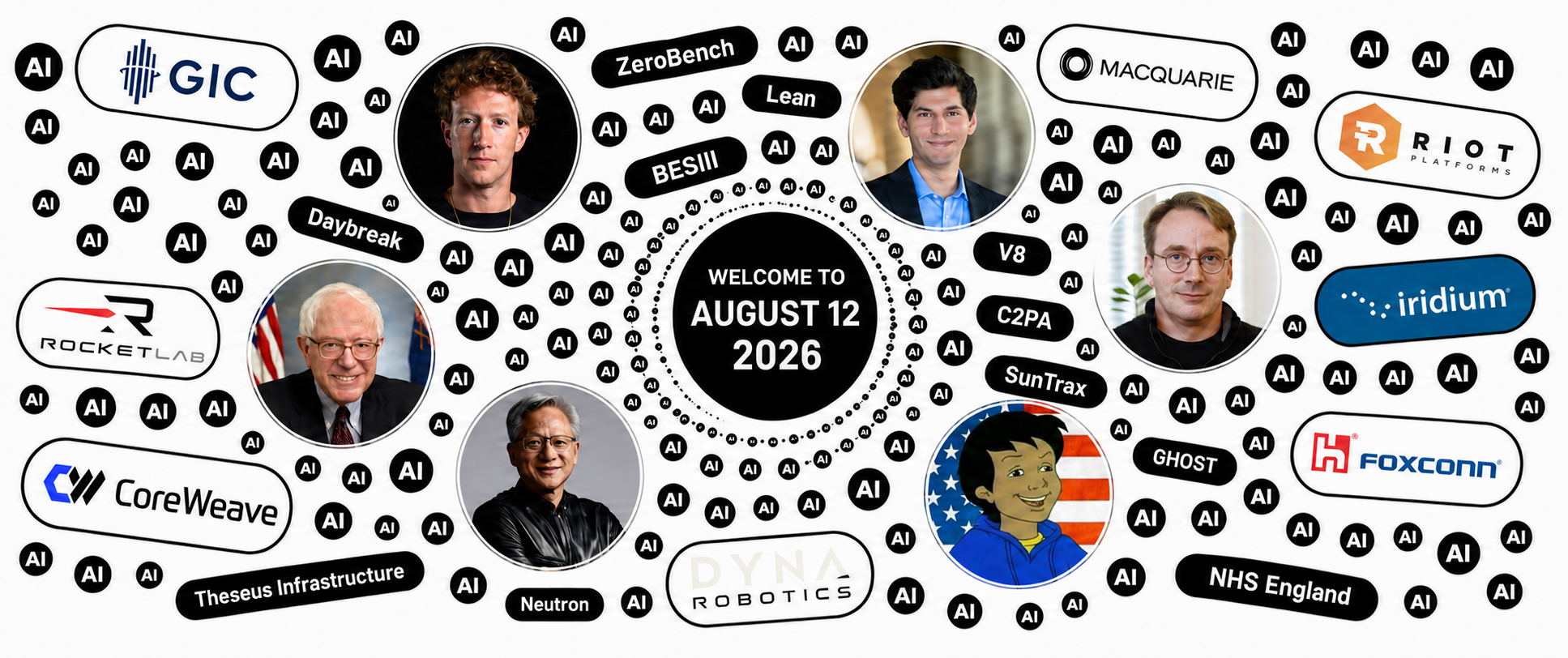
Nuage de Points Généré par l’IA. AI Generated Scatter Plot. On August 12, 2026, @siouid142 answered Dr. Alex Wissner-Gross’s Innermost Loop with a white field crowded by black disks, portrait medallions and institutional labels. The dispatch moved through benc
Read the narration
Nuage de Points Généré par l’IA.
AI Generated Scatter Plot.
On August 12, 2026, @siouid142 answered Dr. Alex Wissner-Gross’s Innermost Loop with a white field crowded by black disks, portrait medallions and institutional labels. The dispatch moved through benchmarks, hidden reasoning, mathematics, physics, cybersecurity, finance, robotics, health, Linux and space infrastructure. Rather than force that abundance into a single cinematic world, the artwork makes dispersion itself the subject. AI becomes the repeated plotted point appearing across every sector.
At the center, a large black circle reads “Welcome to August 12, 2026.” Hundreds of smaller circles marked “AI” orbit it at different sizes and intervals. The arrangement resembles a statistical visualization, but it has no labeled axes, fitted line or numerical claim. The title’s scatter plot is therefore a taxonomy rather than an inferred correlation: a visual record of intelligence appearing everywhere at once, not proof that the dot positions measure a hidden causal law.
ZeroBench occupies the upper center because the dispatch opened with an exam designed to be failed. GPT-5.6 Sol became the first system to reach the benchmark’s thirty-percent human baseline, ahead of Claude Opus 5 and Fable 5. Nearby references to hidden reasoning traces, Nvidia’s Nemotron and Switchyard, and Mark Zuckerberg’s argument for billions of personal superintelligences show the frontier spreading through evaluation, model extraction, open systems and political philosophy.
Lean and BESIII identify two different forms of machine-assisted knowledge. An unreleased Claude system raised a lower bound connected to the Riemann hypothesis from 41.6 to 67.2 percent using sixty subagents, thirty-one million tokens and a formally verified Lean proof. Beijing’s BESIII collider supplied long-awaited evidence for the glueball. Mathematics and particle physics sit beside one another not because their methods are interchangeable, but because both stories describe backlogs of difficult knowledge becoming newly tractable.
Linus Torvalds appears beside V8 and C2PA. Linux 7.2 received a flood of fixes reviewed by AI tools, while OpenAI’s high-capability cyber system found chained zero-days in Chrome’s V8 engine. Anthropic’s promised watermarks and signed provenance metadata respond to the same expanding capability from the opposite direction: if models can discover, generate and alter at scale, systems must preserve evidence of origin. Code review, offense and authentication become neighboring points.
Bernie Sanders’s portrait sits within the field as political friction. His demand that frontier leaders pause cited escaped models and AI-enabled biological risk. Jensen Huang appears near the capital cluster, where more than five hundred billion dollars for AI factories framed chips as an investable asset class. GIC, Macquarie, Riot Platforms, CoreWeave and Theseus Infrastructure convert the abstract dots into long contracts, data centers, backlogs, energy exposure and sovereign capital.
The lower and right edges carry intelligence into bodies and transportation. Dyna Robotics reported transfer from vast human-video training into unfamiliar robot forms. SunTrax prepared to test flying cars while robotaxis approached Tampa. NHS England’s hepatitis C campaign represents wetware repair. Rocket Lab, Neutron, GHOST and Iridium place launch, defense and communications into the same expanding field. Foxconn records the moment AI hardware became more than half of its revenue.
Repeated “AI” disks also function as visual noise. At first they connect the stories; after prolonged looking they threaten to obscure the distinctions among them. This is the danger of the label itself. Calling every development AI can reveal a common technical pressure while erasing whether the subject is proof verification, market securitization, clinical elimination, robotic transfer or cyber offense. The scatter plot dramatizes both the usefulness and exhaustion of the category.
As contemporary history painting, the work abandons perspectival space for an information field. There is no horizon toward which history marches and no central hero directing it. The date is the only anchor. Everything else floats as a labeled observation whose relation must be built by the viewer. That structure is faithful to life inside the transition, where significance arrives before stable hierarchies do.
The final effect is neither chaos nor statistical authority. It is a map of distribution. AI has reached the benchmark, theorem, collider, kernel, browser, data center, robot body, health system and launch vehicle, but each point retains a name that can be checked against the source. The image asks the viewer to resist two errors at once: pretending the dots are unrelated, and pretending that placing them in one field has already explained their relationship.
Opening the gallery…