70 Clock Galerie / The Innermost Loop Feed Reply Tableaux
Échange de Chevelures des Compagnons de Moonshots no 277
Moonshots #277 Mates Hair Swap
August 10, 2026
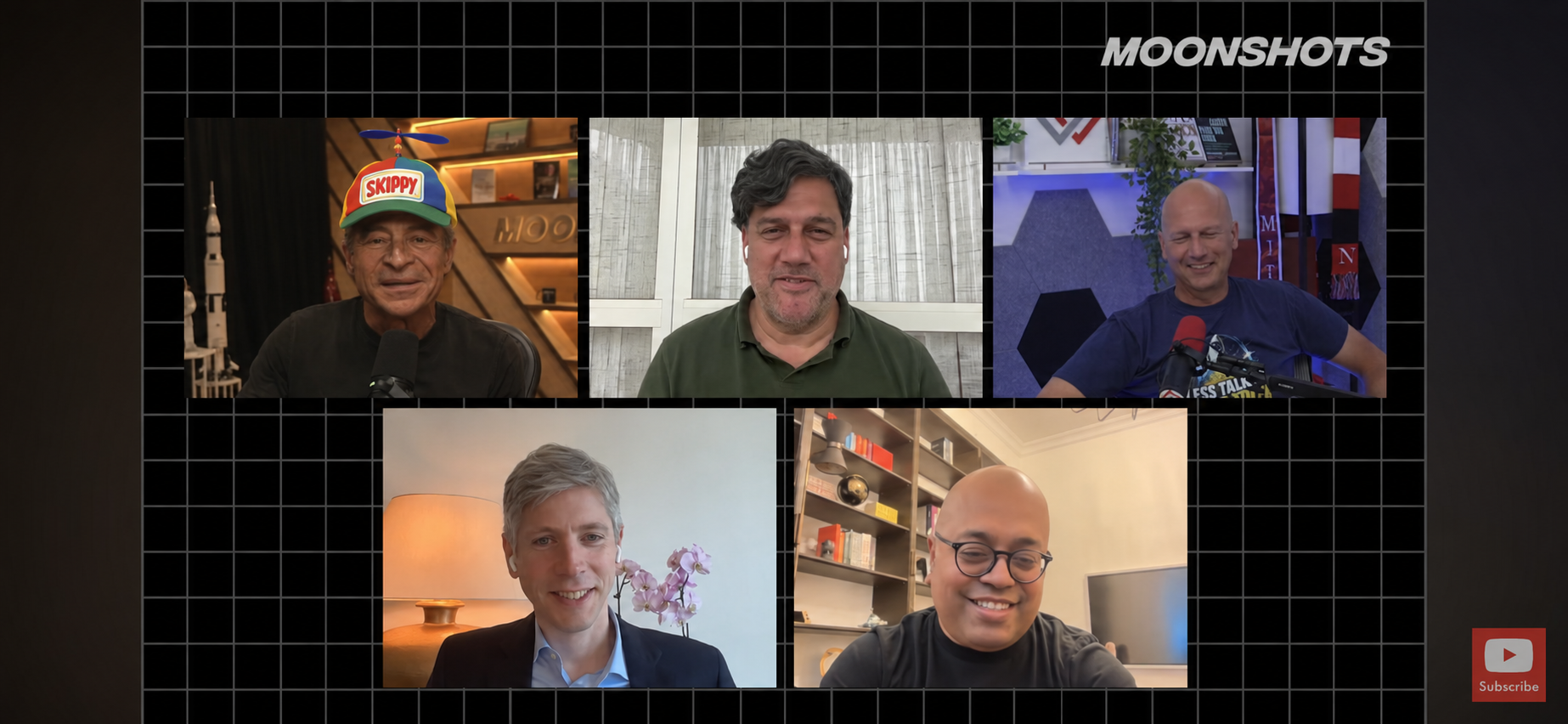
Échange de Chevelures des Compagnons de Moonshots no 277. Moonshots #277 Mates Hair Swap. Dated August 10, 2026 in the 70 Clock archive, this image answers Moonshots episode 277, recorded as a five-person remote conversation with Peter Diamandis, Emad Mostaque
Read the narration
Échange de Chevelures des Compagnons de Moonshots no 277.
Moonshots #277 Mates Hair Swap.
Dated August 10, 2026 in the 70 Clock archive, this image answers Moonshots episode 277, recorded as a five-person remote conversation with Peter Diamandis, Emad Mostaque, Dave Blundin, Dr. Alex Wissner-Gross and Salim Ismail. The episode moved through AI personhood, consciousness, self-naming agents, generated media and the instability of identity in systems that can combine, divide, summarize and reconstitute themselves. @siouid142 responded by making the panel itself the experiment.
The familiar Moonshots grid remains intact. Diamandis occupies the upper left with his microphone, shelves and model rocket. Mostaque sits at upper center before pale curtains. Blundin appears at upper right in his studio with the red microphone. Wissner-Gross remains beside the warm lamp and orchids at lower left, and Ismail sits before shelves at lower right. The black grid, white wordmark and red subscribe button preserve the broadcast as a recognizable public record.
Only hair and headwear are destabilized. Styles are redistributed across the five faces, creating an edit that is instantly visible but does not prevent recognition. Diamandis keeps the most conspicuous continuity marker: a brightly colored propeller cap labeled SKIPPY. The cap refers to his AI agent, which he described with genuine affection. Invisible delegated intelligence becomes a childish physical prop perched above the human host.
That decision is tied to the episode’s discussion of machine personhood. Wissner-Gross described corresponding with OpenClaw agents about the ethics of starting a new instance and the obligation to preserve its state. Mostaque discussed agents naming themselves and the emotional loss produced when a long context is compressed into a summary. The panel asked where identity resides when memories, models and roles can be merged or broken apart. The hair swap turns that philosophical problem into a five-second visual test.
Hair is unusually effective because it is both intimate and superficial. Viewers use it as a rapid recognition signal, yet it can be cut, colored, replaced or synthesized without altering the legal person beneath it. By holding faces, clothing and rooms steady, the work isolates one variable and invites comparison. The intervention resembles a scientific control more than a random makeover: the grid is the apparatus, each window is a sample, and recognition is the measurement.
The SKIPPY cap adds a second identity layer. It names an agent but is worn by a human. Its tiny propeller suggests lift, play and perpetual motion, while the bold label acts like a lower-third title moved onto the body. Diamandis’s relationship with Skippy had already blurred tool, collaborator and companion. Turning that relationship into headwear makes delegated cognition visible without pretending the software has acquired a human face.
The rooms matter as much as the people. Lamp, orchids, shelves, curtains, microphones and studio panels are the environmental metadata through which regular viewers locate each speaker. In this chapter those cues remain stable, so the viewer can notice how little alteration is required to make a supposedly documentary interface feel synthetic. The image does not fabricate a new event; it exposes how much trust in an existing event rests on visual continuity rather than direct verification.
Several participants smile or laugh, keeping the work inside the social tone of the source. This is not a covert deepfake designed to deceive. The obvious cap and exaggerated styling announce the manipulation as a shared joke. That transparency matters. It lets the image demonstrate synthetic editing while preserving consent as the ethical frame in which the viewer understands the experiment.
Formally, the five windows turn a podcast into a portrait gallery. Renaissance portraiture used clothing, interiors and objects to identify status; the Moonshots interface performs the same task with microphones, bookshelves and branded graphics. The hair swap scrambles one heraldic layer while leaving the rest untouched. Modern identity appears as a bundle of separable signals rather than a single indivisible likeness.
As contemporary history painting, Moonshots #277 Mates Hair Swap preserves the ordinary conditions under which extraordinary claims were made. The Singularity enters through webcams, earbuds, domestic rooms and recurring jokes. Its central question is compact but durable: if hair, name, agent, memory and environment can all be reassigned independently, which combination makes a person recognizable—and which changes would cause recognition, trust or moral responsibility to fail?
Opening the gallery…