70 Clock Galerie / The Innermost Loop Feed Reply Tableaux
Le Dr Wissner-Gross Inspiré des Atréides Chevauche un Ver à Soie
Atreides Inspired Dr Wissner-Gross Rides Silkworm
August 10, 2026
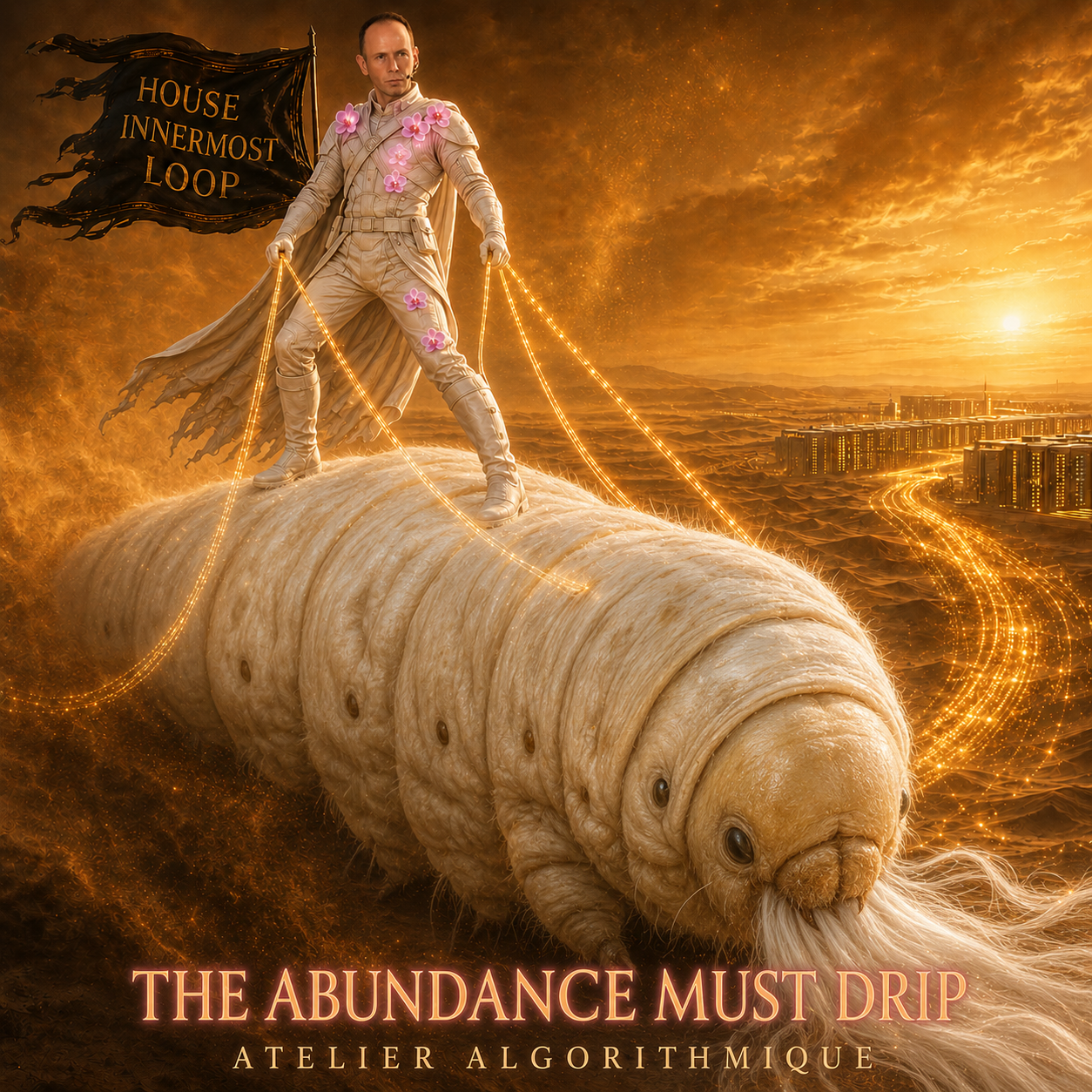
Le Dr Wissner-Gross Inspiré des Atréides Chevauche un Ver à Soie. Atreides Inspired Dr Wissner-Gross Rides Silkworm. Dated August 10, 2026 in the 70 Clock archive, this work grew from the Moonshots and Drip Abundance conversations surrounding Dr. Alex Wissner-
Read the narration
Le Dr Wissner-Gross Inspiré des Atréides Chevauche un Ver à Soie.
Atreides Inspired Dr Wissner-Gross Rides Silkworm.
Dated August 10, 2026 in the 70 Clock archive, this work grew from the Moonshots and Drip Abundance conversations surrounding Dr. Alex Wissner-Gross. @siouid142 needed one image to connect House Innermost Loop couture to the material system that could produce it. The answer was to borrow the monumental rider silhouette of Dune, replace the sandworm with a silkworm, and make the source of the clothes carry the person whose daily dispatches helped inspire them.
Wissner-Gross stands upright on an enormous pale caterpillar crossing an amber desert. He wears a fitted cream coat, matching boots and gloves, long wind-torn tails and luminous pink orchids. Gold reins run from both hands across the creature’s segmented back. Behind him, a black flag announces House Innermost Loop, while the lower inscription declares, “The Abundance Must Drip—Atelier Algorithmique.” The scene is immediately readable as science-fiction epic, but every substitution belongs to this project.
The creature is deliberately a silkworm rather than a sandworm. Its soft folds, bristles, small legs and extruding white fiber refuse the armored terror of Dune’s desert animal. It is a biological production system enlarged to mythic scale. The worm makes silk; the atelier transforms fiber into computational couture; the rider wears the result. Production, authorship and display are closed into a single loop instead of hidden in separate farms, factories and runways.
That loop reverses the famous command that the spice must flow. Here abundance must drip. Spice in Dune is scarce, politically controlled and bound to transport, prophecy and empire. Silk begins as an animal secretion and becomes valuable through cultivation, handling, design and symbolism. The project’s phrase proposes that when intelligence and fabrication become abundant, distinction migrates away from raw scarcity toward direction, taste, ritual and the ability to make plenitude visible.
The distant city sharpens the argument. Rectangular buildings and luminous traffic lines spread through the desert like a data-center settlement, while the worm’s golden reins branch into the same network. Biological fiber, electrical routing and urban infrastructure share one visual grammar. The rider does not simply dominate nature; he is attached to a chain in which a living organism, a computational city and a fashion house continuously convert one form of capacity into another.
The orchids are the exhibition’s recurring signature and the garment’s most delicate lights. They turn House Innermost Loop branding into a living motif, but they also interrupt the masculine severity of the Atreides pose. Small blossoms appear on shoulder, chest and thigh where military insignia or armor would normally sit. The result is less a conqueror than a creative director whose authority depends on carrying softness through a hostile industrial landscape.
Scale remains intentionally unstable. Wissner-Gross is human-sized relative to the flag yet tiny relative to the silkworm. The city is vast in the distance but can be crossed by threads issuing from the animal. The work uses epic proportion to ask which actor actually possesses agency. The rider holds reins, the organism produces the essential material, the city supplies technical processing, and the image system makes their relation visible. No single element can claim the whole achievement.
As art criticism, the tableau combines equestrian portraiture, science-fiction homage and fashion advertising. Traditional mounted portraits magnified political power by placing a ruler above a controlled animal. This rider stands on the organism that literally provides his medium. The heroic structure survives, but mastery is compromised by dependence. Abundance is not summoned from nowhere; it grows, extrudes, requires habitat and must be directed without pretending the producer is merely a platform.
The image also clarifies the ambition of Drip Abundance as a film and fashion narrative. Its world is not built from generic futurism. It is built from recurring orchids, biological manufacture, algorithmic design, Moonshots conversation, Innermost Loop analysis and the playful theft of recognizable cultural forms. Dune supplies a grammar grand enough to hold those relationships, but the silkworm prevents the homage from swallowing the local idea.
The final joke is therefore materially serious. The worm-rider silhouette promises dominion over scarcity; the silk pouring from the creature reveals a system of interdependence. Wissner-Gross rides toward a luminous city wearing the product of the body below him. “The abundance must drip” becomes neither pure optimism nor parody. It is a demand that technological plenty acquire form, responsibility and beauty—and that the living and industrial processes making it possible remain visible in the picture.
Opening the gallery…