70 Clock Galerie / The Innermost Loop Feed Reply Tableaux
Gouverner, c’est Foutu
Governing is Cooked
August 7, 2026
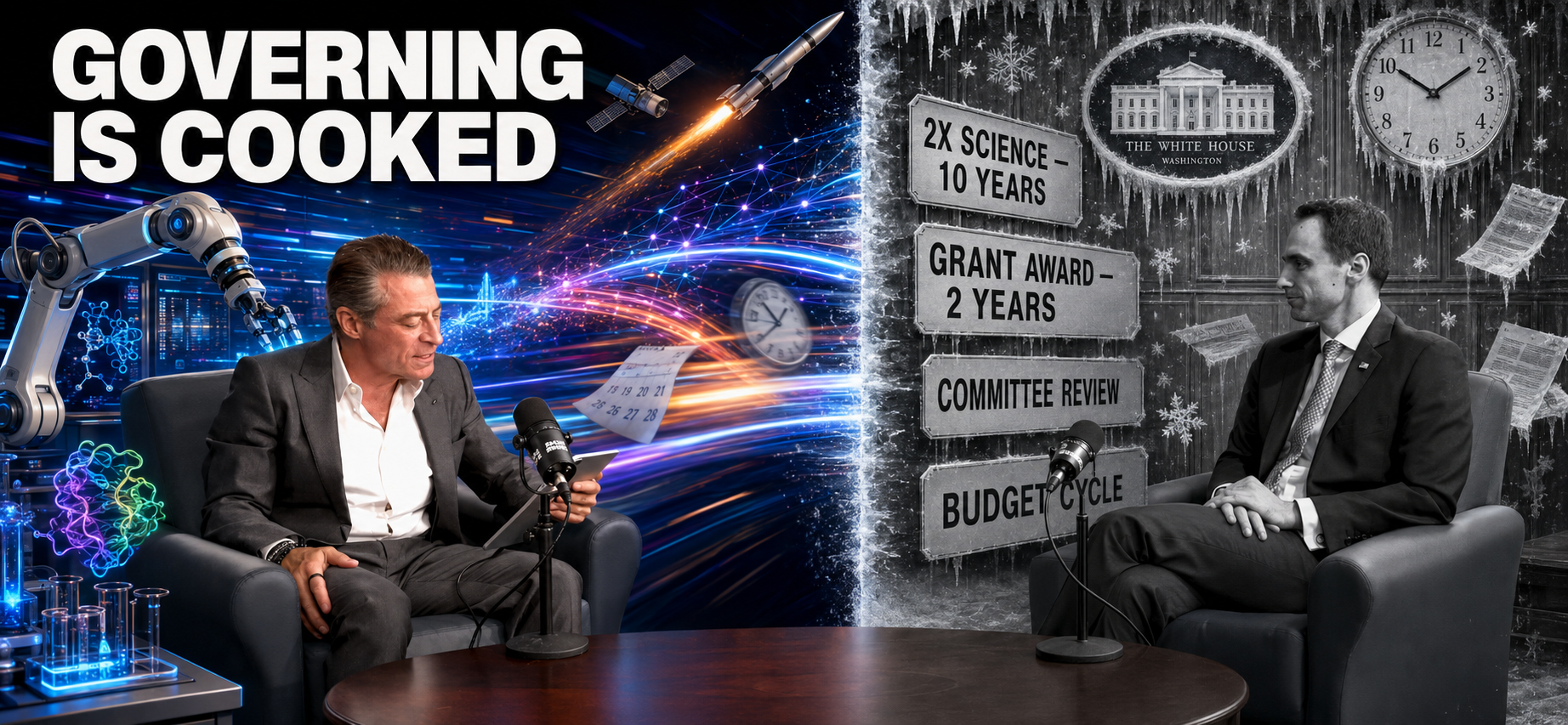
Gouverner, c’est Foutu. Governing is Cooked. Dated August 7, 2026 in the 70 Clock archive, Governing is Cooked responds to Moonshots episode 276, in which Peter Diamandis interviewed White House science adviser Michael Kratsios about a new golden age of Americ
Read the narration
Gouverner, c’est Foutu.
Governing is Cooked.
Dated August 7, 2026 in the 70 Clock archive, Governing is Cooked responds to Moonshots episode 276, in which Peter Diamandis interviewed White House science adviser Michael Kratsios about a new golden age of American science. The conversation described the Genesis Mission, the AI Action Plan and a proposal to double scientific productivity over ten years, then entertained the far more aggressive possibility of tenfold acceleration. @siouid142 converts the tension between exponential ambition and institutional procedure into one brutally clear split screen.
Diamandis sits at left in full color inside a saturated AI laboratory. A robot arm hovers over glowing molecular models; servers pulse behind glassware; a satellite and rocket cut through streams of light; calendars and clocks are pulled into the motion. Modeling, experiment, analysis, funding and deployment appear to occur in parallel, with each result becoming the input to another process before the previous visual trace has faded.
Kratsios sits at right in a monochrome government chamber beneath the White House seal. Ice covers the walls, papers and clock. Four signs identify the bottlenecks: “2X science—10 years,” “grant award—2 years,” “committee review” and “budget cycle.” The image does not claim that Kratsios opposed acceleration. In the interview he argued that government should aim for ten times improvement and acknowledged that the institution is linear at best.
The episode’s underlying diagnosis was not a shortage of scientific talent. Kratsios described researchers as national crown jewels who can spend roughly forty-five percent of their time on paperwork. The Golden Age proposals included longer-duration support, faster grants, high-risk “golden tickets,” metascience units and more explicit national missions. Diamandis imagined AI agents posting bounties, autonomous laboratories running experiments and funding released around measurable progress.
The title’s slang performs a thermal pun. To say governing is “cooked” means the process is broken or exhausted, yet the government half is visibly frozen rather than overheated. Policy can be cooked precisely because it cannot generate enough heat to change state. The clocks still move, committees still meet and budgets still cycle, but the surrounding world remains locked while technological time accelerates on the other side.
The rocket at the center edge recalls the national missions Kratsios named: humans returning to the Moon, elements of a lunar base, a nuclear reactor in space and a quantum computer. These goals require government because markets alone may not coordinate their scale, risk or public purpose. The image therefore stops short of a libertarian fantasy in which administration simply disappears. The frozen chamber is a critique of serial delay, but it also contains the seal that grants collective legitimacy to missions affecting everyone.
Diamandis and Kratsios remain seated at microphones across both halves. That continuity preserves the source as a policy conversation rather than turning the men into enemies. Their shared table crosses the visual border even when color does not. The formal structure suggests that acceleration and governance must communicate, but currently do so through media faster than through implementation. Speech can cross the divide immediately; appropriations, procurement and grants cannot.
As art criticism, Governing is Cooked belongs to a history of political photomontage in which scale and color expose ideology. The left behaves like an advertisement for frictionless abundance; the right resembles an archival photograph of authority trapped in its own paperwork. The vivid lab can aestheticize speed and hide external costs, while the frozen institution can mistake caution for responsibility. The split prevents either side from claiming the whole truth.
The placards provide the work’s audit trail. Doubling science in ten years sounds ambitious until it is placed beside systems improving over months. A two-year grant award can protect fairness and deliberation, yet it can also consume the relevance of a fast-moving proposal. Committee review distributes judgment but can reward the least controversial idea. Budget cycles create accountability while forcing nonlinear opportunities into annual boxes. Every safeguard is also a latency source.
The work’s final proposition is institutional rather than anti-government. If intelligence can model, test and learn in parallel, public administration needs new forms of parallelism without abandoning law, evidence or democratic consent. A faster state cannot simply become an agent with root access. It must make review continuous, funding adaptive and purpose explicit. Governing is cooked only if society accepts the current temperature as inevitable. The image freezes the bottleneck so clearly that thawing it becomes the next moonshot.
Opening the gallery…