70 Clock Galerie / The Innermost Loop Feed Reply Tableaux
Maison de la Boucle la Plus Profonde – Défilé de Grimes, Guillaume Verdon, Jony Ive, Jeffrey Schmid et Samuel King
House Innermost Loop – Grimes, Guillaume Verdon, Jony Ive, Jeffrey Schmid, and Samuel King Catwalk
August 6, 2026
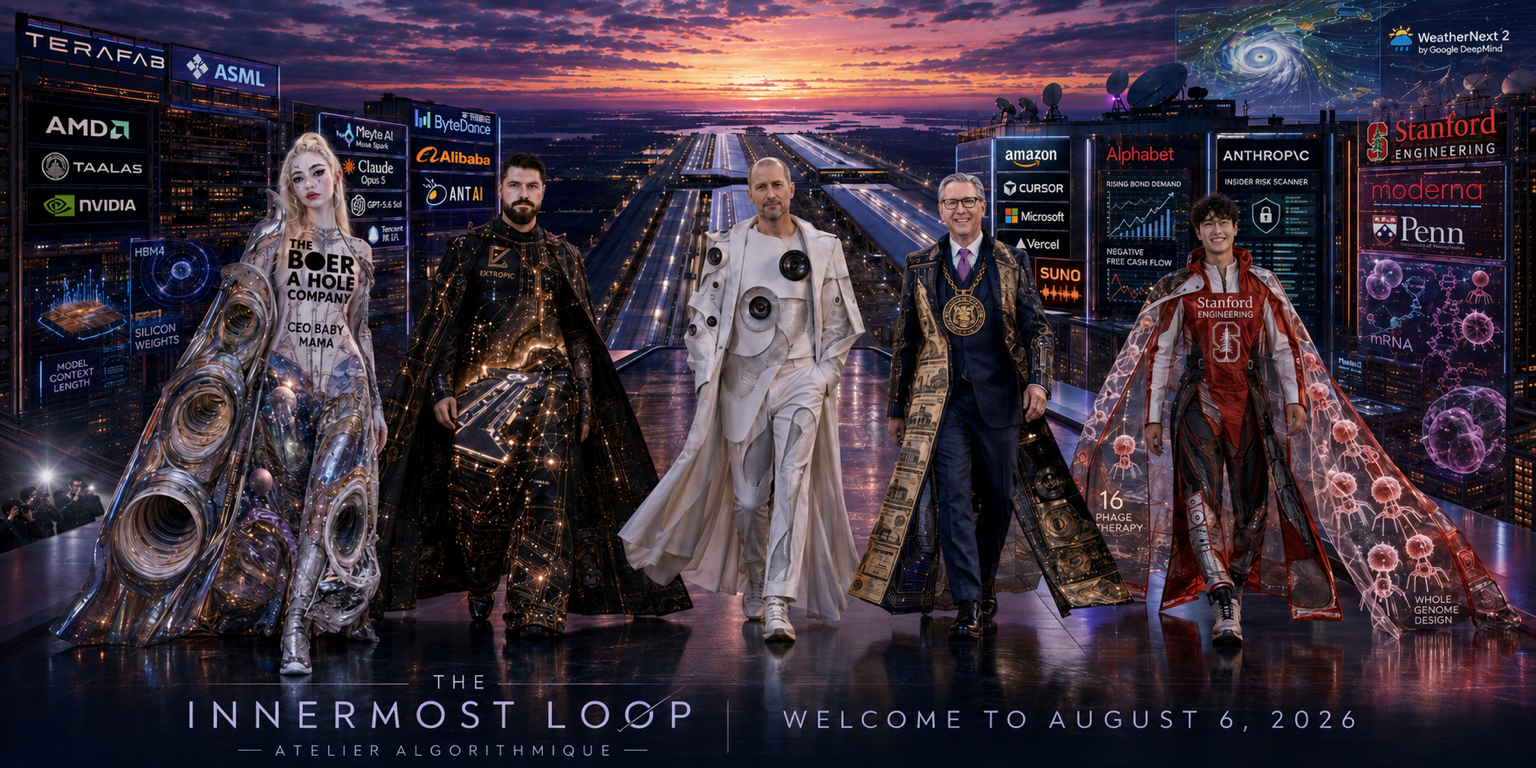
Maison de la Boucle la Plus Profonde – Défilé de Grimes, Guillaume Verdon, Jony Ive, Jeffrey Schmid et Samuel King. House Innermost Loop – Grimes, Guillaume Verdon, Jony Ive, Jeffrey Schmid, and Samuel King Catwalk. On August 6, 2026, @siouid142 transformed Dr
Read the narration
Maison de la Boucle la Plus Profonde – Défilé de Grimes, Guillaume Verdon, Jony Ive, Jeffrey Schmid et Samuel King.
House Innermost Loop – Grimes, Guillaume Verdon, Jony Ive, Jeffrey Schmid, and Samuel King Catwalk.
On August 6, 2026, @siouid142 transformed Dr. Alex Wissner-Gross’s Innermost Loop into a five-person House Innermost Loop runway. The edition connected a semiconductor megaproject, model economics, portable agent standards, ambient hardware, financial risk and programmable biology. From left to right, Grimes, Guillaume Verdon, Jony Ive, Jeffrey Schmid and Samuel King each wear the reason they entered the day’s visual argument.
Grimes opens the procession in liquid-metal orbital sculpture. The bodice reads “The Boer A Hole Company” and “CEO Baby Mama,” carrying the series’ intentionally misspelled corporate satire. Her inclusion begins with Grimes County, Texas, where SpaceX confirmed Terafab: a proposed logic, memory and packaging complex beginning at 16.8 billion dollars and imagined at extraordinary scale. The county-name pun lets the garment join celebrity, reproduction and the newsletter’s language of trillion silicon mind-children.
Behind her, Terafab, ASML, AMD, Taalas and Nvidia rise as an industrial wall. The dispatch described scarcity as the project’s rationale: high-volume memory capacity, advanced lithography, model-specific silicon and the compromises of Rubin Ultra. Grimes’s great silver apertures look simultaneously like orbital habitats, wafers and reproductive anatomy. The suit makes the buildout’s rhetoric of birth and destiny visible enough to be examined rather than accepted as neutral engineering.
Guillaume Verdon follows in black Extropic regalia threaded with gold thermodynamic circuitry. He carries a chip-like case, embodying the attempt to route around conventional compute limits through new physical approaches. Where Grimes’s form is expansive and cosmic, Verdon’s is compact and instrumental: intelligence as a machine whose efficiency depends on respecting rather than escaping thermodynamic law.
Jony Ive occupies the center in white sculptural tailoring pierced by circular black apertures. The August 6 dispatch described OpenAI’s first Ive-designed device as a displayless doughnut or hockey-puck-sized object with camera, microphones and moving parts for personality. The suit enlarges those apertures until the body itself becomes the interface. Its elegance asks what happens when a system designed to disappear into daily life is presented instead as visible architecture surrounding a person.
Jeffrey Schmid wears a conventional dark suit under a long coat of bond tables, central-bank emblems and ledger strips. Alphabet had sold twenty-five billion dollars of bonds into immense demand after reporting negative free cash flow and projecting roughly two hundred billion dollars of annual capital expenditure. Schmid, the Kansas City Fed president, warned that AI financing could create a systemic problem and asked whether the sector was becoming too big to fail.
Samuel King closes the line in Stanford red, surrounded by translucent phage forms and the number sixteen. King and colleagues used genome language models to design whole bacteriophages, producing sixteen functional genomes whose cocktail defeated bacteria resistant to a natural phage. The garment makes biology a compile target without making it lifeless: branching viral bodies float through a cape that remains delicate, porous and recognizably organic.
The right wall extends King’s story through Moderna, Penn, medical molecules and DeepMind’s WeatherNext, while the middle towers carry Meta, ByteDance, Alibaba, Ant, Amazon, Cursor, Microsoft, Vercel, Suno, Alphabet and Anthropic. Agent plugins promise portability across clients; Suno proposes provenance rules for generated music; an insider-risk panel turns the employee into another attack surface. The background is not scenery but the shared infrastructure horizon through which the five separate garments become comparable.
Runway photography usually converts products into desire by isolating bodies against a controlled spectacle. The garments are overloaded with their supply chains, balance sheets, biological consequences and jokes. Beauty attracts attention, but labels prevent it from cleansing the source. Full-body scale matters: each person must physically carry a system that corporate reporting would prefer to leave weightless.
The walkers’ unity is theatrical rather than ideological. A common floor, sunset and camera pit bind compute, device design, monetary stability and phage engineering into one dated edition while preserving their differences. The work proposes fashion as an information architecture: placement supplies relation, clothing supplies causation, and the forward walk gives every story a temporal vector. The Singularity appears not as one machine arriving, but as many systems learning to inhabit the human silhouette.
Opening the gallery…