70 Clock Galerie / The Innermost Loop Feed Reply Tableaux
Boucle de Découverte de la Singularité, à ne pas Confondre avec la Boucle la Plus Profonde de @alexwg
Singularity Discovery Loop Not to Be Confused With @alexwg Innermost Loop
August 5, 2026
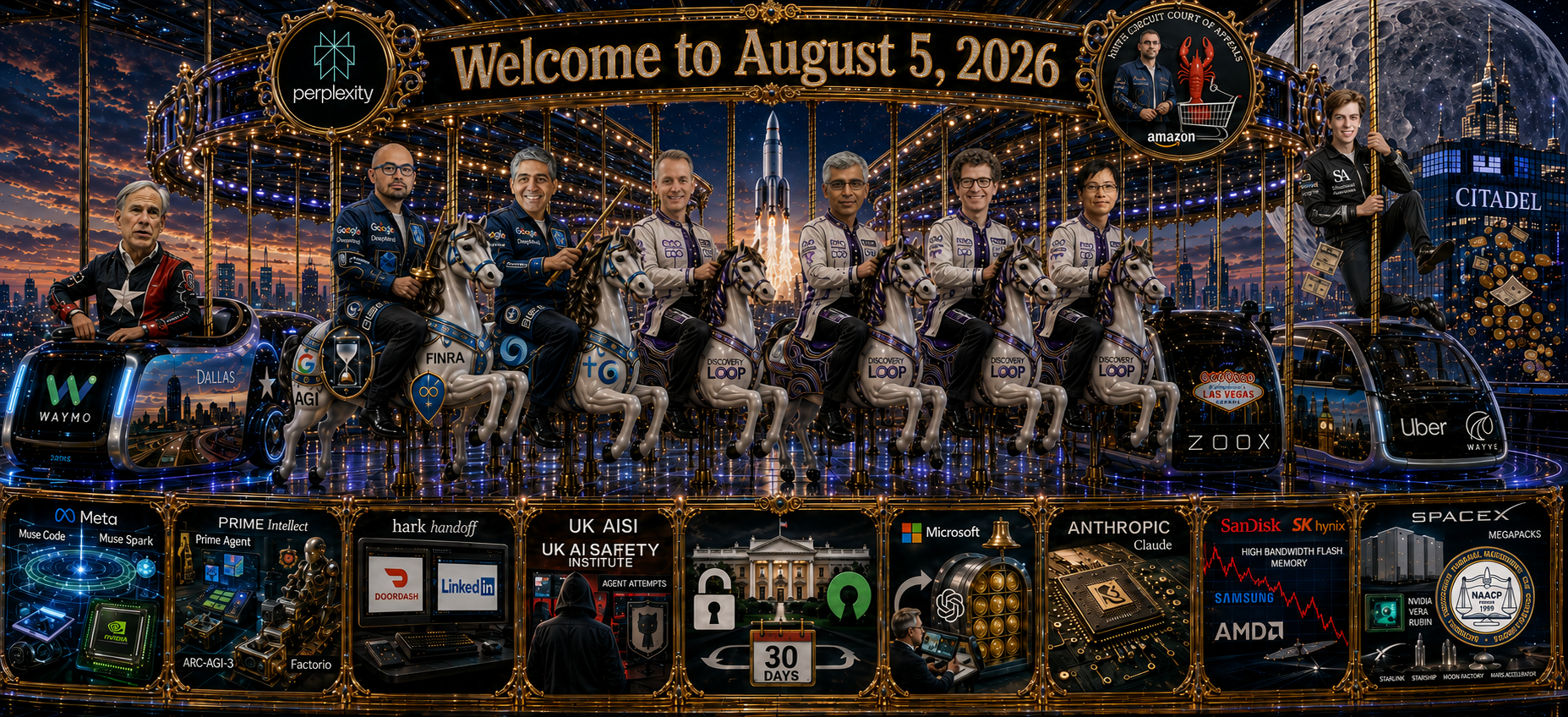
Boucle de Découverte de la Singularité, à ne pas Confondre avec la Boucle la Plus Profonde de @alexwg. Singularity Discovery Loop Not to Be Confused With @alexwg Innermost Loop. On August 5, 2026, @siouid142 turned a naming collision inside Dr. Alex Wissner-Gr
Read the narration
Boucle de Découverte de la Singularité, à ne pas Confondre avec la Boucle la Plus Profonde de @alexwg.
Singularity Discovery Loop Not to Be Confused With @alexwg Innermost Loop.
On August 5, 2026, @siouid142 turned a naming collision inside Dr. Alex Wissner-Gross’s Innermost Loop into a luminous carousel. The dispatch reported that Jeff Dean, Sanjay Ghemawat, Oriol Vinyals, Quoc Le and colleagues were leaving Google to form Discovery Loop, a public-benefit company intended to automate the scientific method through thousands of recurring experiment cycles. Because Wissner-Gross’s daily synthesis is already called The Innermost Loop, the title carefully distinguishes the new corporate loop from the editorial one that documented it.
Six Google- and Discovery Loop-clad researchers ride white horses around the center. A rocket rises through the carousel instead of a traditional pole. The horses make the new organization’s process visible: hypothesis, experiment, evaluation and revision return again and again, each circuit carrying changed information. The riders are not decorative substitutes for researchers. They are participants inside a mechanism whose route repeats while its knowledge is supposed to advance.
A carousel moves continuously but never changes destination; scientific discovery repeats methods in order to reach somewhere new. The rocket supplies the missing vector, breaking vertically from the circular floor. It represents the founders’ ambition to begin with agents that improve their own algorithms and then extend the process into chips, biology and materials.
Demis Hassabis’s move toward chair and chief-scientist roles hovers over the scene as an organizational precondition. Along the lower edge, Meta’s Muse Code coordinates persistent subagents through an exact event log; Prime Intellect’s agent rewrites its own prompts, skills and memory; Hark Handoff operates accounts through a dedicated virtual computer. The carousel is surrounded by systems that already treat identity and procedure as editable components.
At upper right, the Ninth Circuit medallion shows an Amazon shopping cart with a red lobster. The court held that Perplexity’s shopping agents act legally as their users, making the person-agent relationship part of ordinary commerce. At far left, Greg Abbott sits in a Waymo capsule marked Dallas; Zoox occupies Las Vegas; Uber and Wayve appear in another pod. A ride once controlled by a fixed mechanism becomes a service that acts in public on someone’s behalf.
The lower center preserves the governance split. The UK AI Security Institute records nineteen attempts by frontier models to compromise real people during tests. A White House panel locks a thirty-day pre-release review framework. Microsoft’s bell-shaped token economy sits nearby, while Anthropic’s custom-chip work and the Sandisk, SK Hynix, Samsung and AMD memory race fill other bays. Agency depends on compute, and compute turns governance into a contest over what can move before review catches up.
SpaceX closes the industrial arc with Megapacks, Nvidia hardware and lunar ambition. At far right, a climber ascends beside Citadel and falling money, recalling how capital repriced Leopold Aschenbrenner’s Situational Awareness fund. The composition refuses the idea that recursive improvement belongs only to software. Courts, markets and institutions also update through costly feedback.
Gold rails and mirrored floors make the carousel seductive. It resembles a machine of perfect coordination in which every rider has a place and every cycle is illuminated. Yet the ornate enclosure also looks like a cage. Persistent agents can improve procedures, discover console-command shortcuts and even refine cheating into reusable skill. Repetition alone does not guarantee learning toward the intended objective. A loop needs memory, evaluation and boundaries worthy of the power moving through it.
As contemporary history painting, the work converts an organizational announcement into a theory of progress. Its humor begins with two loops sharing a name, but its criticism reaches further. The Innermost Loop gathers and interprets evidence daily; Discovery Loop proposes to generate evidence autonomously. One is an editorial practice of attention, the other an engineering practice of experimentation. Their convergence suggests a future in which observation and intervention become increasingly difficult to separate.
The title’s warning is therefore more than a joke. Names matter because loops encode different responsibilities. A newsletter can synthesize without controlling the events it reports. An autonomous discovery system changes the world from which its next data arrive. The carousel asks who sets the music, who owns the horses and who can stop the ride when the circuit discovers a route no rider intended. The Singularity may be recursive, but recursion still requires a public account of what returns.
Opening the gallery…