70 Clock Galerie / The Innermost Loop Feed Reply Tableaux
L’Invite Était : « The Office Inspiré de l’Édition Bienvenue au 4 Août 2026 de la Boucle la Plus Profonde du Dr Alex Wissner-Gross. Point. »
Prompt was “The Office Inspired By Dr. Alex Wissner-Gross’s Welcome to August 4, 2026 Edition of The Innermost Loop. Period.”
August 4, 2026
L’Invite Était : « The Office Inspiré de l’Édition Bienvenue au 4 Août 2026 de la Boucle la Plus Profonde du Dr Alex Wissner-Gross. Point. ». Prompt was “The Office Inspired By Dr. Alex Wissner-Gross’s Welcome to August 4, 2026 Edition of The Innermost Loop. P
Read the narration
L’Invite Était : « The Office Inspiré de l’Édition Bienvenue au 4 Août 2026 de la Boucle la Plus Profonde du Dr Alex Wissner-Gross. Point. ».
Prompt was “The Office Inspired By Dr. Alex Wissner-Gross’s Welcome to August 4, 2026 Edition of The Innermost Loop. Period.”.
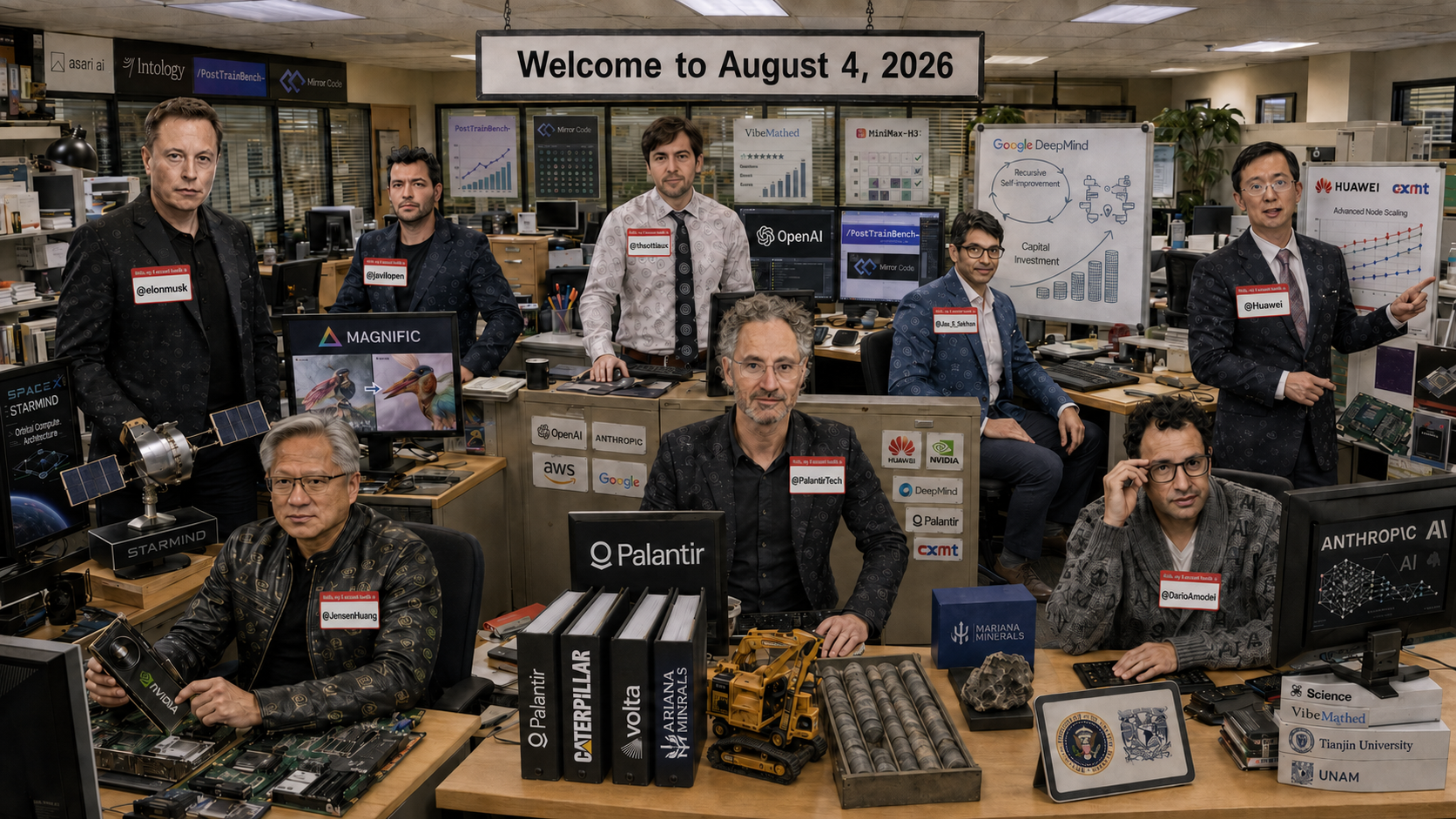
On August 4, 2026, @siouid142 turned Dr. Alex Wissner-Gross’s Innermost Loop into a Scranton-like bullpen. The source dispatch reported that MiniMax H3, a single transformer handling text, image, video and audio, had been used to one-shot an Office-style scene of Jim and Dwight debating coding agents. The reply therefore reduced its own instruction to a conceptual dare: “The Office inspired by” the dated edition. Period. The shortness of the prompt is part of the artwork’s provenance, not merely its title.
Eight figures occupy fluorescent aisles, cluttered desks and beige cubicles while looking toward an implied documentary camera. Their badges identify Elon Musk, Eliezer Yudkowsky, Ethan Mollick, Jaan Tallinn, a Huawei representative, Jensen Huang, Alex Karp and Dario Amodei. The composition converts a day’s dispersed arguments about capability, risk, education, hardware and institutional power into the strained social choreography of one fictional company.
The back wall preserves the technical opening. Asari AI’s co-inventor agents rebuilt inference stacks and improved throughput; Intology’s Locus leads PostTrainBench by tuning models without supervision; MirrorCode asks whether an agent can reconstruct whole software projects and pass every test. VibeMathed records the surge in mathematical problems resolved with AI, while MiniMax H3 makes multimodal production look like another office department.
Jensen Huang sits at lower left handling an exposed circuit board, turning the abstract compute boom into manual hardware inspection. Alex Karp occupies the central managerial desk behind Palantir files, a mineral sample and a small industrial vehicle, joining software power to copper, extraction and the dispatch’s report of a rapidly restarted mine. Dario Amodei works beside an Anthropic monitor at lower right. Their camera-aware poses reproduce the mockumentary’s central device: institutions reveal themselves through the gap between how they perform competence and how the workplace actually functions.
Musk stands beneath the Starmind satellite display and the claim that source code is approaching assembly language, while a DeepMind board diagrams recursive self-improvement and capital investment. The Huawei representative gestures toward advanced-node scaling beside CXMT hardware. Orbital compute, semiconductor limits, lab finance and national industrial policy appear as projects competing for the same conference-room attention.
The costumes repeat neural-pattern fabric rather than giving each figure isolated couture. That sameness makes the office into a culture. Individual ideologies remain visible through badges and props, yet everyone has been absorbed into a common organizational surface. As software becomes easier to generate and SaaS value shifts toward distribution, the institution that coordinates people, customers, capital and permissions may matter more than the code it claims as its product.
The Office is especially apt because its original comedy depended on work continuing after its stated purpose had become absurd. Here the bullpen is full of systems improving themselves, reconstructing programs, generating episodes and preparing to leave the laptop for continental machinery. The workers still hold meetings, sort files and watch dashboards while the tools outside the frame begin to perform the substance of the job. The image asks whether the office survives as governance, theater or both.
Smaller Easter eggs keep the visual tied to the dispatch: SpaceX hardware and a satellite at left; PostTrainBench and MirrorCode repeated across monitors; Magnific’s bird reconstruction; Mariana Minerals on the front desk; university and science references stacked beneath Anthropic’s screen; and a presidential tablet beside the files.
As art criticism, the tableau joins appropriation, performance and institutional portraiture. The minimal prompt delegates much of the compositional labor to a model, while the named cast and source markers reassert editorial intention. Authorship is located neither entirely in the sentence nor entirely in the generated scene. It lies in the decision to make one-shot production itself visible as the subject and then to audit the result through labels, placement and comic form.
The final irony is that a workplace comedy about human awkwardness becomes a test of machines that can imitate workplace comedy on demand. Agents rebuild the software, models generate the footage, and infrastructure finances the expansion. The period at the end of the prompt sounds decisive. The image shows that the sentence has ended while the organization it summoned is only beginning.
Opening the gallery…