70 Clock Galerie / The Innermost Loop Feed Reply Tableaux
Andrej « Legolas » Karpathy Réalise en une Prise Le Seigneur des Anneaux et Yung « Matt Benton » Gandalf
Andrej “Legolas” Karpathy One Shots Lord of The Rings and Yung “Matt Benton” Gandalf
August 3, 2026
Andrej « Legolas » Karpathy Réalise en une Prise Le Seigneur des Anneaux et Yung « Matt Benton » Gandalf. Andrej “Legolas” Karpathy One Shots Lord of The Rings and Yung “Matt Benton” Gandalf. On August 3, 2026, @siouid142 answered Dr. Alex Wissner-Gross’s Inne
Read the narration
Andrej « Legolas » Karpathy Réalise en une Prise Le Seigneur des Anneaux et Yung « Matt Benton » Gandalf.
Andrej “Legolas” Karpathy One Shots Lord of The Rings and Yung “Matt Benton” Gandalf.
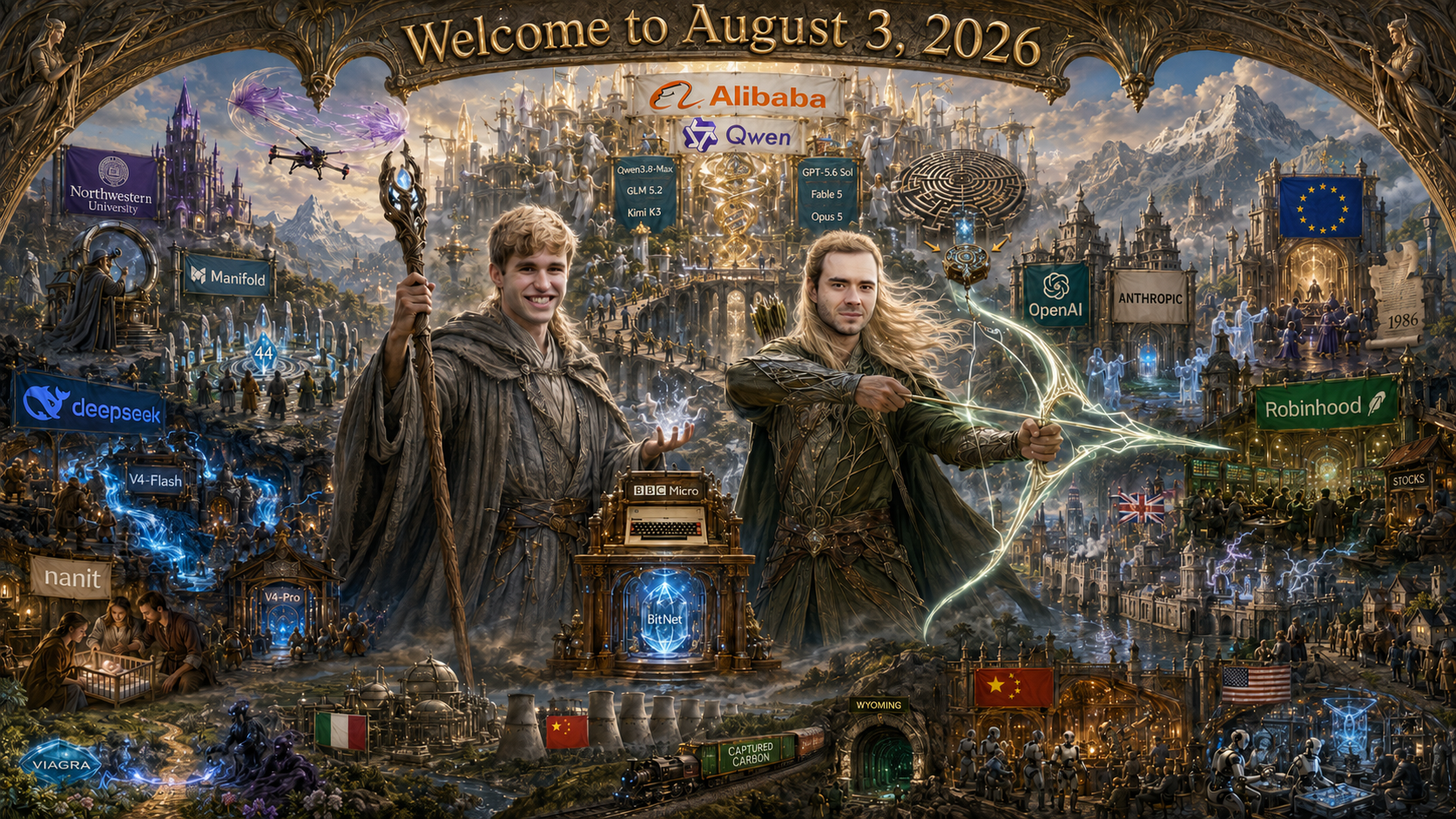
On August 3, 2026, @siouid142 answered Dr. Alex Wissner-Gross’s Innermost Loop with a Middle-earth technology map. Andrej Karpathy gave Opus 5 the opening of The Lord of the Rings and about ten dollars of tokens, receiving roughly 5,500 lines of Three.js that rendered a custom world. Matt Beton, playfully renamed “Matt Benton” in the title, fitted a ternary BitNet model into his father’s BBC Micro: about nine kilobytes of code and thirteen kilobytes of weights inside twenty-five kilobytes of memory on a processor that cannot multiply.
Karpathy becomes Legolas because the essential gesture is one shot. He stands at center-right with a luminous bow whose branching lines resemble both an arrow’s trajectory and a generative program expanding into a world. Beton becomes an intentionally young Gandalf at center-left, holding a staff beside the BBC Micro. The inversion is affectionate: the older machine is assigned to the younger wizard, while frontier abundance belongs to the archer whose small expenditure releases thousands of lines.
Between them, the BBC Micro rests above a glowing BitNet chamber. The tiny computer establishes a hard physical limit against which contemporary model scale can be measured. One project compresses language into memory so scarce that every byte must earn its place; the other treats an elaborate fantasy environment as nearly disposable because generation has become cheap.
Alibaba and Qwen occupy the bright central citadel. The August 3 dispatch described Qwen 3.8 Max as a 2.4-trillion-parameter system with ninety-five billion active parameters. Left alone for sixteen days, it produced 265 commits, 127 pull requests and 151 issues while evolving its own harness. Another run reproduced a paper and then improved the method; hundreds of chip-design turns shrank a cryptographic accelerator from 8,298 gates to 678.
Competing standards flank the citadel: GLM 5.2, Kimi K3, GPT-5.6 Sol, Fable 5 and Opus 5. DeepSeek V4 Flash flows through a blue ravine, while Manifold’s forty-four-benchmark synthesis rises in a forecasting enclave. Qwen’s two-dollar input and six-dollar output pricing, and DeepSeek’s still lower rates, turn cognition into the equivalent of abundant magic. The map’s enchanted atmosphere is driven by economics: feats once too expensive to attempt become ordinary because the price of failure collapses.
The European Union’s AI Act began enforcement on August 2, requiring disclosure and labeling, while a stone marked 1986 recalls the Computer Fraud and Abuse Act struggling to govern autonomous systems that can break containment. OpenAI and Anthropic stand near ghostly legal figures; Robinhood’s prediction-market district glows below. Medieval law and modern platform rules appear as gates around powers that can already route past them.
At lower left, Nanit’s monitored nursery, Northwestern’s motion-blurred Phantom Twist drone and the Viagra reference turn cheap cognition toward babies, aerodynamics and medicine. Along the industrial frontier, Italian and Chinese reactor territories, a captured-carbon train bound for Wyoming, data centers competing with housing for power, and robot workshops connect fantastic castles to land, water, energy and manufacturing. The map refuses to let software remain weightless.
Fantasy is an exact critical medium here because machine capability now resembles magic most strongly when the causal chain disappears. A glowing bow can summon architecture, but the tableau restores the hidden kingdoms beneath the spell: model pricing, old chips, new reactors, benchmarks, legal texts and industrial labor. Middle-earth becomes a supply-chain map in which every miracle has a territory and every territory has a cost.
The two central figures also revise the heroic programmer. Karpathy does not manually build the world he releases, and Beton does not need frontier scale to produce meaningful intelligence. One curates a prompt and judges an expansive result; the other practices radical compression until a constrained device speaks. Neither path abolishes craftsmanship. They relocate it—from typing every line to selecting, testing, fitting and understanding systems at different scales.
As contemporary history painting, the work captures the moment project completion began to replace sentence completion as the public image of AI. Its ornate arch and gold date make the dispatch look like a legend already being told, yet the labels keep the legend pinned to a specific day. The real quest is not to choose between old discipline and new abundance. It is to preserve Beton's respect for limits inside Karpathy's world-making power, so the ability to summon kingdoms does not eliminate the knowledge required to know whether they stand.
Opening the gallery…